



An SMS service helps a business send text messages to customers at scale or in response to a specific action. That could be an OTP, an order update, a payment alert, an appointment reminder or an offer. Unlike a personal text sent from one phone to another, business SMS is managed through a platform that can automate sends, route messages through telecom networks and report whether a message reached its destination.
That makes SMS useful far beyond promotions, especially when a message must reach a customer quickly without relying on internet access.
We have already covered one important SMS use case in our guide to SMS Fallback for WhatsApp OTP in India: what happens when a WhatsApp OTP cannot be delivered and SMS needs to take over. This guide takes a broader look at the SMS service itself, how it works, the different kinds of SMS messaging, and where it fits alongside WhatsApp.
What is an SMS service?
An SMS service lets a business create, send and track text messages to mobile numbers through a dashboard, software integration or both.
Business → SMS platform or API → SMS gateway → telecom operator → customer’s phone
The business creates the message; the platform receives it and the gateway routes it to a mobile network. Many providers return delivery reports, so the business can see whether it was delivered, failed or is pending.
An SMS service provider may also offer templates, scheduling, campaign reporting and integrations.
How does an SMS service work?
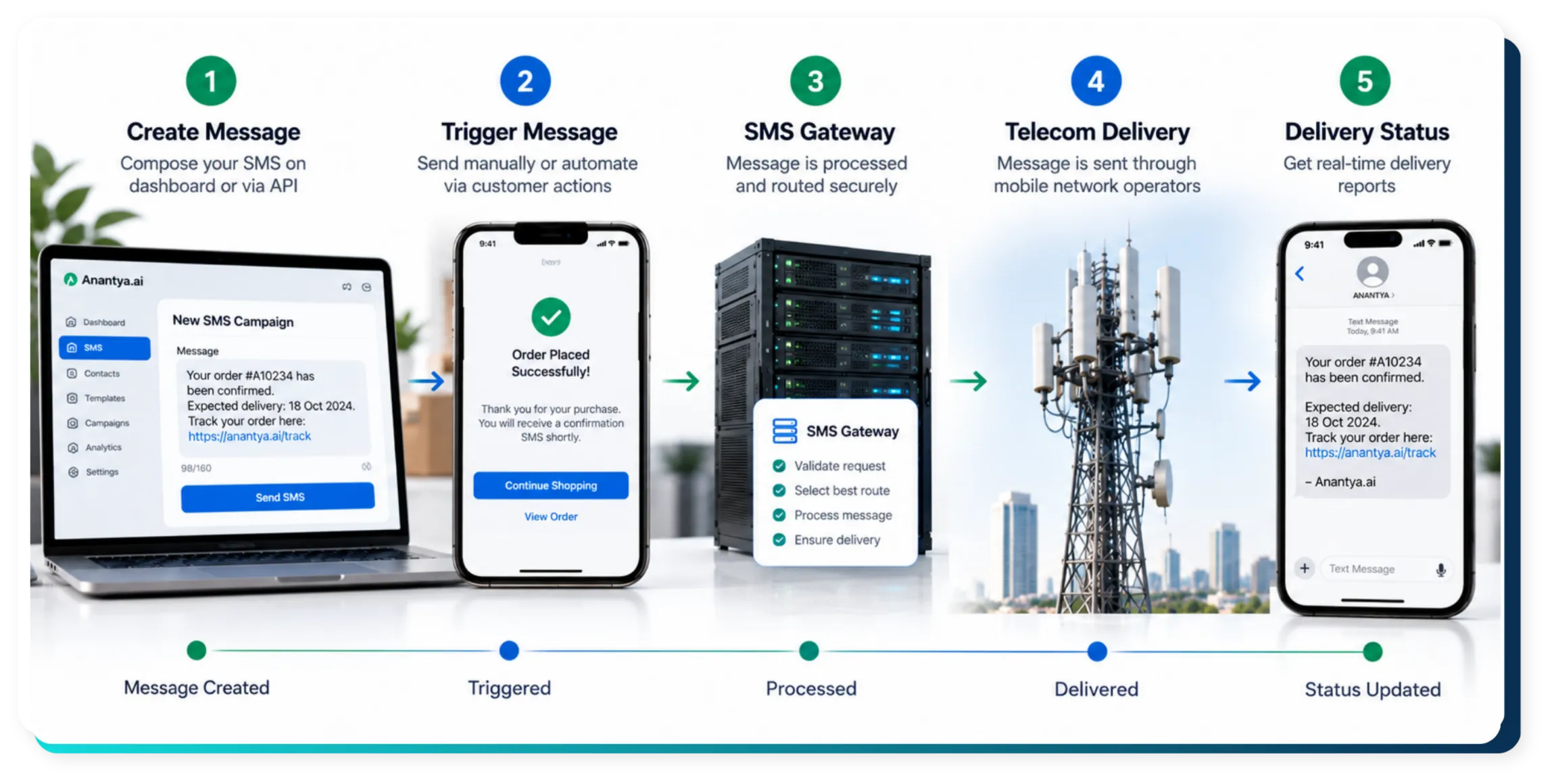
A business creates a message. It may be a login OTP, a booking confirmation, a payment alert, an order update or a promotional offer.
The message is triggered. A team member can send it manually from a dashboard, or a customer action can trigger it automatically. For example, placing an order can trigger an order-confirmation SMS.
The SMS gateway processes it. The gateway validates the request and selects the route that connects the business message to the telecom network.
The telecom network delivers it. The operator attempts delivery to the customer’s mobile number.
A delivery status is returned. The platform can show whether the SMS was delivered, failed or remained pending, depending on the route and operator response.
With an SMS API, a website, app, CRM or payment system can trigger an SMS automatically.
Types of SMS services
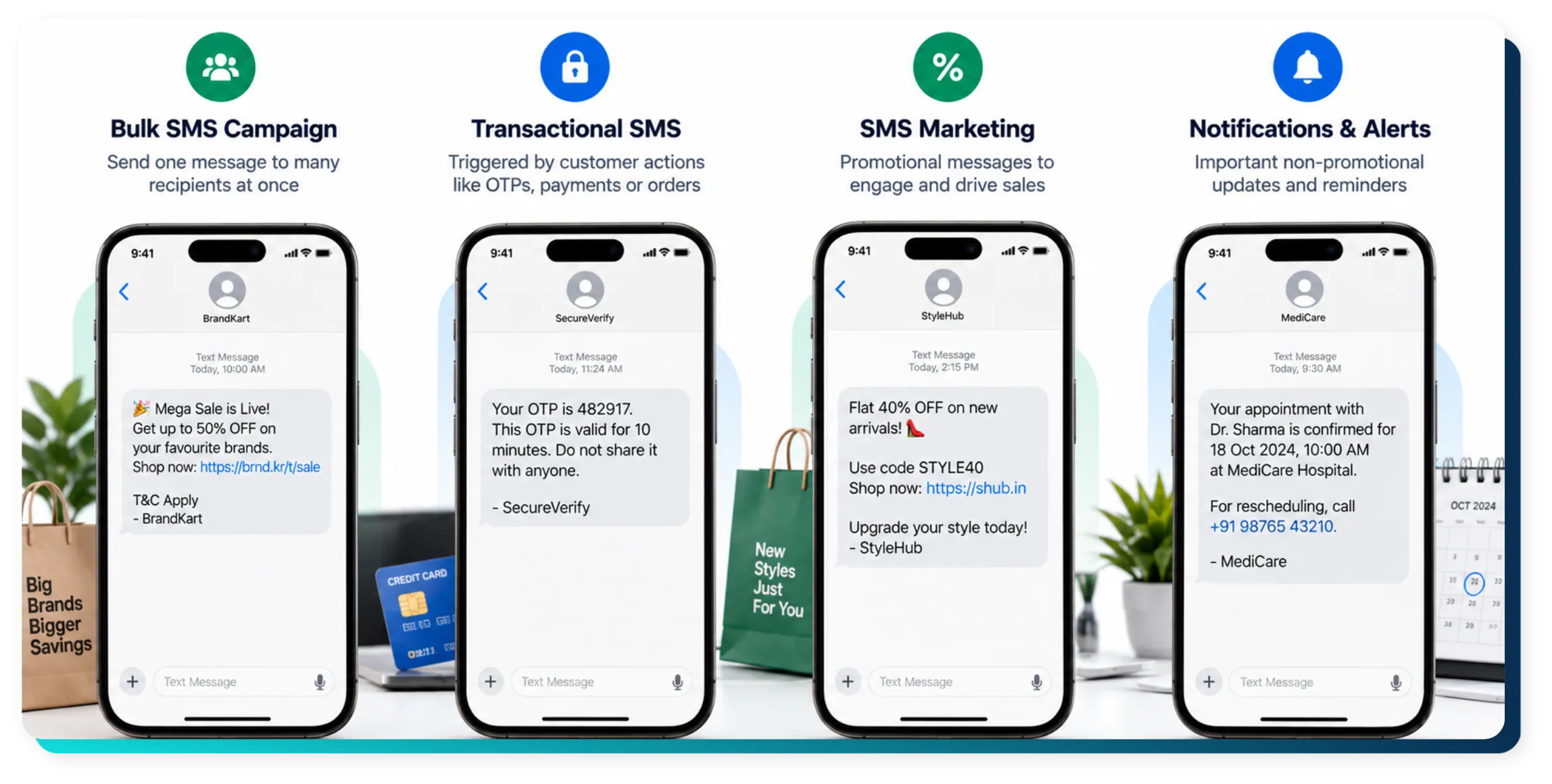
Bulk SMS service
A bulk SMS service sends one message to many recipients at once. It is useful when a business needs to communicate the same update, offer or announcement to a defined audience.
Common bulk SMS use cases include:
Sale announcements and promotional campaigns
Event invitations and reminders
Store or service updates
Product launches
Customer notices
It works best when the audience is relevant and the message is sent with the required consent.
Transactional SMS
Transactional SMS is triggered by a customer’s action or an important account event. The purpose is to confirm, verify, inform or protect, not to promote.
Examples include OTPs, payment confirmations, booking confirmations, delivery updates, password resets and account alerts. Because these messages often carry time-sensitive information, delivery reliability and status tracking matter more than campaign design.
SMS marketing
SMS marketing covers promotional messages sent to encourage a customer to browse, buy, return or take advantage of an offer. Flash-sale alerts, festive discounts, loyalty offers and abandoned-cart reminders are typical examples.
The key difference is intent: transactional SMS helps complete or confirm an action; SMS marketing aims to generate an action. Businesses should keep these streams separate in their messaging strategy and follow the applicable consent and sender-ID rules in each market.
SMS notifications and alerts
Notifications can be non-promotional updates such as appointment reminders, service interruptions, school announcements and renewal alerts.
Bulk SMS vs regular SMS messaging
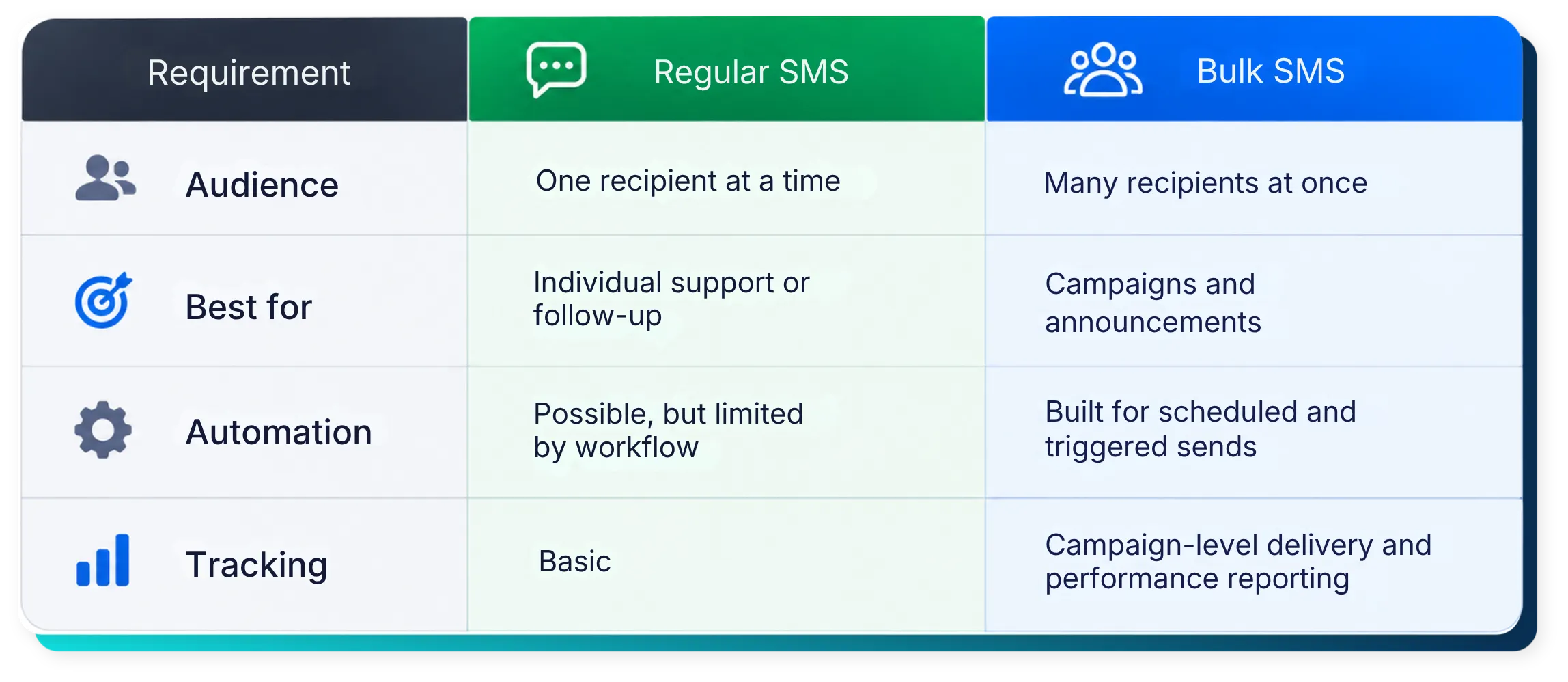
Regular SMS messaging is generally one-to-one. Bulk SMS delivers the same campaign or update to a larger group in one operation.
For a retail sale announcement, bulk SMS makes sense. For an order confirmation, a triggered transactional SMS is the better fit.
What is an SMS gateway?
An SMS gateway is the routing layer between a business application and mobile networks. It receives a message request, validates it, routes it through the appropriate telecom connection and returns a delivery result when available.
It is helpful to separate the gateway from the tools people use to access it:
An SMS API is the interface a developer uses to ask a system to send an SMS.
An SMS gateway is the infrastructure that moves that request toward the telecom network.
An SMS service is the broader business offering that may include the platform, API, gateway connectivity, reporting and support.
Its routing quality affects delivery speed, coverage and failure visibility.
What is an SMS API, and how does it help businesses?
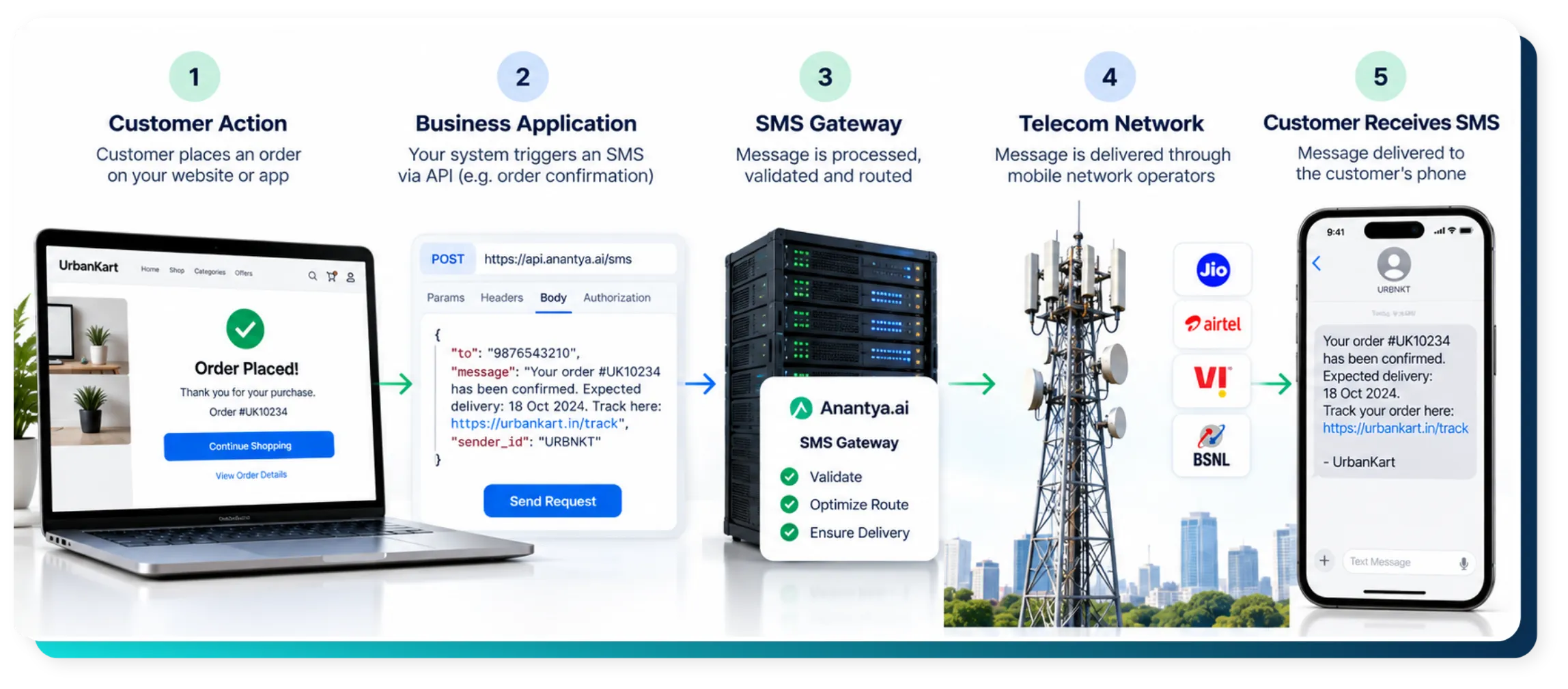
An SMS API connects SMS capabilities with the tools a business already uses. Instead of exporting numbers and manually sending a message, a system can trigger it at the right moment.
For example:
Customer action → business application → SMS API → SMS gateway → mobile network → customer
This supports OTPs, order and payment notifications, delivery alerts, appointment reminders and password resets. An order can trigger a confirmation; a login attempt can trigger an OTP.
When evaluating an SMS API, check documentation, delivery-status webhooks, rate limits and integration with the existing product or CRM.
Why WhatsApp messages may fail to send or reach customers
WhatsApp is often a primary customer channel, but critical messages should not depend on one delivery path. Distinguish these four situations:
WhatsApp message not sending: it has not left the business system, often because of an API, template or configuration issue.
WhatsApp message not delivered: it was sent but has not reached the recipient’s WhatsApp account; the recipient may be offline or unavailable.
WhatsApp messages not received: the customer did not see it; it may be undelivered, delayed or missed in their chats.
WhatsApp message delivery: the status a business monitors, sent, delivered, read or failed, where available.
The status determines the next step. A sending problem needs a system check; a delivery failure may call for another channel.
WhatsApp SMS and SMS fallback
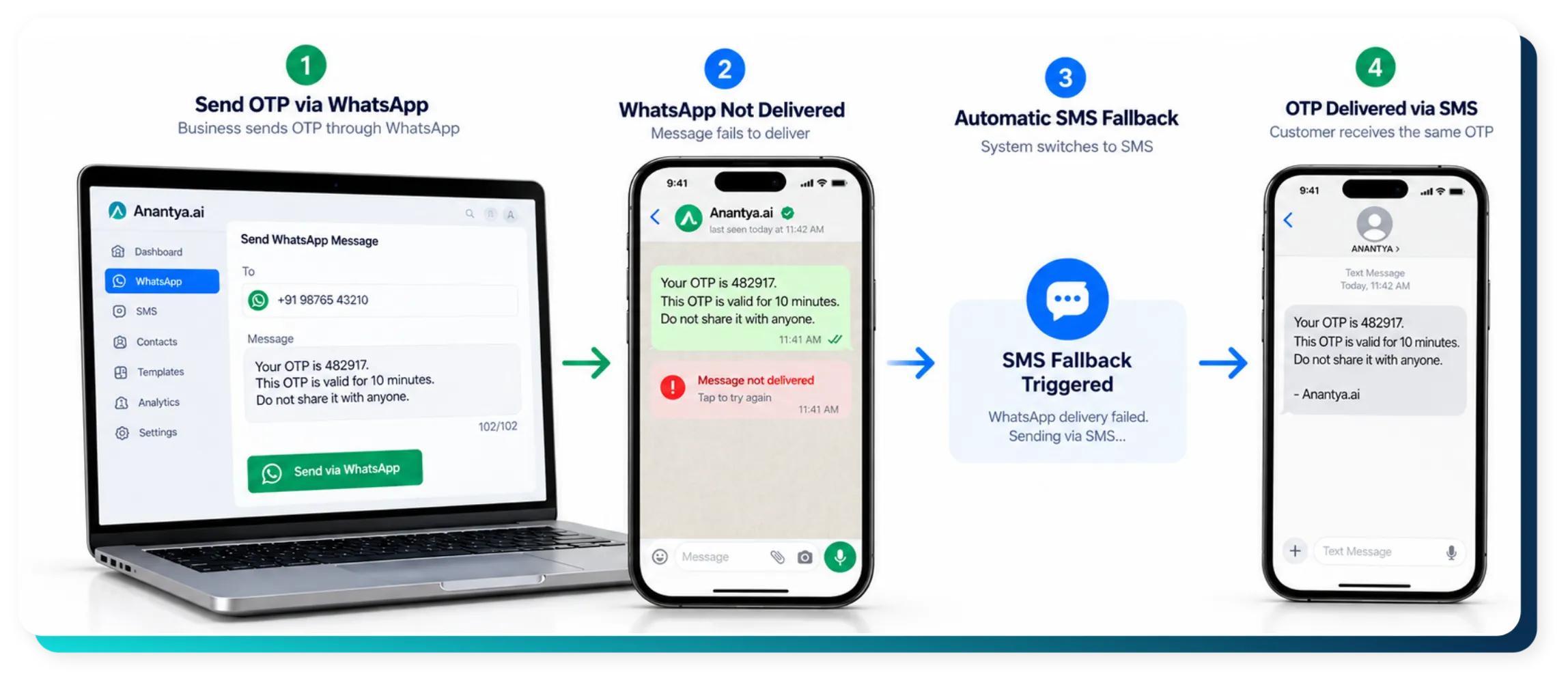
When WhatsApp is the preferred channel but delivery cannot be completed, SMS can act as a fallback. The flow is simple:
WhatsApp → delivery check → SMS fallback → customer receives the message
“WhatsApp SMS” is often used loosely for this combined approach: WhatsApp handles the primary interaction, while SMS provides an alternative route. A WhatsApp SMS service can be set around delivery events so both channels are not used unnecessarily.
For instance, a customer requests a verification code. The business sends the OTP on WhatsApp, checks delivery and triggers SMS only if WhatsApp fails. In system-driven workflows, teams may describe the integration as a WhatsApp SMS API or WhatsApp SMS gateway setup.
This is valuable for authentication, payment confirmations and account recovery.
SMS backup: a safety net for critical communication
An SMS backup gives businesses a second route when a primary channel does not deliver an important message. It strengthens WhatsApp rather than replacing it.
SMS backup is most relevant for:
Login verification and authentication codes
Payment or transaction confirmations
Password resets
Urgent delivery or service alerts
Time-sensitive appointment updates
The aim is simple: use the channel that gives the customer the best experience first, then have a reliable alternative ready when that message does not reach them.
WhatsApp Authentication and SMS fallback
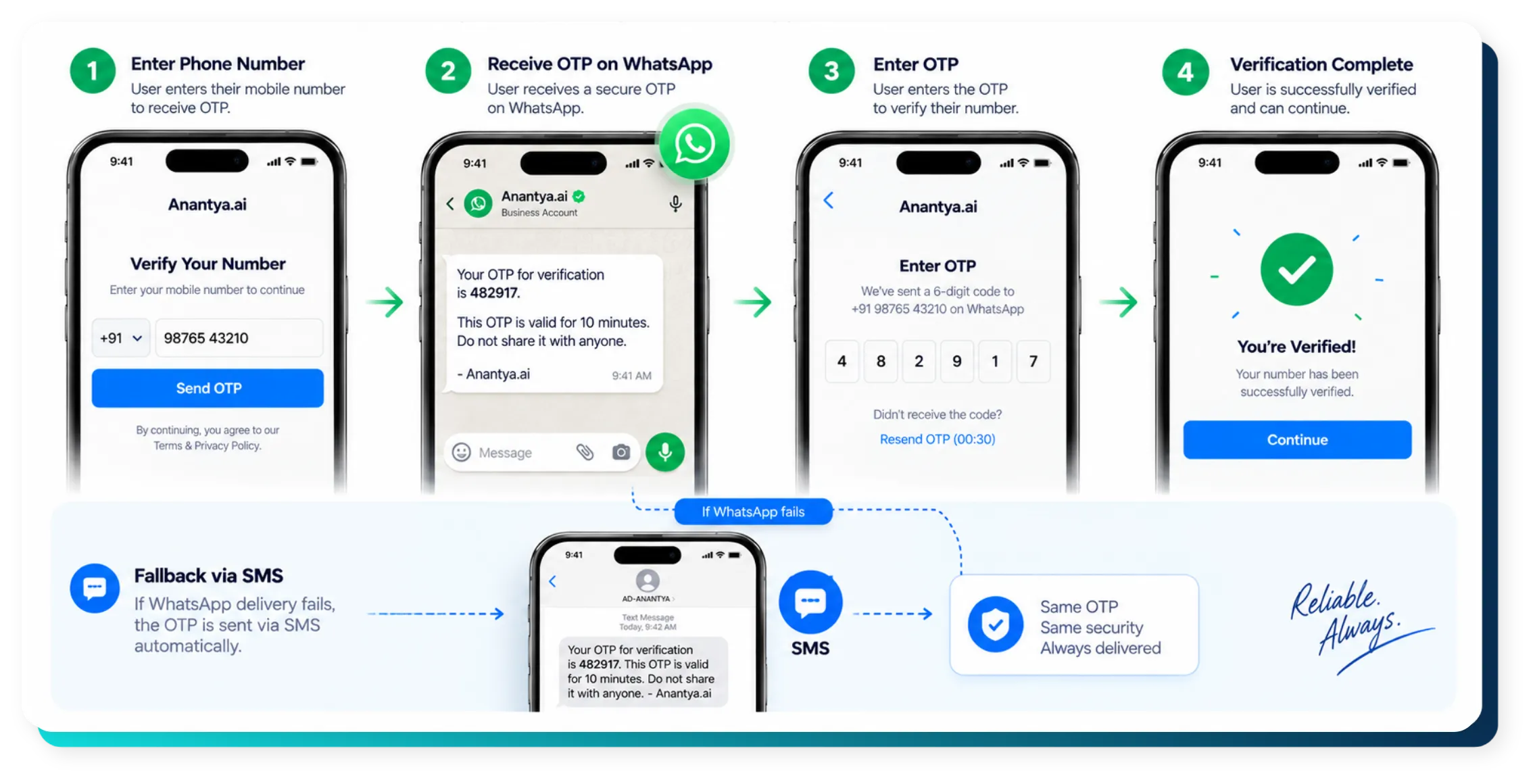
WhatsApp Authentication is the use of WhatsApp to verify a user’s identity, usually by sending an OTP or verification code through the WhatsApp Business API. A typical flow is:
User enters phone number → WhatsApp OTP is sent → user enters OTP → verification is completed
Businesses use WhatsApp authentication because verification messages can sit inside a familiar conversation channel. If the WhatsApp OTP is not delivered, SMS can send the same time-bound code so the customer can continue.
For a detailed explanation of use cases, implementation and OTP delivery options, read our WhatsApp Authentication: Complete Guide.
SMS service use cases across industries
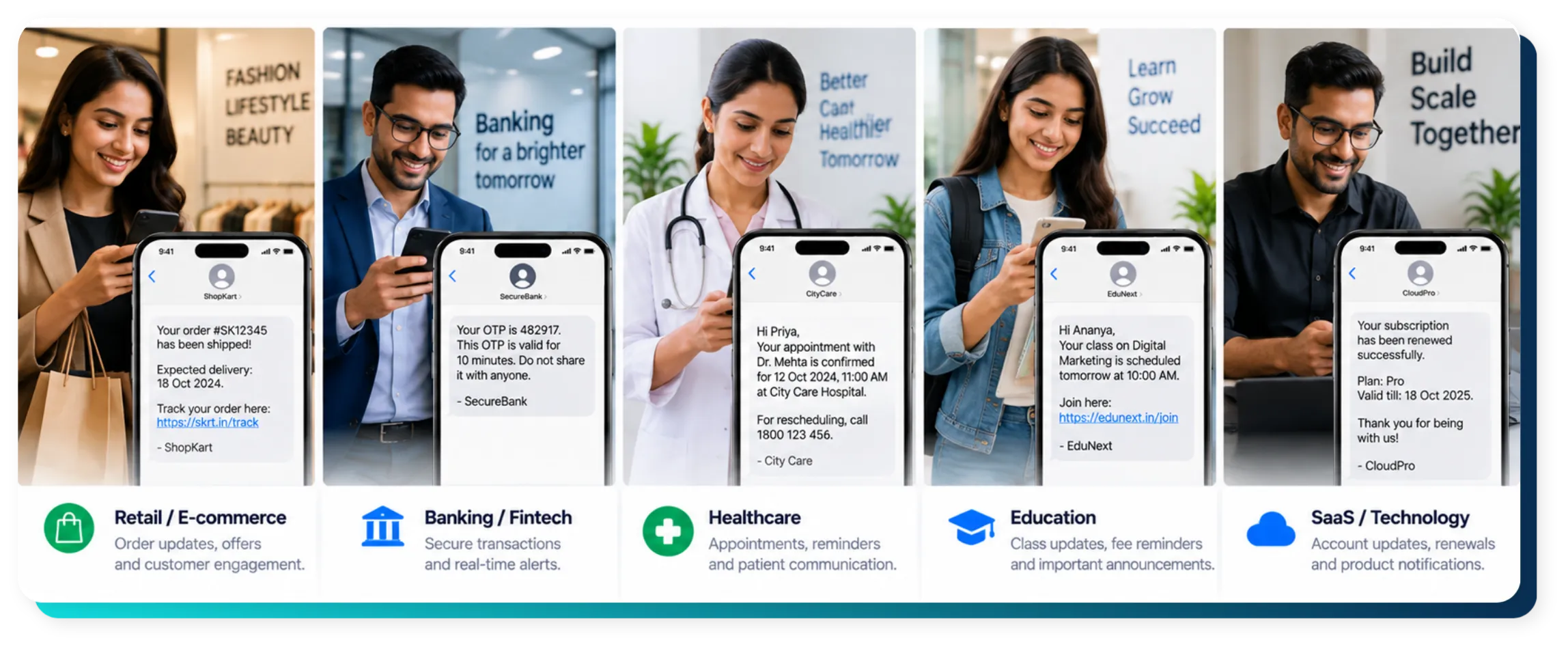
E-commerce and retail
Order confirmations, shipping updates, COD verification, payment alerts and promotional SMS campaigns help customers stay informed before and after a purchase.
Banking and fintech
Transactional SMS is commonly used for OTPs, transaction alerts, login verification and fraud-related notifications, where timely delivery is essential.
Healthcare
Appointment confirmations, reminders, booking alerts and follow-up notices can reduce missed appointments while keeping communication simple.
Education
Schools, colleges and coaching businesses can send admission updates, fee reminders, timetable changes and important announcements.
SaaS and digital products
Login OTPs, password resets, account alerts and usage notifications can be automated through an SMS API as part of the product experience.
How to choose an SMS service provider
Do not choose an SMS service provider on message price alone. Check whether it supports the messages that matter to your business.
Delivery reliability: Ask about routes, coverage and delivery reporting.
API and integration options: Your SMS service should work with your website, app, CRM or existing workflows.
Bulk SMS capabilities: Check audience management, scheduling, templates and reporting.
Transactional support: OTPs and alerts need reliable, trigger-based delivery.
Compliance controls: Confirm sender-ID, consent and template requirements for the markets you serve.
Scalability and support: It should handle growth and delivery investigations.
SMS service vs WhatsApp: which should businesses use?
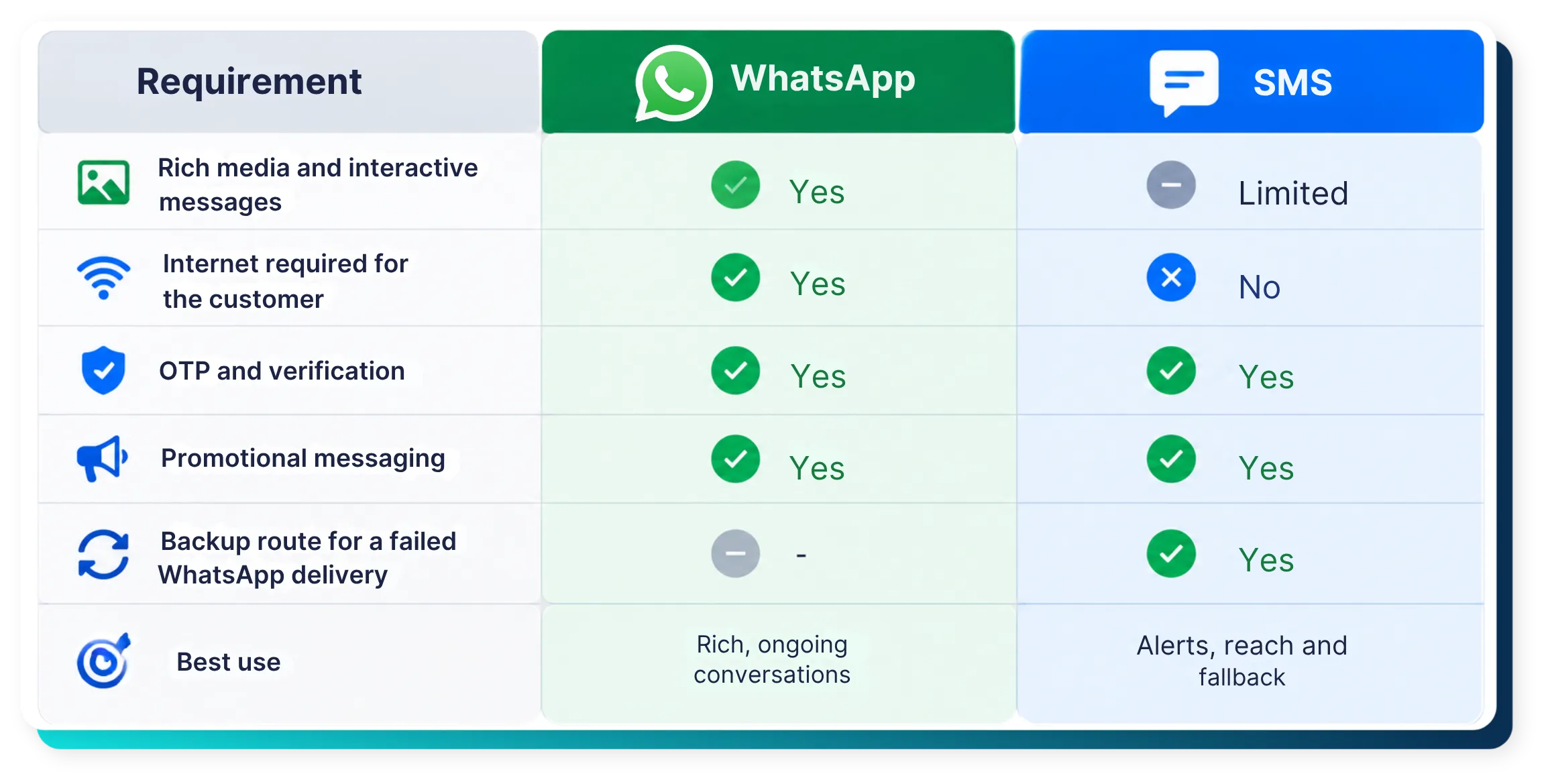
WhatsApp is ideal for interactive updates and richer content. SMS remains valuable for alerts, authentication and a backup path when a WhatsApp message is not received.
Why SMS service still matters
An SMS service remains a practical business messaging layer for high volume campaigns, transactional updates, authentication and urgent alerts. Bulk SMS and SMS marketing help businesses communicate at scale; SMS APIs and gateways make that communication automated; and SMS backup adds resilience when another channel does not deliver.
If your customer journeys already use WhatsApp, SMS can strengthen them without replacing them. Anantya.ai helps businesses bring WhatsApp, SMS and workflow automation into a connected communication setup built around the messages customers need to receive.