



WhatsApp Authentication: Complete Guide to Secure User Verification in 2026
The Silent Revenue Leak Nobody Talks About
Here is something most SaaS founders and eCommerce operators have never measured: how much revenue they lose every month because their OTP never arrived.
Not failed payments. Not cart abandonment. Not even poor ad targeting. Plain, boring OTP delivery failure.
A user signs up on your app. They enter their phone number. They wait. The SMS OTP does not arrive in 5 seconds, it arrives in 47 seconds, or not at all. They refresh. They try again. Maybe they request a resend. Maybe they just close the tab.
That drop-off does not show up as a "failed authentication" in your dashboard. It shows up as "incomplete registration" or "user did not convert." The root cause disappears silently into your funnel.
Industry data from Gartner and multiple CPaaS providers consistently shows that SMS OTP delivery rates hover between 70-85% globally, depending on carrier, region, and time of day. That means for every 100 users trying to verify themselves, somewhere between 15 and 30 are failing the first attempt.
And here is the brutal business math: if your monthly new registrations are 10,000 users, and 20% face OTP friction, and even half of those abandon, that is 1,000 lost users a month. At a modest LTV of Rs. 2,000, that is Rs. 20 lakhs in lifetime value walking out the door every single month, invisibly.
This is why WhatsApp Authentication is not just a feature upgrade. It is a revenue protection strategy.
Introduction: Why WhatsApp Authentication Is the Verification Standard for 2026
User verification used to be simple. A phone number, an SMS, a 6-digit code. Done.
But in 2026, that flow is creaking under the weight of user expectations, carrier unreliability, and increasingly sophisticated fraud. Businesses that built their entire authentication stack on SMS OTP are now discovering what telecom insiders already knew: SMS was never designed for time-critical, conversion-sensitive transactions.
WhatsApp authentication has emerged as the credible, scalable alternative. Whether it's a WhatsApp login for a fintech app, an OTP for eCommerce checkout, or a 2FA trigger for a SaaS platform, the underlying logic is the same: users complete verification faster, with more confidence, when the message arrives in WhatsApp. With over 2 billion active users globally and near-universal penetration in markets like India, Brazil, Southeast Asia, and the MENA region, WhatsApp has become the default communication channel for a significant share of the world's smartphone users.
Sending an OTP through WhatsApp doesn't just change the delivery mechanism. It changes the entire user experience of verification. The message arrives inside a familiar app, from a verified business profile, with brand context. Users trust it. They open it. They act on it quickly.
The shift from SMS OTP to WhatsApp-based verification is accelerating for three reasons: delivery reliability, open rates, and user trust. Businesses that have made the switch are reporting measurably lower drop-off at the verification step and meaningfully higher registration completion rates.
This guide covers everything you need to know about WhatsApp authentication in 2026 from how it works technically, to why businesses across industries are adopting it, to the best practices that separate high-performing implementations from mediocre ones.
What Is WhatsApp Authentication?
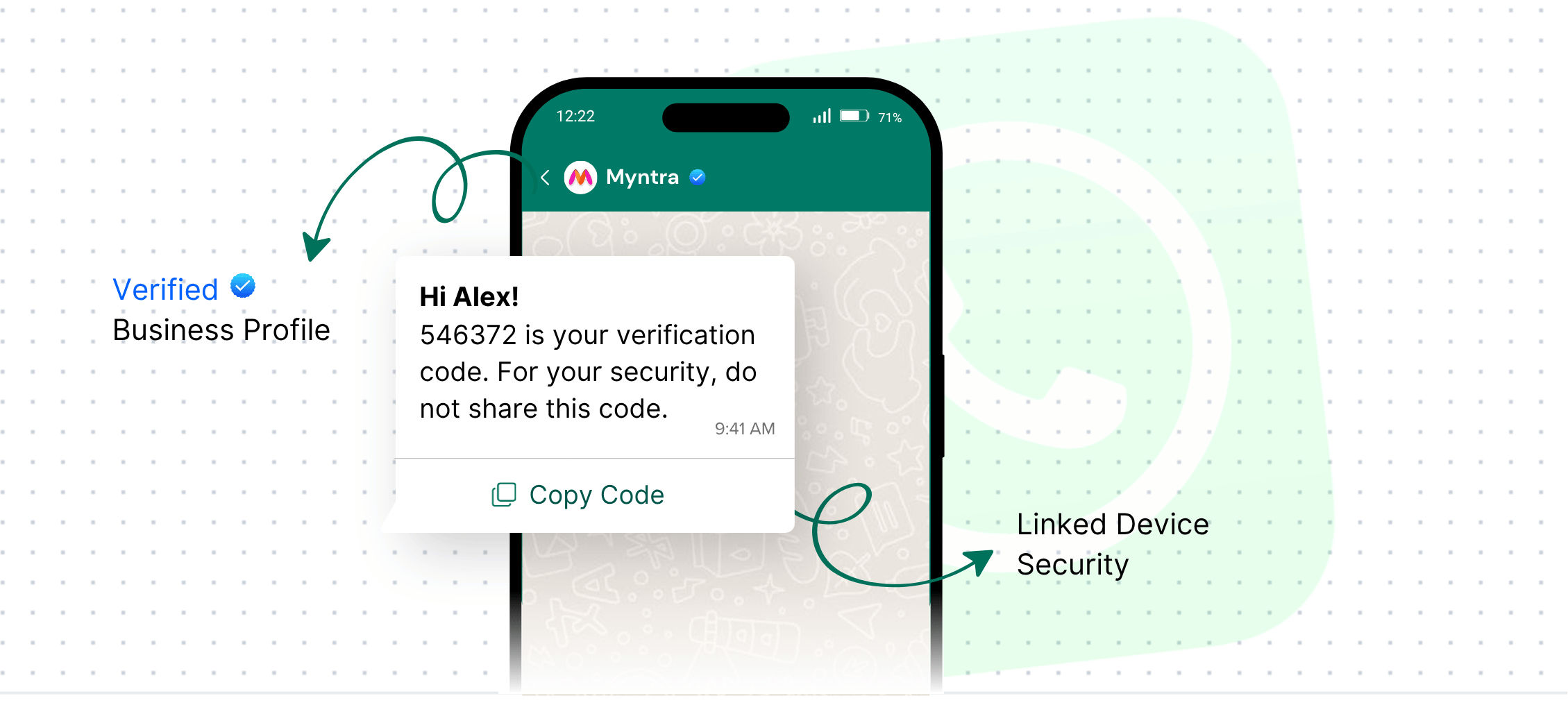
WhatsApp authentication is a method of verifying a user's identity by sending a one-time password (OTP) or verification code through WhatsApp, rather than through a traditional SMS.
At a technical level, it uses the WhatsApp Business API to send structured, pre-approved message templates to a user's WhatsApp number. The user receives the message, reads the OTP, enters it in the product interface, and the backend validates it. Authentication complete.
But the mechanics are only part of the story. What makes WhatsApp authentication distinct is the context layer that comes with it. Every message is delivered from a verified WhatsApp Business account with a business name, profile picture, and in many cases a blue tick verification badge. Users immediately know who the message is from. There is no "unknown number" anxiety, no potential for phishing confusion.
The WhatsApp Business API also enables two key capabilities that SMS cannot match: read receipts andrich message formatting. Businesses can see exactly when a user has read the OTP message. They can also format the message clearly with the OTP highlighted, instructions written in the user's language, and an expiry time stated explicitly. This is verification that is designed to be understood, not just received.
WhatsApp authentication is not limited to OTPs. It can cover:
- WhatsApp login verification (confirming identity before granting account access)
- Transaction authentication (approving a payment or order)
- Account recovery (resetting a password or regaining access)
- Two-factor authentication (2FA) (layered security after password entry)
- New device verification (flagging and confirming login from an unfamiliar device)
This versatility is why WhatsApp authentication API integrations are expanding rapidly across fintech, eCommerce, healthcare, and SaaS.
How WhatsApp Authentication Works: Step-by-Step
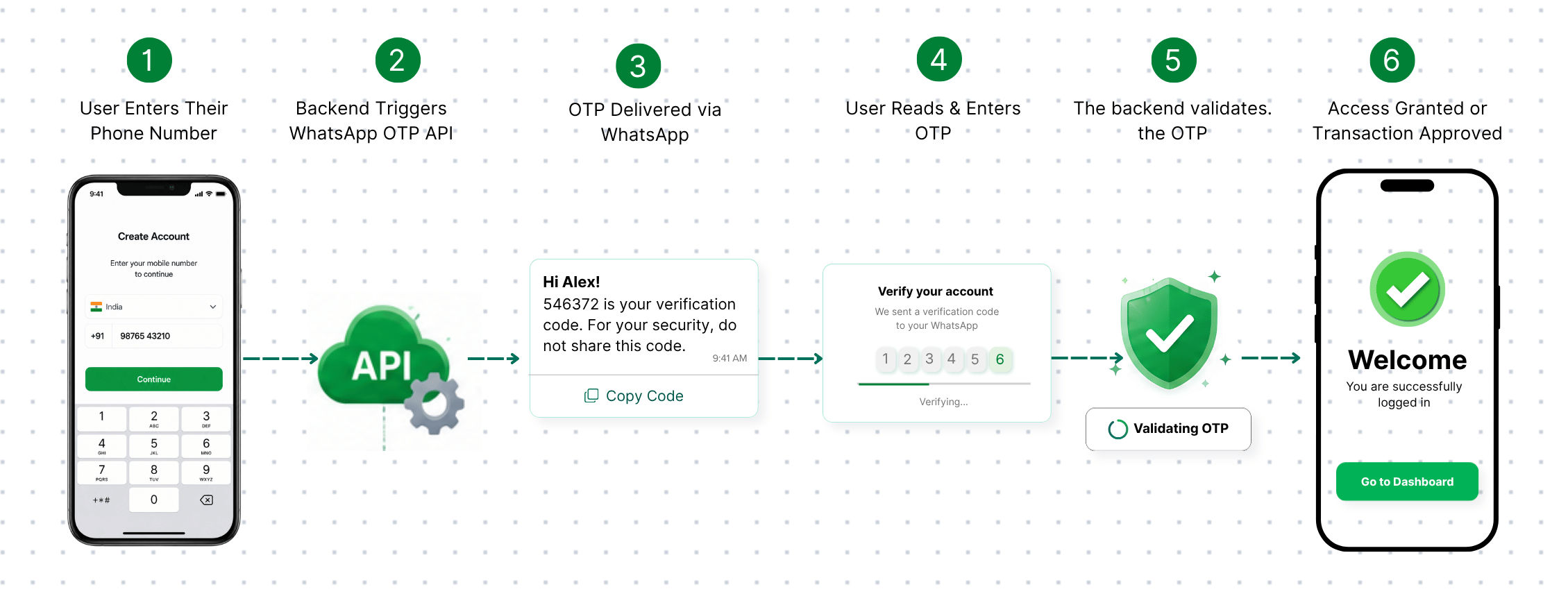
Understanding the verification flow helps businesses set it up correctly and helps users trust it. Here is the end-to-end process:
- Step 1: User Enters Their Phone Number The user provides their mobile number in the product's registration, login, or verification screen.The product interface typically shows a country selector and a number field.
- Step 2: Backend Triggers the WhatsApp OTP API The application's backend sends a request to the WhatsApp Business API (either directly or via a BSP like Anantya.ai), specifying the recipient's number and the approved OTP message template. The OTP is generated at this stage, usually 6 digits, with a timestamp and expiry window.
- Step 3: OTP Delivered via WhatsApp The user receives the OTP message in their WhatsApp inbox, typically within 3–5 seconds. On most devices, this means a push notification arrives on the WhatsApp Business app the user already has installed no new app, no new friction. The message comes from the business's verified WhatsApp account, with the OTP clearly stated and the expiry time mentioned.
- Step 4: User Reads and Enters the OTP Because WhatsApp notifications are high-priority and familiar, the user sees and opens the message almost immediately. On Android devices, the OTP can even be auto-read by the system if the business has set up Android's SMS Retriever API equivalent for WhatsApp (where applicable).
- Step 5: Backend Validates the OTP The user submits the code in the product interface. The backend cross-checks it against the generated OTP with time-sensitivity logic (rejecting expired or reused codes). If valid, authentication is confirmed.
- Step 6: Access Granted or Transaction Approved The user is logged in, the transaction is approved, or the account action is confirmed. The session is initiated with appropriate security tokens.
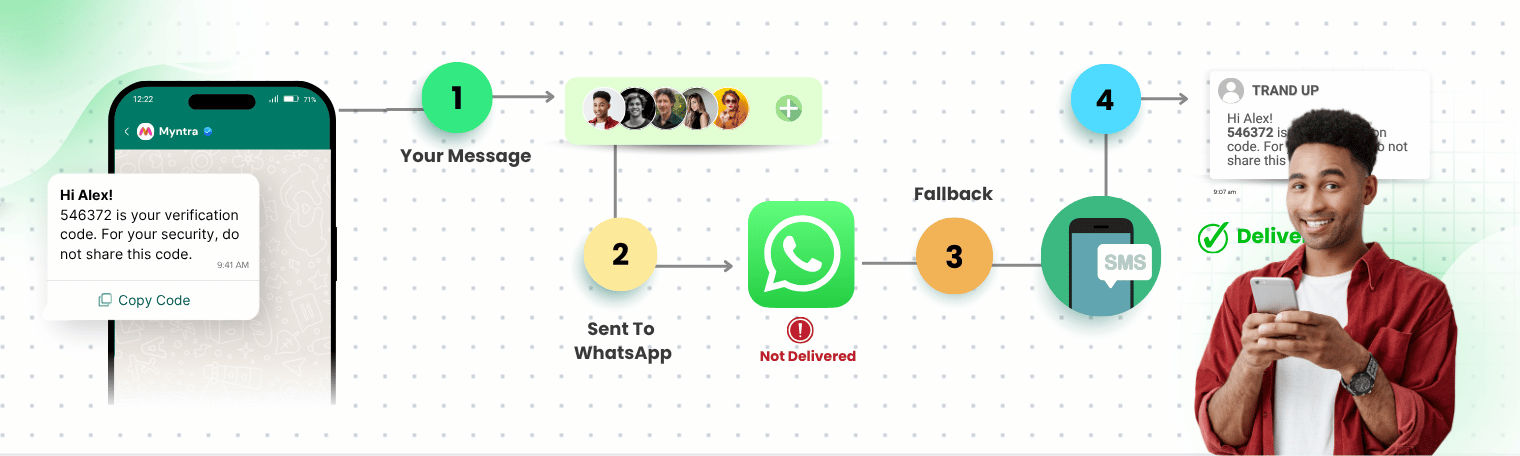
Optional step: fallback to SMS. If the WhatsApp message fails to deliver (user has no WhatsApp, number is inactive on WhatsApp, delivery timeout), a well-built system automatically triggers an SMS OTP as fallback, ensuring no user is blocked from completing verification.
Why Businesses Are Shifting to WhatsApp Authentication
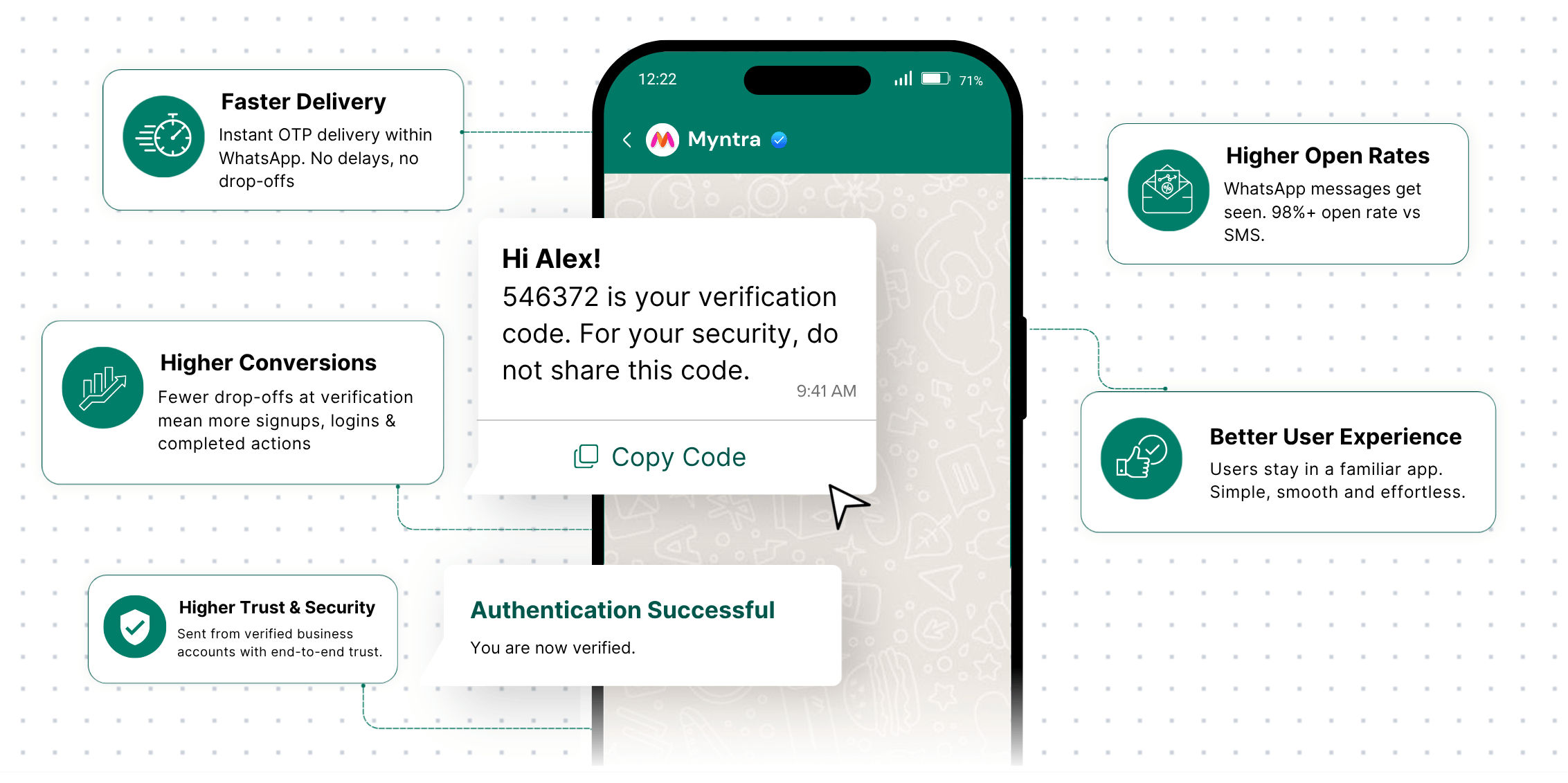
Higher Open Rates Mean Faster Conversions
WhatsApp messages have an open rate of approximately 98%, compared to SMS open rates that typically range between 85–90% and email open rates that barely breach 25–30%. But the more important metric isn't the open rate itself, it's the time-to-open. WhatsApp messages are opened within 90 seconds of delivery on average. For time-sensitive OTPs with a 10-minute expiry window, this speed is critical. Users who receive OTPs instantly are far more likely to complete verification without friction.
Faster and More Reliable Delivery
SMS routing goes through carrier networks that can be congested, blocked, or subject to DLT (Distributed Ledger Technology) regulations that slow down transactional messages. WhatsApp delivery, by contrast, works over internet data and bypasses carrier SMS infrastructure entirely. In markets with dense carrier traffic India during peak hours, for example WhatsApp OTP delivery is meaningfully more reliable.
Better User Experience at Every Step
The verification step is one of the most underrated touchpoints in the user journey. A clunky verification experience creates an immediate first impression: this product doesn't work well. WhatsApp authentication flips that impression. Users receive a message in an app they already have open on their phone, from a branded business account, with clear instructions. The experience feels native, trusted, and smooth.
Global Reach Without Carrier Dependency
For businesses expanding across India, Southeast Asia, the Middle East, and Latin America, WhatsApp is often the dominant or primary communication channel. Building a WhatsApp-native verification flow means you're meeting users where they already are, without needing separate carrier integrations for each market.
Reduced Fraud and SIM Swap Risk
SMS OTPs are vulnerable to SIM swap attacks, SS7 protocol exploits, and interception by malicious actors. WhatsApp authentication is tied to the user's WhatsApp account, which requires device-level access and WhatsApp credentials. This significantly raises the bar for fraudsters attempting to intercept verification messages.
WhatsApp Authentication vs SMS OTP: A Direct Comparison
| Feature | WhatsApp Authentication | SMS OTP |
|---|---|---|
| Delivery Rate | 95-99% (internet-based) | 70-85% (carrier-dependent) |
| Average Delivery Speed | 2-5 seconds | 5-60 seconds (variable) |
| Open Rate | ~98% | ~85-90% |
| User Trust | High (branded business account) | Medium (often unknown number) |
| Phishing Risk | Lower (verified business profile) | Higher (number spoofing common) |
| Rich Formatting | Yes (OTP + instructions + expiry) | Limited (plain text only) |
| Read Receipts | Yes | No |
| Fallback Support | Yes (SMS fallback possible) | No equivalent fallback |
| Cost | Slightly higher per message | Lower per message |
| Regulatory Complexity | Requires BSP, Meta approval | Requires DLT registration |
| Global Reliability | Consistent across markets | Variable by carrier/region |
The cost difference is the only category where SMS OTP has a clear edge. But when you factor in failed deliveries, abandoned verifications, and their downstream impact on LTV, WhatsApp OTP delivers a better return per verification attempt.
Key Benefits of WhatsApp Authentication for Businesses
Increased Registration and Conversion Rates
When the OTP arrives in under 5 seconds inside a trusted app, users complete the verification step without hesitation. This directly impacts registration completion rates and reduces the number of users who drop off at what should be the easiest step of onboarding.
Lower Drop-Off at Critical Funnel Points
Every second of OTP latency increases the probability of user abandonment. A slow or failed SMS OTP is often the invisible culprit behind unexplained drop-offs at registration, checkout, or login screens. WhatsApp authentication eliminates that latency.
Improved Customer Trust From the First Interaction
The first message a customer receives from your business sets the tone for the entire relationship. A verified WhatsApp business message with your brand name and logo creates immediate legitimacy. Compare that to an SMS from a random alphanumeric ID which, in 2026, users have been trained to be suspicious of.
Better Engagement Through Familiar Channels
WhatsApp is where people already spend a significant portion of their day. Receiving a verification message in the same app they use to talk to friends and family creates a contextual familiarity. It feels less transactional and more natural.
Branding Advantage Over Competitors
Most businesses still send OTPs via SMS. Switching to WhatsApp-based verification signals to users that your business is modern, thoughtful about UX, and invested in their experience. In competitive categories like fintech or D2C, that signal has real differentiation value.
Use Cases Across Industries
E-Commerce: Login and Checkout OTP
For eCommerce platforms, authentication touchpoints exist at login, at checkout (especially for guest users), and at account recovery. WhatsApp login where a user enters their phone number and receives an OTP via WhatsApp to access their account creates a frictionless, passwordless entry point that works especially well on mobile. At checkout, a fast and reliable OTP can be the difference between a completed order and an abandoned cart. Given that India's eCommerce sector loses an estimated 60–70% of carts at checkout, removing even one point of friction is significant.
Banking and Fintech
Financial services have the highest stakes for authentication reliability. A failed OTP during a fund transfer or a new payee addition doesn't just frustrate the user, it damages trust in the platform's security. WhatsApp authentication, with its higher delivery rate and lower fraud risk compared to SMS, is gaining rapid adoption among neobanks, lending platforms, and payment apps. Many are implementing it as a 2FA layer on top of password login.
Healthcare
Healthcare platforms handling appointment booking, prescription access, and telemedicine consultations need secure, quick user verification. WhatsApp OTP ensures that patients can log in smoothly, even on first use, without the frustration of SMS delays. For platforms serving older demographics less comfortable with technology, WhatsApp's familiar interface reduces the learning curve.
EdTech
Online learning platforms typically experience peak registration surges during admission seasons or when courses go on sale. SMS OTP systems under these load spikes often fail. WhatsApp OTP API, delivered over internet infrastructure, maintains consistent delivery rates even under high volume. This is especially relevant for EdTech platforms with large user bases in tier-2 and tier-3 cities where SMS delivery can be inconsistent.
SaaS Platforms
For B2B and B2C SaaS companies, the first minute of a user's experience from landing page to inside the product is the highest-stakes minute in the product lifecycle. WhatsApp authentication makes that first minute smooth. It also opens a communication channel that can be used post-onboarding for updates, alerts, and re-engagement, making it a foundational element of the WhatsApp-first customer communication strategy.
Many SaaS platforms also use WhatsApp authentication for re-authentication events: moments when a user tries to change sensitive account settings, update billing information, or invite new team members. These are high-stakes actions where you want a quick, reliable second-factor check. WhatsApp OTP handles this better than SMS precisely because the user is already in an active digital session and typically has WhatsApp open or nearby.
Travel and Hospitality
Booking platforms, hotels, and airlines handle authentication at multiple points: initial booking, check-in, rebooking, and cancellations. Each of these is a high-anxiety moment for the user. A smooth, fast WhatsApp OTP flow reduces friction at exactly the moments when users are most likely to abandon or call customer support. Several OTA (Online Travel Agency) platforms in India have reported measurable improvements in checkout completion rates after switching OTP delivery from SMS to WhatsApp.
Logistics and Delivery
Last-mile delivery apps frequently require driver verification, customer confirmation, and OTP-at-door delivery systems. WhatsApp authentication is particularly well-suited here because it eliminates the delay of SMS in areas with inconsistent cellular signal but decent data connectivity. For delivery confirmation, a WhatsApp-based OTP creates an auditable, time-stamped delivery record that both the business and customer can reference.
Common Challenges and How to Solve Them
Challenge: Message Delivery Failure
Not every user will receive the WhatsApp OTP instantly. Network issues, app-level settings, or WhatsApp account inactivity can cause delivery delays.
Solution: Build a smart fallback system. If the WhatsApp OTP isn't delivered or opened within a defined window (typically 30–60 seconds), the system should automatically trigger an SMS OTP to the same number. Users should also see a "Didn't receive it? Try the SMS" option as a manual fallback. Well-designed platforms handle this invisibly.
Challenge: User Not on WhatsApp
A portion of users, particularly in less urban markets or older demographics, may not use WhatsApp at all.
Solution: Don't position WhatsApp authentication as the only option. Lead with it as the default, but always offer SMS as an alternative. A toggle between "Get OTP on WhatsApp" and "Get OTP via SMS" with WhatsApp as the pre-selected option creates a positive default without creating exclusion.
Challenge: WhatsApp Business API Integration Complexity
Getting direct API access from Meta requires going through an approved Business Solution Provider (BSP), completing business verification, and getting message templates pre-approved. This setup process can be confusing for first-time integrators.
Solution: Work with an established BSP like Anantya.ai that handles the onboarding, template submission, and API integration process. A good BSP cuts the setup time from weeks to days and ensures your templates are compliant with Meta's messaging policies from the start.
Challenge: Regulatory and Compliance Requirements
Different markets have different rules around user data, consent, and communication. India's TRAI regulations, GDPR in Europe, and Meta's own messaging policies all intersect in complex ways for authentication use cases.
Solution: Ensure your OTP templates explicitly state the purpose of the message, include the business name, and include an expiry window. Never send marketing content through the same template used for authentication. Maintain opt-in records for your users. A competent BSP partner will help you structure compliant templates.
Best Practices for WhatsApp Authentication
- Keep the OTP message short and scannable. Users should be able to read the OTP in one glance. The message should contain: the OTP, the business name, and the expiry time. Nothing else.
- Use approved, branded templates. WhatsApp authentication messages must use pre-approved templates. Use this constraint to your advantage: design a template that is instantly recognizable as your brand. Include your business name clearly.
- Set a clear expiry time. For example: "Your OTP is 847291. It expires in 10 minutes." This removes anxiety and prompts users to act quickly without confusion.
- Build a fallback system before launch. Don't go live with WhatsApp authentication without SMS fallback configured. Even if your delivery rates are excellent, edge cases will occur. A user who gets locked out during sign-up won't come back.
- Monitor delivery and read metrics actively. Unlike SMS, WhatsApp gives you delivery receipts and read receipts. Use them. If your read rate drops unexpectedly, investigate the template or delivery routing immediately. These metrics are early warning signals for authentication issues.
- Test across devices and WhatsApp versions. WhatsApp behavior can differ across Android versions, iOS versions, and app update states. Test your OTP flow on multiple device types before pushing to production.
- Optimize the verification screen itself. The UX on your app's OTP entry screen matters as much as the delivery. Auto-focus the OTP input field, show a countdown timer, make the "Resend OTP" button visible but not too prominent (you don't want users clicking it before 30 seconds have passed).
Why Anantya.ai for WhatsApp Authentication
Anantya.ai is a WhatsApp Business platform built for businesses that need authentication, communication, and customer engagement infrastructure that works at scale. From enabling WhatsApp login for consumer apps to powering high-volume OTP delivery for enterprise platforms, Anantya.ai handles the full stack.
For WhatsApp OTP and authentication specifically, Anantya.ai provides:
- Smart Routing: Messages are routed through the most reliable delivery path available, reducing latency and improving delivery rates across markets.
- Automated SMS Fallback: If a WhatsApp OTP fails to deliver within a configurable window, the system automatically triggers an SMS OTP. No manual intervention needed.
- Pre-Built API Integration: Developer-friendly APIs with clear documentation make integration straightforward. Whether you are building a new authentication flow from scratch or replacing an existing SMS OTP setup, the integration is fast.
- Template Management: Anantya.ai handles the Meta template submission and approval process, including compliance review. You don't need to navigate Meta's policy documentation on your own.
- Delivery and Read Analytics: A real-time dashboard gives you visibility into OTP delivery rates, read rates, and fallback trigger rates. This is the data that lets you catch problems before they affect users.
- Scalability for High-Volume Events: Peak traffic periods, sale launches, exam result announcements, IPO subscription windows are exactly when authentication infrastructure is most stressed. Anantya.ai's platform is built to handle volume spikes without degradation.
Getting Started Is Faster Than You Think
Most businesses assume that setting up WhatsApp authentication requires weeks of back-and-forth with Meta, extensive developer resources, and complex infrastructure changes. With the right BSP partner, none of that is true.
The typical setup timeline from initial API access request to first live OTP sent is 3 to 7 business days. Template approval, once submitted correctly, usually takes 24 to 48 hours. And for businesses already using Anantya.ai for WhatsApp campaigns, adding authentication is an API extension rather than a new integration entirely.
For developers, Anantya.ai provides sandbox environments for testing OTP flows before going live, reducing the risk of launching a broken verification system in production.
The Future of Authentication: 2026 and Beyond
The direction of user authentication is clear, and it points toward two things: less friction and more intelligence.
Passwordless Login Is Going Mainstream
The password, as a primary authentication mechanism, is on its way out. Passkeys, biometric authentication, and OTP-first login are replacing it across consumer applications. WhatsApp authentication fits naturally into a passwordless stack: the user identifies with their phone number, receives a WhatsApp OTP, and gains access without ever setting or remembering a password. This flow is already live in several major Indian fintech and eCommerce applications, and it's spreading.
AI-Based Verification and Behavioral Signals
The next evolution of authentication is not just about verifying who the user is, but about continuously assessing whether the user's behavior is consistent with their identity. AI-driven behavioral analysis looking at typing patterns, device location, session timing, and other signals will run in the background while WhatsApp OTP handles the explicit verification layer. The combination creates a layered security model that is both user-friendly and harder to compromise.
WhatsApp-First Communication as Infrastructure
For markets like India where WhatsApp is functionally the internet's messaging layer, businesses are increasingly building WhatsApp as infrastructure, not just as a channel. Authentication is the first touchpoint. But the same WhatsApp channel can then be used for order updates, support conversations, payment reminders, loyalty rewards, and re-engagement. WhatsApp authentication is not just a better OTP it's the entry point to a richer, WhatsApp-native customer relationship.
Unified Identity Across Channels
As businesses collect more customer touchpoints app, web, WhatsApp, email, in-store the pressure to unify identity across those channels will grow. WhatsApp number as a primary identity marker is a strong candidate for the unifying layer, given that it is tied to a real device and a real person in a way that email addresses often are not. Authentication via WhatsApp creates a verified identity anchor that can be referenced across the customer's entire relationship with the brand.
Regulatory Tailwinds for WhatsApp Authentication
Globally, regulators are tightening standards around what constitutes "secure" user verification. The EU's PSD2 directive mandates Strong Customer Authentication (SCA) for financial transactions. India's RBI has been pushing for robust two-factor authentication for digital payments. In both contexts, WhatsApp OTP is not only compliant but stronger than basic SMS OTP, because the delivery is tied to a verified app account rather than just a SIM card. As compliance requirements evolve, WhatsApp authentication will increasingly be treated as the baseline for secure login, not a premium add-on.
WhatsApp Flows and In-Chat Verification
Meta has been expanding WhatsApp's native app capabilities with WhatsApp Flows, which allow businesses to create structured interactive experiences inside a WhatsApp conversation. The trajectory points toward a future where authentication doesn't just happen via an OTP in a chat message, but through a native in-chat verification interface: a small form that opens inside WhatsApp, collects the necessary credential input, and confirms identity without the user ever leaving the app. This type of frictionless, in-app verification is likely to become available through the WhatsApp Business API in the near term and will further cement WhatsApp's role as primary authentication infrastructure for mobile-first businesses.
Conclusion
WhatsApp authentication is not a trend. It is a structural shift in how businesses verify identity and build the first moment of trust with their users.
The case for it is built on real business outcomes: higher delivery rates, faster time-to-open, lower drop-off at verification, reduced fraud exposure, and a meaningfully better first impression. In markets where WhatsApp is the dominant mobile communication platform, sending an OTP via SMS instead of WhatsApp increasingly works against your own conversion goals.
Getting it right requires the right infrastructure: a reliable WhatsApp Business API integration, smart routing, automatic fallback, compliant templates, and visibility into delivery and read metrics.
If you are evaluating how to upgrade your user verification flow, whether for a new product launch or to fix silent drop-off in an existing funnel, WhatsApp authentication is worth a serious look.
Explore how Anantya.ai's WhatsApp authentication API can be integrated into your product, and see what difference reliable, fast, branded OTP delivery makes to your registration and login experience.
Create Your Anantya.ai Account
Frequently Asked Questions
WhatsApp authentication is a method of verifying a user's identity by sending a one-time password (OTP) via WhatsApp instead of SMS. It uses the WhatsApp Business API to deliver secure, branded verification codes directly to a user's WhatsApp inbox.
The WhatsApp authentication API is built on the WhatsApp Business API and allows businesses to programmatically send OTP messages through WhatsApp. It requires integration via a Meta-approved Business Solution Provider (BSP).
The user enters their phone number, the backend triggers the WhatsApp Business API, and an OTP is delivered to their WhatsApp in 2-5 seconds. The user enters the code, the backend validates it, and access is granted.
Yes. WhatsApp authentication is tied to a verified app account and device, making it resistant to SIM swap attacks and SS7 exploits that commonly compromise SMS OTPs. It also comes from a verified business profile, reducing phishing risk.
WhatsApp OTP delivery rates typically reach 95-99%, while SMS OTP delivery rates range between 70-85% depending on carrier and region. WhatsApp delivers over internet data, bypassing carrier congestion entirely.
WhatsApp authentication is widely used in eCommerce, banking, fintech, healthcare, EdTech, SaaS, travel, and logistics. Any industry with a login, checkout, or account verification flow can benefit from it.
A well-built WhatsApp authentication system includes an automatic SMS fallback. If the WhatsApp OTP is not delivered within a set window, the system sends the code via SMS instead, ensuring no user is blocked.
With an established BSP partner, setup typically takes 3 to 7 business days. This includes WhatsApp Business API access, business verification, and message template approval by Meta.
Yes. WhatsApp authentication supports passwordless login flows, where users verify identity using only their phone number and a WhatsApp OTP. Several fintech and eCommerce platforms in India have already implemented this.
WhatsApp OTP offers higher delivery rates, faster time-to-open (under 90 seconds on average), lower fraud risk, and a branded verification experience, all of which reduce drop-off and improve conversion at the verification step.