

There's a particular irony in how most wellness businesses communicate with their customers.
They sell calm. They sell consistency. They sell the idea of showing up for yourself, every day, without friction.
And then they send booking confirmations over email, class reminders through an app that requires a separate download, and follow-ups via SMS that look like they were written in 2009. The channel mismatch isn't annoying. It's costing them customers.
Wellness is one of those categories where retention is everything. A yoga studio doesn't need 10,000 new customers every quarter. It needs 200 loyal ones who come back every week, refer their friends, and don't cancel when life gets busy. The entire business model depends on trust and consistency, two things that are very hard to build when your communication feels impersonal or unreliable.
That's why WhatsApp for wellness brands isn't just a nice-to-have channel. For businesses in fitness, yoga, nutrition, mental health, and holistic care, it's becoming the primary thread connecting them to their customers, from the first booking to the long-term relationship.
This blog covers how that actually works: the real use cases, the common mistakes, and what the brands doing this well are getting right.
Why Wellness Customers Respond Differently to WhatsApp
Before getting into tactics, it helps to understand why WhatsApp works differently in the wellness category than it does for, say, an eCommerce brand pushing discounts.
Wellness customers aren't impulse buyers. They're in a trust relationship with the brand. When someone signs up for a yoga class, books a nutrition consultation, or subscribes to a mental health app, they're making a small but meaningful commitment. The channel a brand uses signals how seriously it takes that relationship.
Email feels like marketing. SMS feels transactional. A push notification feels like an interruption.
WhatsApp feels like a conversation.
That distinction matters more in wellness than almost any other category because the customer is already primed to be thoughtful about how they spend their attention and energy. A message that feels like spam doesn't just get ignored. It creates friction with the brand itself.
WhatsApp, when used correctly, doesn't feel like a broadcast. It feels like your studio is actually paying attention.
Bookings: Removing Every Point of Friction
Most wellness businesses have a booking problem they don't fully recognize. They think the friction is in the payment step, or the scheduling UI, or the number of classes available. But the actual drop-off happens earlier: when the customer has to leave the conversation to make a booking.
Someone sees a Reel from a local yoga studio, or gets a referral from a friend. They're interested. Maybe they DM the studio on Instagram. And then they're told: "Check our website to book, link in bio."
That's where most of them go quiet.
The attention window in wellness is short. The customer's intent is high at that moment and starts dropping immediately. Every extra click is a chance for them to think about it later, which usually means never.
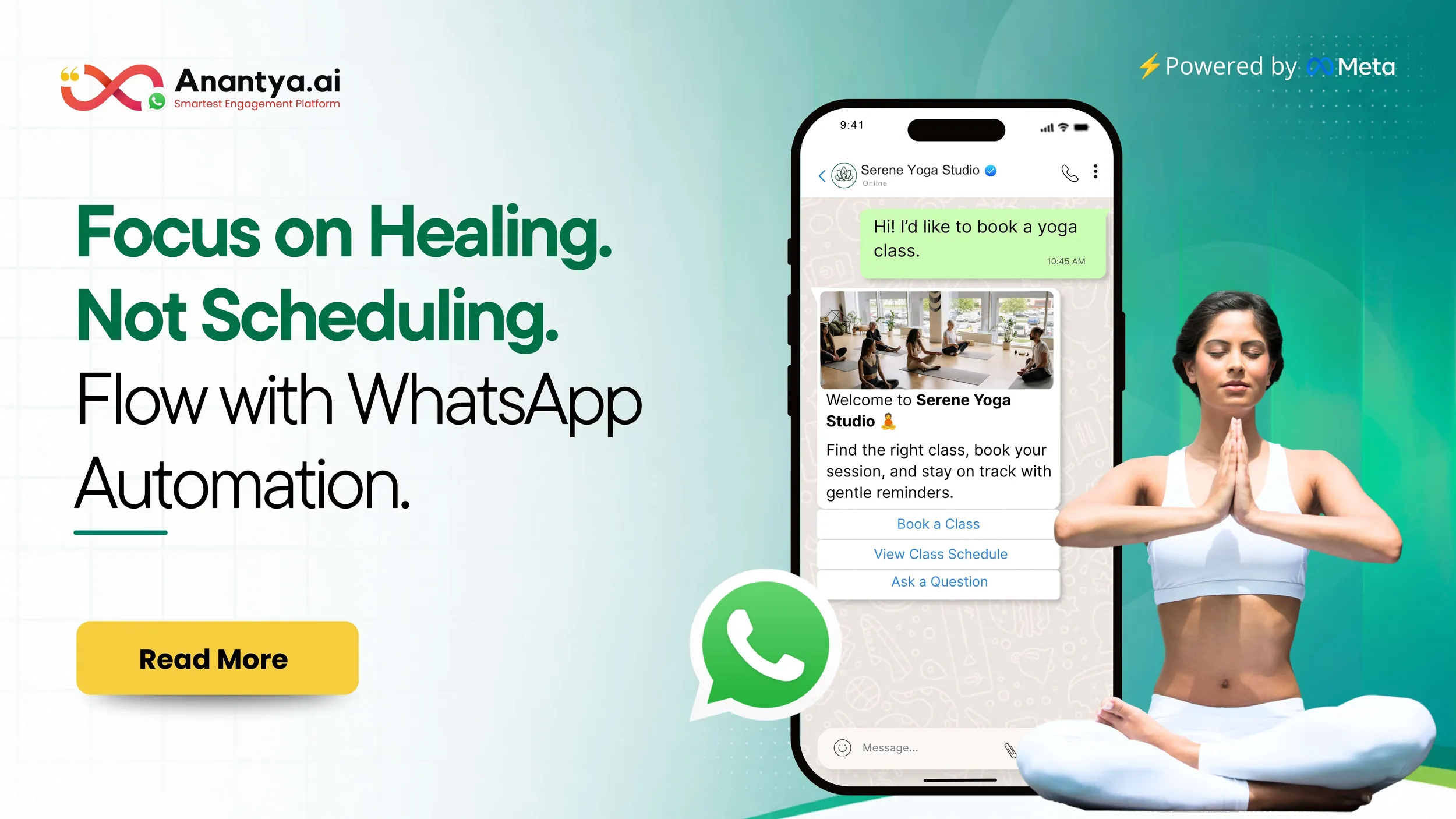
WhatsApp for bookings changes this by collapsing the conversion path. When a wellness brand has WhatsApp Business API set up, a prospective customer can click a link, land directly in WhatsApp, and book a class, trial session, or consultation inside the same conversation. No app download. No login. No new tab.
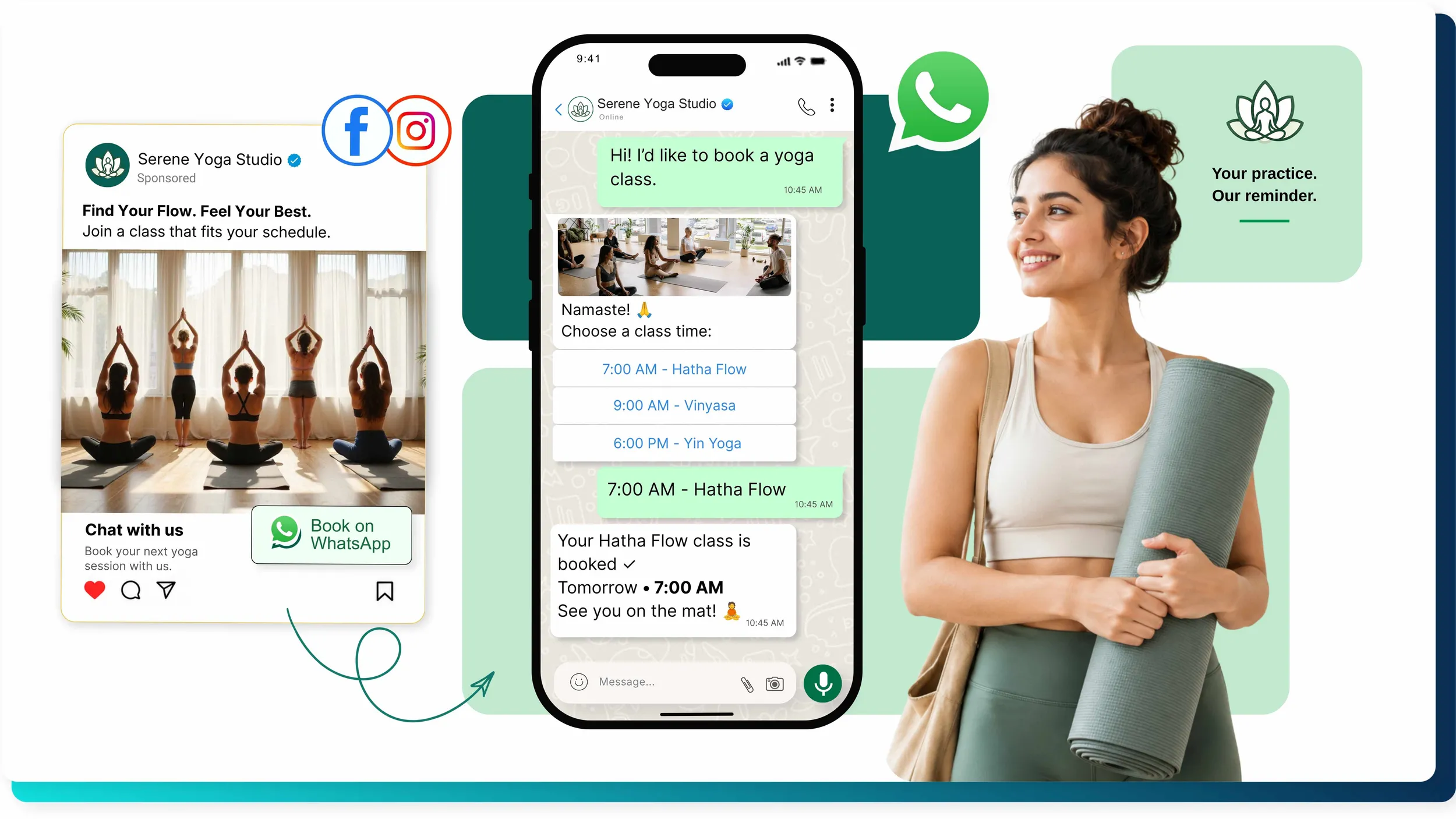
Here's how this looks in practice for a yoga studio:
A potential customer sees an Instagram ad for a free trial class. The ad has a Click-to-WhatsApp button. One click opens a WhatsApp conversation. An automated greeting message comes through: "Hi! We'd love to have you join us. Are you interested in our free trial class this week?" They reply yes. The bot surfaces available slots. They pick a time. They get confirmation. Done.
The entire flow takes under two minutes and never leaves WhatsApp.
For health businesses running consultations, the flow works slightly differently but the principle is the same. Instead of a booking calendar link, the WhatsApp bot asks qualifying questions: what's your primary health concern, have you consulted a nutritionist before, what time slots work for you. The answers pre-qualify the lead and help the consultant prepare, while the customer feels like they've already been seen before the session even starts.
The thing that most wellness brands miss here is that the booking flow is also the first impression. How a customer books a class tells them a lot about how the brand operates. A smooth, fast, conversational booking process says: we're organized, we respect your time, and we're easy to work with. That matters a lot in a category where customers are evaluating whether they can trust you with their body and health.
Reminders: Small Gestures that keep People Engaged
Wellness businesses lose a lot of revenue not only to cancellations, but also to no-shows . Someone books a 7am yoga class with genuine enthusiasm on a Sunday evening. By Tuesday night, the enthusiasm has faded. They don't cancel, they just don't show up.
WhatsApp reminders for class bookings have significantly higher open rates than email and higher engagement than SMS. People open WhatsApp frequently where they talk to people they care about. The conditioning runs deep. A message on WhatsApp demands attention in a way that an email cannot compete with.
But the reminder itself needs to be right. There are two failure modes here.
The first is the generic reminder: "Your class is tomorrow at 7am. See you there!" This gets the job done but barely. It doesn't move the needle on whether the customer shows up or feels good about the brand.
The second failure mode is the overly formal reminder that reads like it came from a hospital appointment system. "This is a confirmation of your upcoming session on 24th July, Friday." Cold, impersonal, and does nothing for a customer who's already on the fence about rolling out of bed at 6:45am.
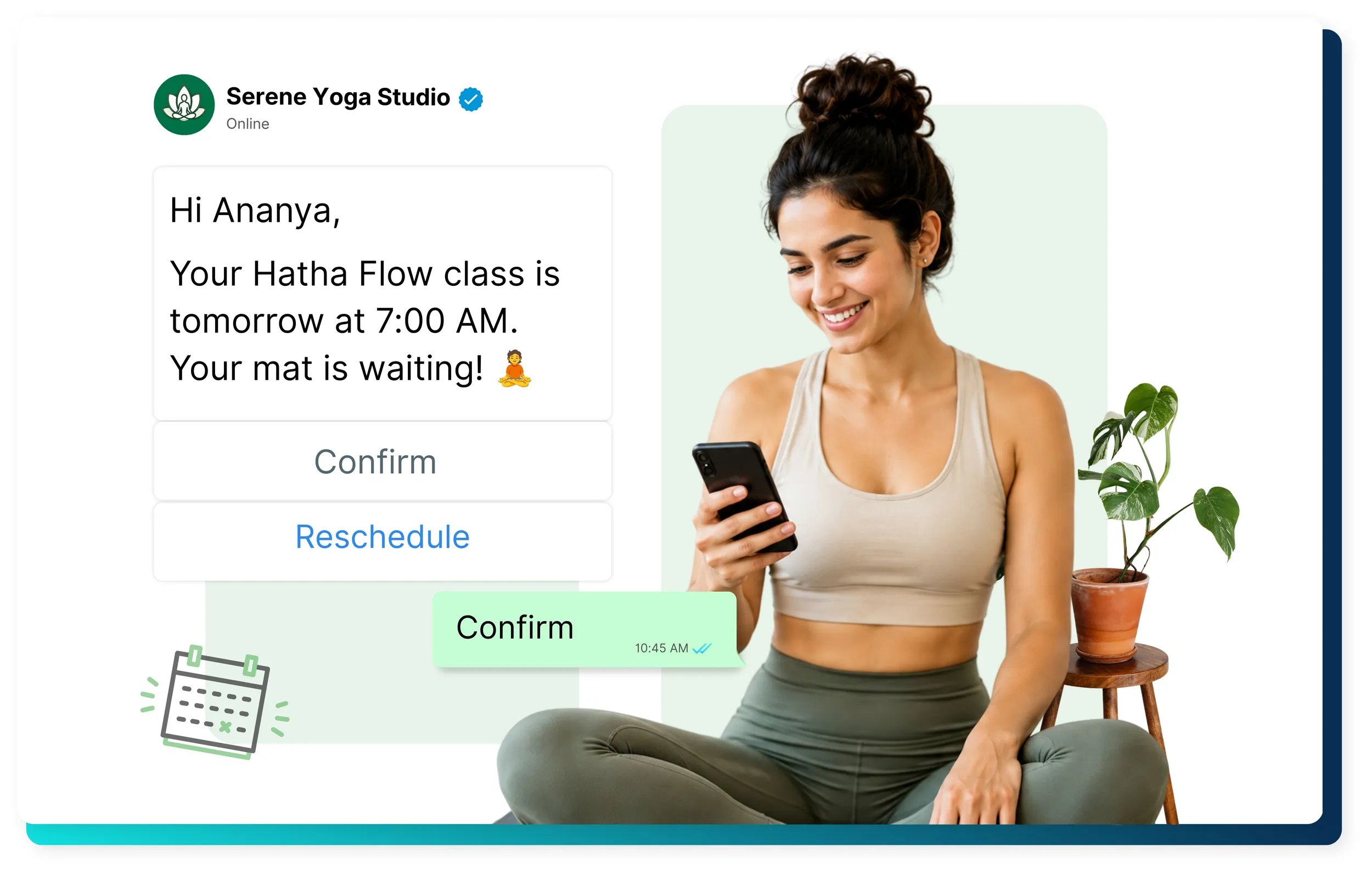
The reminders that actually work in wellness do something different. They acknowledge the customer's state of mind.
A good reminder message for a yoga studio might look like: "Hey Ananya, your 7am flow class is tomorrow morning. Your mat is waiting. Set your alarm tonight, you've already done the hard part."
It's short, warm & anticipates the reason the customer might bail (not wanting to get up) and nudges gently against it. It doesn't feel like a system message. It feels like a message from someone who knows why their customers don't show up.
For health and nutrition businesses, reminders do even more work. A pre-session reminder for a nutrition consultation can include a short prompt: "Your call with Mokshika is tomorrow at 11am. No need to prep anything, but if you've been tracking your meals or energy levels this week, have that handy." Kind of message that reduces no-shows and makes the actual session more productive.
Reminder sequences can also be layered. A good WhatsApp automation for a yoga studio might include:
A confirmation message immediately after booking
A 48-hour reminder with any prep notes (what to bring, where to park, what to wear)
A 2-hour reminder on the day
A post-class follow-up asking how the session went
That sequence covers the customer across the entire journey of a single class visit, not just the administrative confirmation. Each touchpoint reinforces the relationship. Over time, those touchpoints are what turn a first-time visitor into a regular.
Retention: Where WhatsApp Actually Separates Good Businesses from Great Ones
Reminders keep customers showing up. Retention is about keeping them from leaving in the first place.
This is where most wellness businesses have a gaping hole. They invest heavily in acquisition, moderate effort in activation (the first experience), and almost nothing in the ongoing relationship. Then they wonder why retention numbers are poor.
WhatsApp for retention is not about blasting customers with promotional messages every week. That approach works against itself in wellness, where customers are highly attuned to what feels genuine versus what feels like marketing. If your WhatsApp messages are primarily deals, upsells, and event promos, customers will mute the chat or stop engaging with it entirely.
Retention on WhatsApp works when it's built around the customer's journey, not the brand's calendar.
A few specific retention plays that work well for wellness businesses:
Milestone acknowledgments.
Most studio software tracks attendance. WhatsApp automation can sit on top of that data and trigger messages when a customer hits a meaningful milestone: their 10th class, their one-month anniversary, their first month without missing a week. A short, specific message marking that moment does something that discounts can't: it makes the customer feel seen. Here's how it can look like:
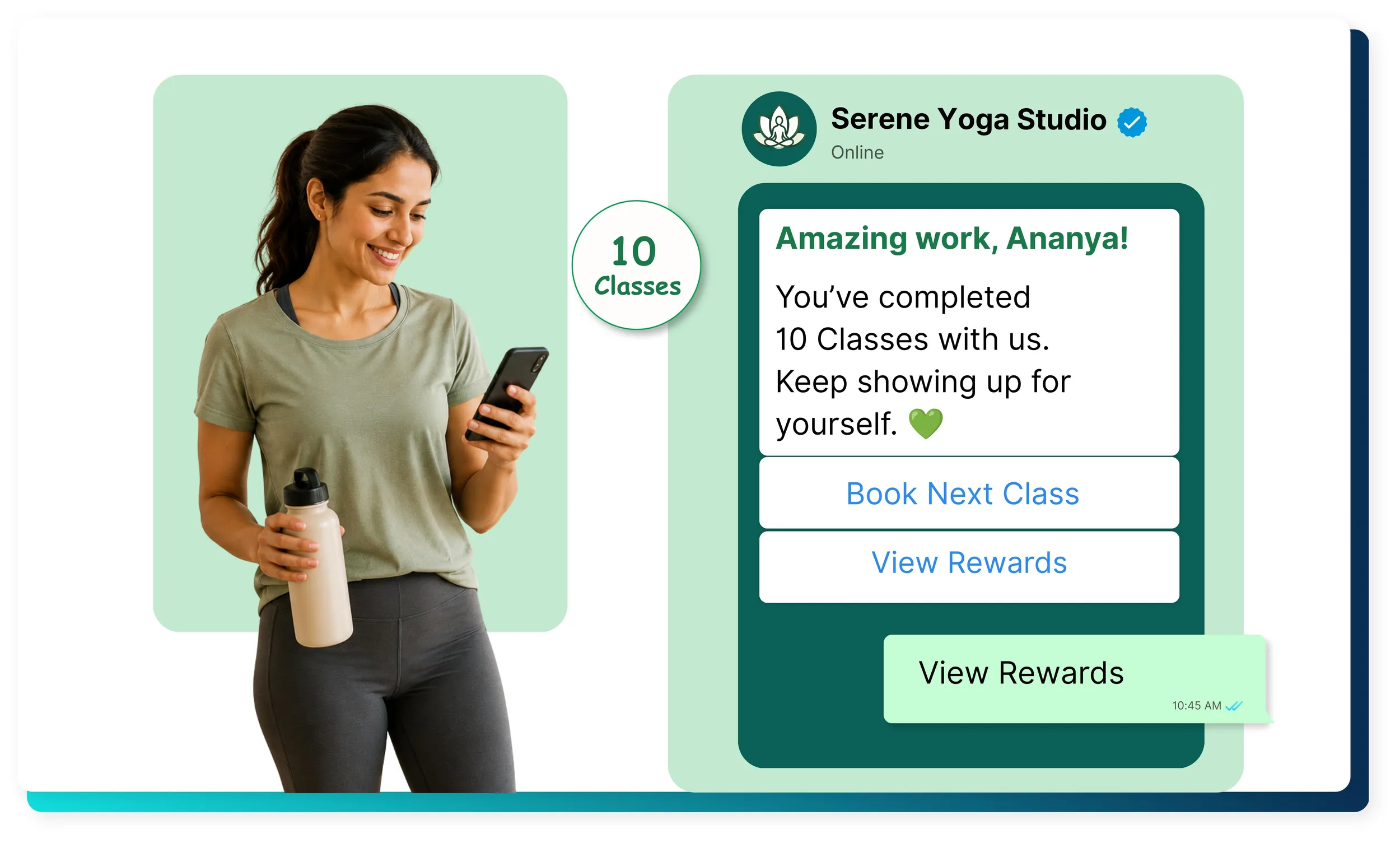
Re-engagement for lapsed customers.
Every wellness business has a cohort of customers who came regularly for a few weeks or months and then disappeared. Some of them left because of a life change. Some of them just lost momentum. Most of them never officially cancelled, they just drifted.
WhatsApp re-engagement works better than email in this context because it reaches lapsed customers in a channel where they're already active. A message sent a few weeks after someone's last class, something direct and human like "We haven't seen you in a while. How are you doing?" followed by a low-barrier offer (a single class on us, a shorter session, a free check-in call) pulls back a meaningful percentage of the lapsed base.
The key is the timing and the tone. This message should not read like a win-back campaign. It should read like the studio noticed the customer was gone.
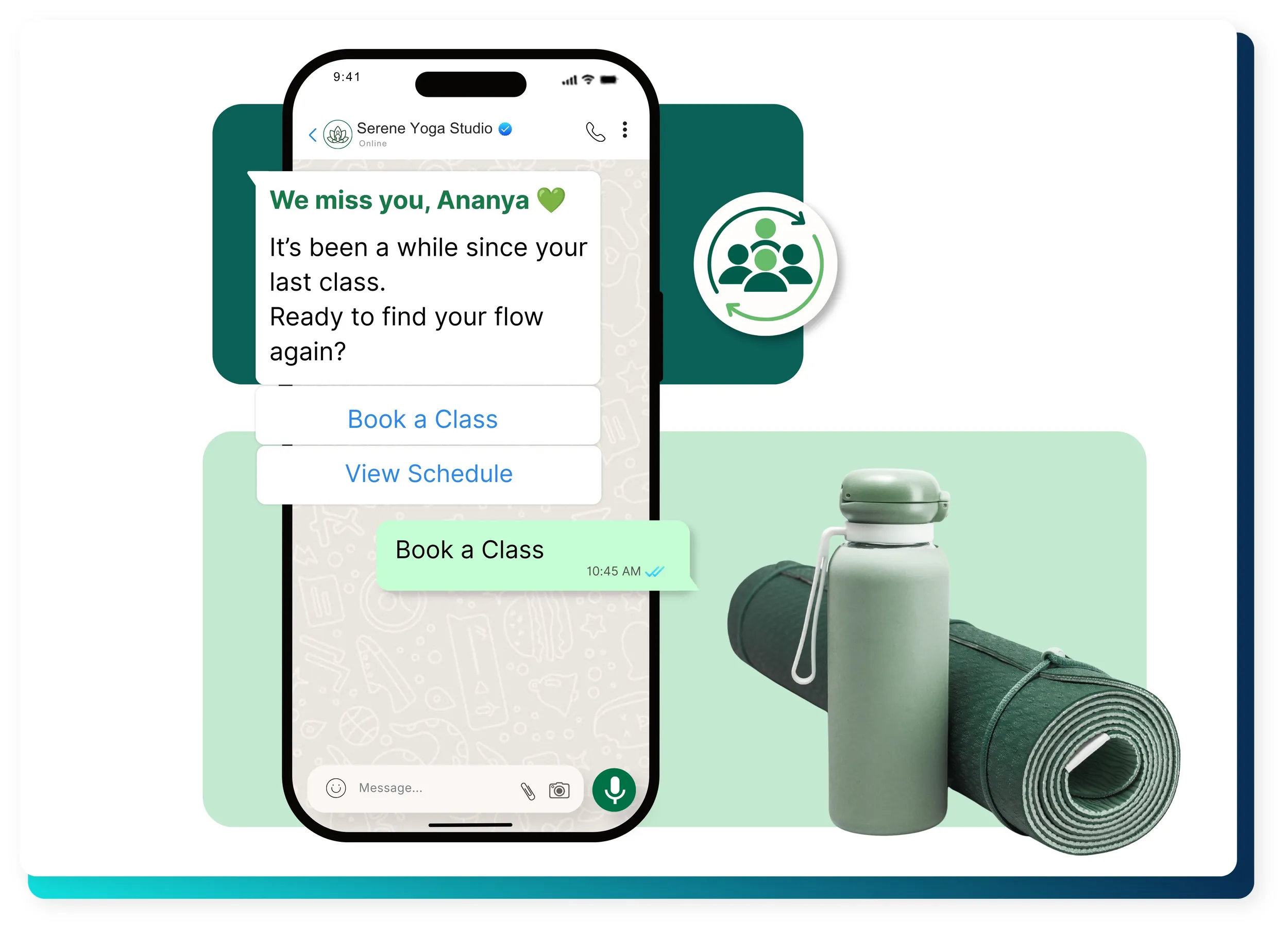
Habit reinforcement content.
This is the underused one. WhatsApp for wellness doesn't have to be transactional. A yoga studio can use its WhatsApp channel to send a short breathwork prompt on a Monday morning, a tip on post-class recovery, or a question: "What's your intention this week?"
None of these messages directly drive bookings. All of them build the relationship that makes customers want to keep booking. The brand becomes a presence in the customer's wellness routine, not just the place where they pay for classes.
This is a careful line to walk. The content has to genuinely add value or it becomes noise. But done right, a WhatsApp channel that shares useful, short, well-timed content becomes part of what the customer is actually paying for.
WhatsApp Business API vs. WhatsApp Business App: What Wellness Brands Actually Need
A lot of wellness businesses start on WhatsApp Business App, the free version, and it works well enough at the beginning. One instructor, one phone, a few dozen customers. Manual messages, quick replies for common questions, a catalogue for packages.
The problems start when the business grows or when they need to do anything that requires automation, multiple team members, or analytics.
WhatsApp Business App works well for smaller operations, but its automation, integration, workflow, and reporting capabilities remain more limited than those available through WhatsApp Business Platform. Although the app supports linked devicesand eligible subscriptions may provide expanded multi-agent accessit is not designed for deeply integrated booking journeys, event-triggered automation, or advanced campaign management at scale.
WhatsApp Business API is the infrastructure that wellness businesses need to actually scale their WhatsApp operations. It allows:
Multiple team members to handle conversations from one number
Automated flows triggered by bookings, cancellations, milestones, and inactivity
Integration with booking platforms and CRMs so customer data informs the communication
Broadcast campaigns to segmented lists (say, all customers who haven't booked in 30 days)
Analytics on open rates, response rates, and campaign performance
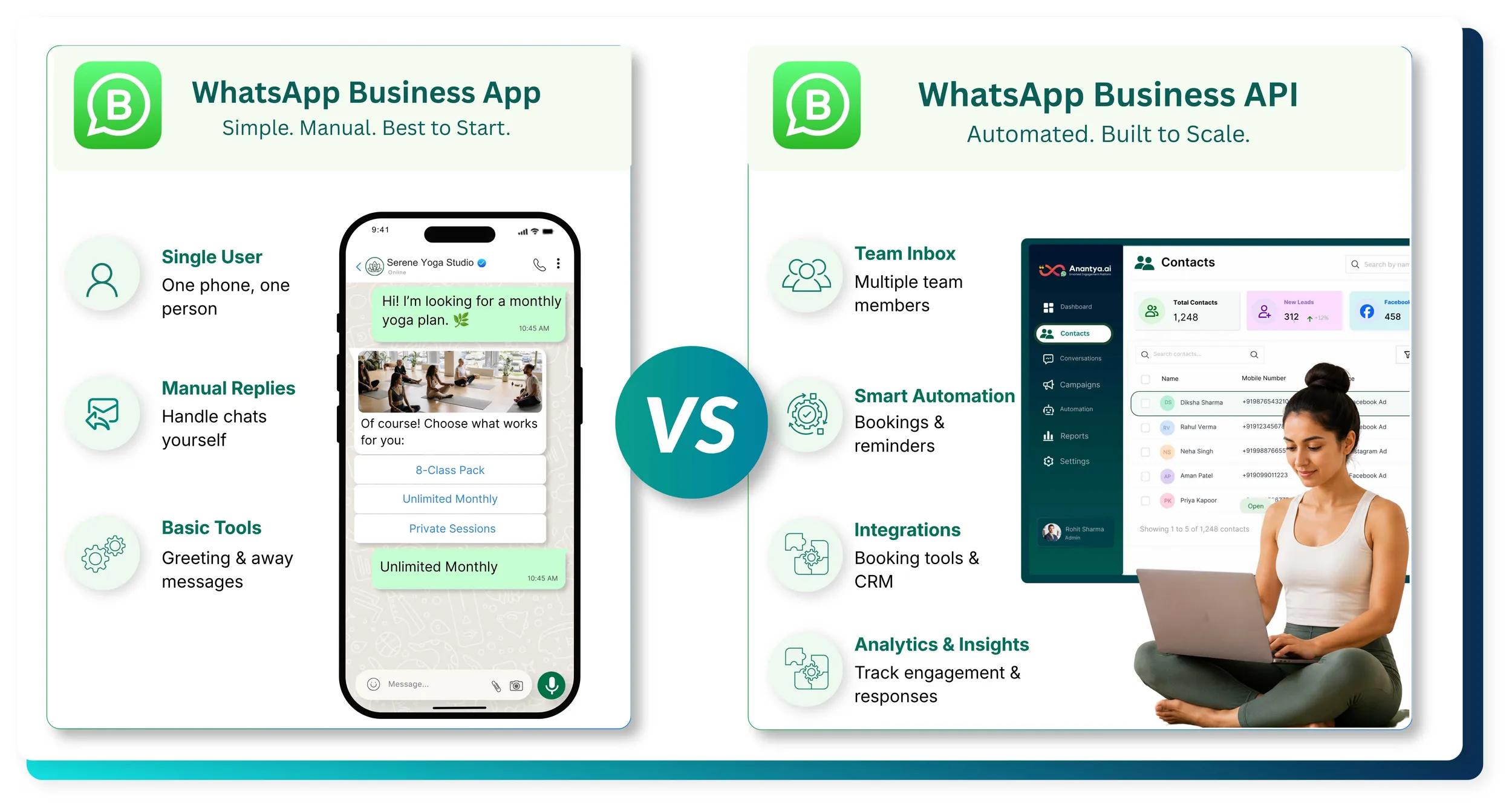
For a wellness business with any real volume, the API is what makes WhatsApp operationally feasible rather than operationally exhausting. The following flows are useful starting points for a yoga studio or health business:
Booking confirmation and welcome flow.
Triggered the moment a booking is made, ideally integrated with the booking system. Includes confirmation details, what to bring, a map or address, and a note on what to expect from a first session.
Reminder sequence.
As covered earlier: 48 hours out, 2 hours out, and a post-class check-in.
Package expiry nudge.
For studios that sell class packs or monthly memberships, an automated message when a pack is running low (say, 2 classes remaining) nudges renewal before the customer's habit breaks.
Lapse detection and re-engagement.
If a customer hasn't visited in 21 days, trigger a check-in message. If no response in 7 days, trigger a low-barrier re-engagement offer.
Feedback collection.
After a session, a short WhatsApp message: "How was today's class?" with a quick rating option or an open-ended prompt. This collects useful data and signals that the brand cares enough to ask.
Each of these flows is straightforward to build with a WhatsApp Business API platform. The logic isn't complicated. What separates wellness brands that do this well from those that don't isn't technical sophistication. It's the quality of the messages and the thoughtfulness of the timing.
Mistake Most Wellness Brands Make on WhatsApp
Wellness brands get excited about WhatsApp, set up a number, and start messaging their entire customer list with promotional content. New class schedule. Special offer. New instructor joining. Anniversary discount. Every message is about the brand. None of it is about the customer.
This is how email marketing was misused for a decade, and wellness brands are repeating the mistake on WhatsApp with a much shorter runway. Customers in the wellness category are quicker to disengage from anything that feels exploitative of their attention. They opted into WhatsApp because it felt personal. The moment it feels like a broadcast channel, the trust breaks.
The discipline here is this: every message sent should pass a simple test. Does this message serve the customer, or does it serve the business?
A "don't miss our flash sale" message? That's serving the business. Those messages have their place, but they should be rare, well-timed, and surrounded by enough genuine value that the customer doesn't feel like they're being harvested.
The businesses that get WhatsApp right in the wellness space treat it like a 1:1 channel even when it's automated. The messages are specific, timely, and acknowledge who the customer is. That's not easy to do at scale, but it's what the WhatsApp Business API makes possible when it's connected to real customer data.
What Automation Looks Like When It's Implemented
A well-run yoga studio on WhatsApp isn't running a complex marketing operation. It's doing a few things consistently well.
Customers book through WhatsApp or get a WhatsApp confirmation the moment they book elsewhere. They get reminded before every class without having to think about it. When they hit a streak, someone notices. When they go quiet, someone reaches out. The channel stays useful because it doesn't clutter up with irrelevant promotions.
The instructor still teaches the same classes. The studio still operates the same way. But the customer feels more held, more seen, and more connected to the community. That feeling is what retention is actually made of.
And the operational reality is that automating this through WhatsApp Business API takes the administrative burden off the team. The instructors aren't manually sending reminders. The front desk isn't chasing confirmations. The system handles the repetitive work, which means the humans can handle the things that actually require a human.
That's the real case for WhatsApp in wellness. Not open rates and click-through rates, though those are better too. It's that done right, it makes running a care-intensive business a bit more sustainable.
Where to Start
If you're a wellness brand considering WhatsApp as a primary communication channel, the starting point is simpler than most businesses assume.
Start with what already happens manually. What do you or your team message customers about regularly? Confirmations, reminders, follow-ups, check-ins? Pick one of those flows and automate it properly through WhatsApp Business API. Get the message tone right. Check the timing. See how customers respond.
The results from that first flow usually make the rest obvious.
If you want to understand what the API setup looks like for a wellness business specifically, and what integration with your existing booking system might require, Anantya.ai works with businesses across fitness, health, and wellness categories to build exactly this kind of communication infrastructure.
Starting with one useful WhatsApp workflow feels appropriate.
Want to see how WhatsApp automation works for service-based businesses? Explore Anantya.ai's WhatsApp Business API solutions and find out what a setup looks like for your business.
Sources and References
Supports claims about interactive CTAs, rich media, structured experiences, and customer-journey communication.
Supports current Business App capabilities, including linked devices, catalogues, labels, broadcasts, and eligible multi-agent access.
Confirms that WhatsApp Business App is not restricted to a single device.
Supports statements concerning message-level analytics available through WhatsApp Business Platform.
Supports the use of interactive options that help customers make structured selections.
Confirms the move toward Meta’s Cloud API and current Business Platform terminology.