

Table of Contents:
- India's Football Obsession Is Bigger Than Football
- Why the FIFA World Cup Creates a Massive Marketing Opportunity for Indian Brands
- Why WhatsApp Is Becoming the Preferred Channel for Event Marketing
- The Real Opportunity: From Football Fandom to First-Party Data
- How Brands Can Use WhatsApp During the FIFA World Cup
- WhatsApp Broadcast Campaigns for FIFA World Cup Marketing
- How WhatsApp Chatbots Improve Fan Engagement
- Using Click-to-WhatsApp Ads During FIFA Campaigns
- Role of WhatsApp Business API in Event Marketing
- Industry-Wise WhatsApp Marketing Ideas for Indian Brands
- The 5-Phase FIFA Campaign Framework
- Measuring WhatsApp Campaign Performance During the World Cup
- Compliance and Consent
- How Anantya.ai Helps Brands Run WhatsApp Marketing Campaigns
- Conclusion
- FAQs
How Indian Brands Can Use WhatsApp Marketing Campaigns to Win the FIFA World Cup Moment
Published: June 2026 | Reading Time: 16–18 minutes | Author: Devanshi Goel
TL;DR
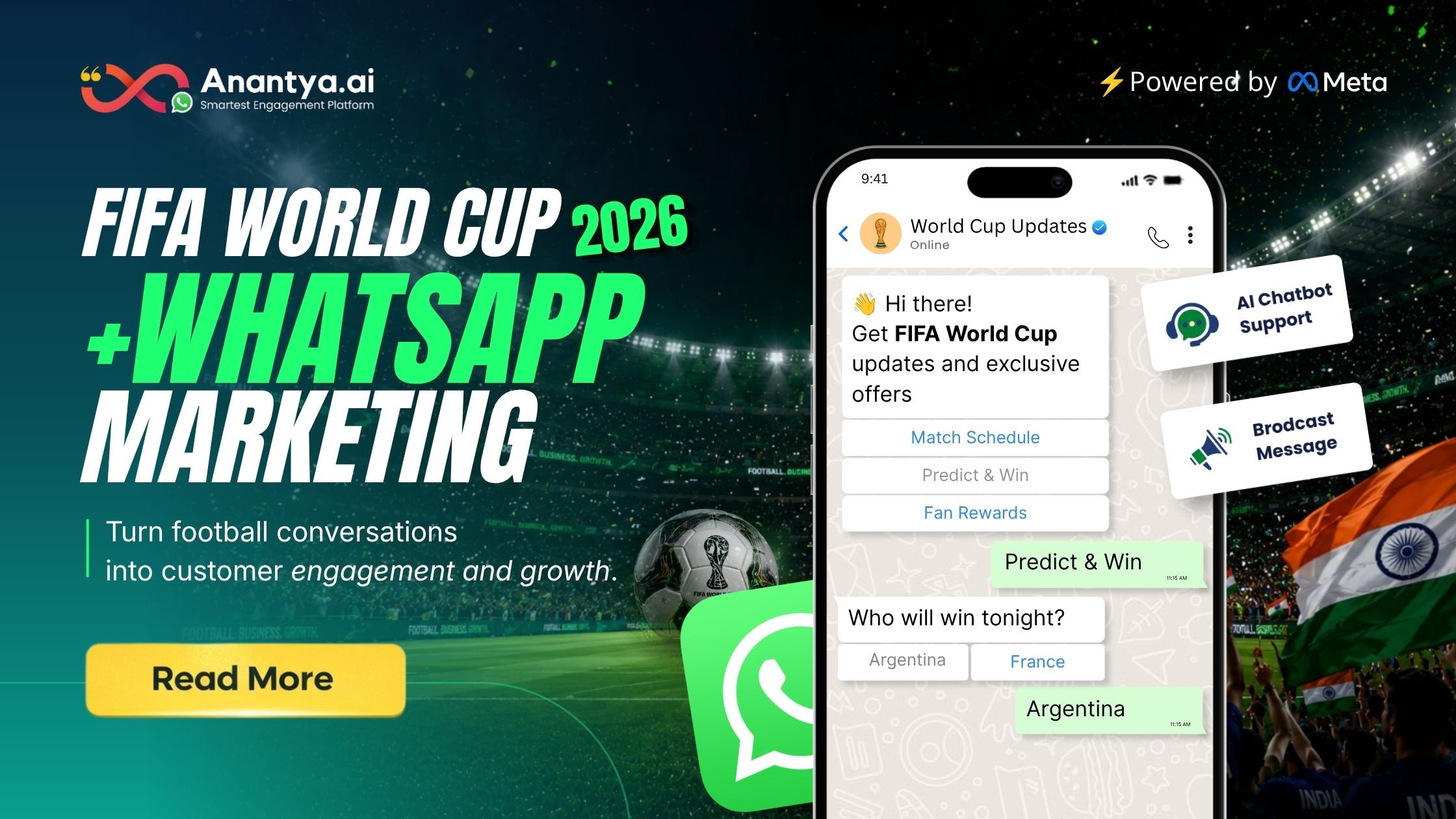
Indian brands can use the FIFA World Cup 2026 as more than a seasonal campaign theme. The real opportunity lies in turning football conversations into customer journeys through WhatsApp marketing campaigns Click-to-WhatsApp ads, WhatsApp broadcast messages, chatbots, automation, and WhatsApp Business API integrations. Instead of only posting World Cup creatives on social media, brands can use WhatsApp to collect opt-ins, run prediction contests, send match-night offers, manage watch-party bookings, recommend products, answer customer queries, and retain users after the tournament ends.
India's Football Obsession Is Bigger Than Football
There are very few things that can turn India into one giant group chat. India vs Pakistan is one of them. The FIFA World Cup is another.
One is easy to explain. The other is more interesting.
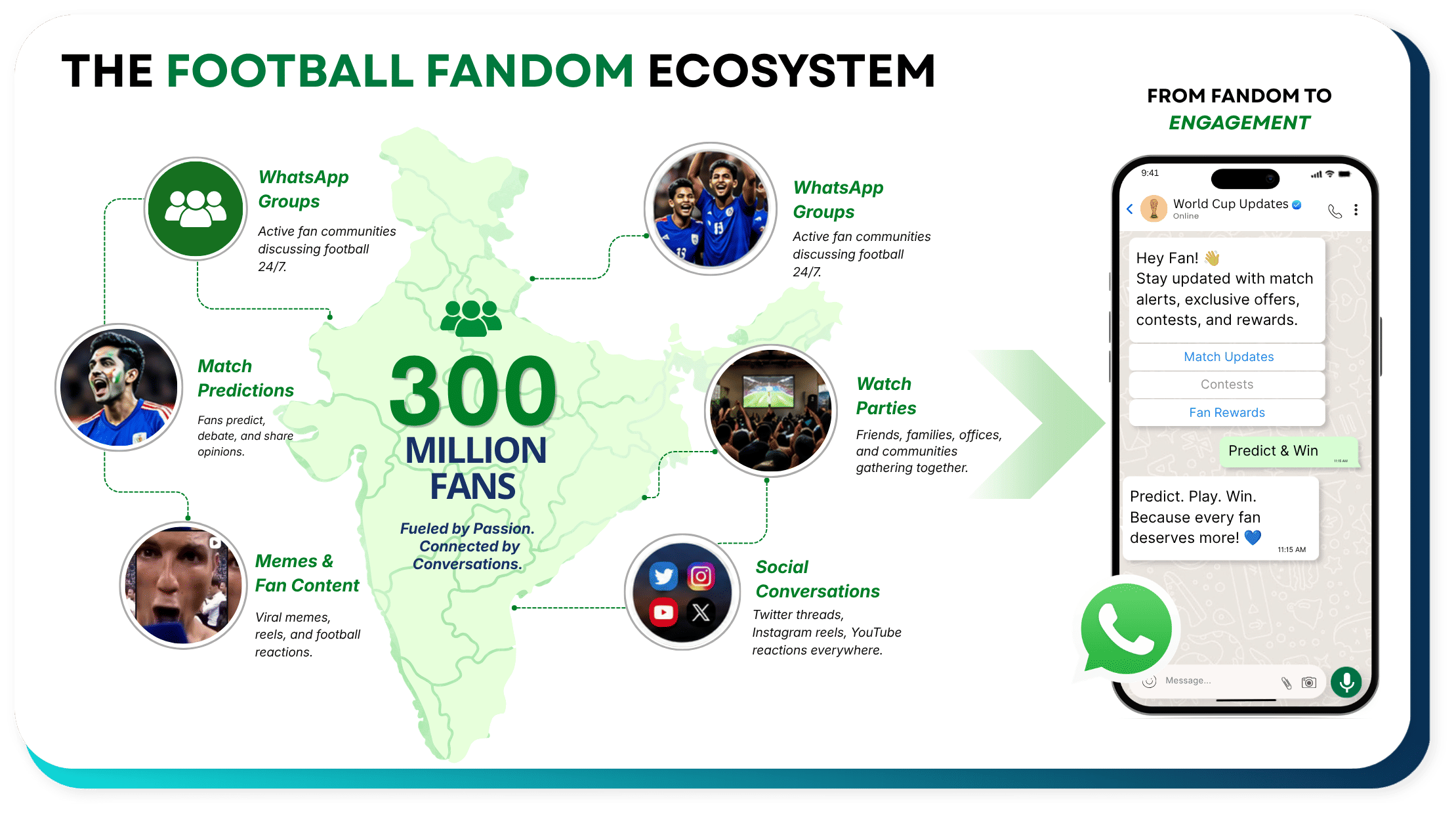
India is not a regular FIFA World Cup team. Most Indian fans do not have a national side to emotionally attach themselves to during the tournament. And yet, every four years, 300 million people across the country pick a side, stay awake through inconvenient match timings, buy jerseys of countries they have never visited, and behave like they have been lifelong citizens of Argentina, Brazil, France, Portugal, Germany, or Spain.
On the surface, this looks like sports fandom. But for marketers, the deeper story is community.
The FIFA World Cup works in India because it gives people something to belong to. Friend groups build their own rivalries. Office teams run prediction pools. Restaurants host match screenings. Families that barely follow club football suddenly care about the final. Social media turns into a public stadium. WhatsApp groups become the real commentary box.
That is why the World Cup is not just a sporting event. It is a month-long cultural moment built on conversations.
For Indian brands, this matters because modern marketing is no longer only about buying visibility. Visibility is crowded, expensive, and often passive. The stronger opportunity is to enter the conversations people are already having and turn that attention into engagement, leads, purchases, bookings, repeat visits, and customer relationships.
This is where WhatsApp becomes important.
WhatsApp is not an outside channel trying to interrupt the World Cup experience. It is already part of how Indian fans experience it. People use WhatsApp to plan match nights, share reactions, forward memes, coordinate orders, discuss predictions, check with friends, and stay connected through the tournament. For brands, that makes WhatsApp one of the most practical channels for FIFA World Cup marketing campaigns.
The real question is not whether Indian brands should talk about the World Cup. Many will. The better question is how they can turn World Cup attention into measurable business outcomes.
The answer lies in using WhatsApp marketing campaigns with sharper intent: not as random broadcasts, but as structured customer journeys powered by the WhatsApp Business API WhatsApp broadcast messages, Click-to-WhatsApp ads, WhatsApp chatbots, automation, segmentation, and conversational commerce.
Why the FIFA World Cup Creates a Massive Marketing Opportunity for Indian Brands
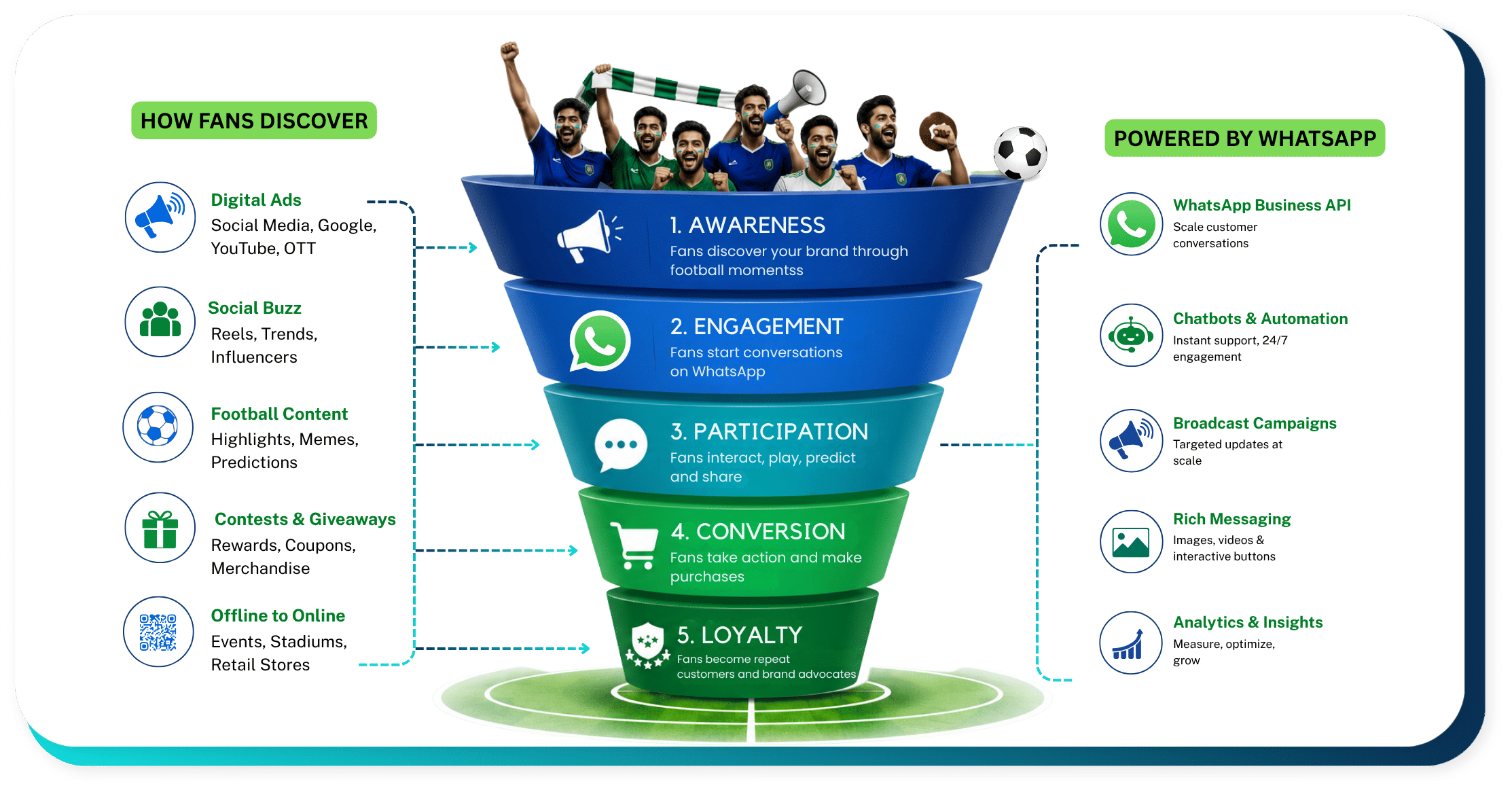
The FIFA World Cup is one of the rare global events that combines scale, emotion, time sensitivity, and social behavior. That combination is difficult for marketers to manufacture from scratch.
A normal campaign has to create its own urgency. The World Cup already has it. Matches have fixed timings. Knockout games have consequences. Finals have emotional weight. Big teams bring built-in fan bases. Even casual viewers become involved when the stakes rise.
This gives brands a useful marketing environment. Audiences are not just watching; they are reacting. They are predicting results, choosing sides, planning where to watch, buying snacks, ordering food, shopping for merchandise, discussing players, and sharing opinions before, during, and after matches.
For Indian brands, the opportunity is especially interesting because football fandom here is not limited to stadium attendance or national participation. It lives across communities. A person may not watch league football throughout the year, but they may still join a watch party for a big World Cup game. A family may not follow football regularly, but they may order food for the final. A D2C brand may not sell sports products, but it can still build a campaign around match-night behavior, group viewing, rewards, contests, and limited-time offers.
That is what makes sports event marketing powerful. The brand does not need to own the sport. It needs to understand the behavior around the sport.
During the World Cup, the behavior is clear. People want to participate. They want to prove they know the game. They want to support a side. They want to be part of a shared event. And they want experiences that feel timely.
This is where many brands make the first mistake. They treat the World Cup like a content calendar theme. They change creatives, add football references, run a few posts, and call it a campaign.
That is not enough anymore.
A serious FIFA World Cup Marketing Campaign needs to move beyond visibility. It should ask:
- What can the customer do after seeing the campaign?
- Can they complete a purchase?
- Can the brand continue the relationship after the tournament ends?
These questions are important because the strongest event marketing strategies are not built around one-way attention. They are built around interaction. And WhatsApp is one of the most useful channels for creating that interaction at scale.
Why WhatsApp Is Becoming the Preferred Channel for Event Marketing
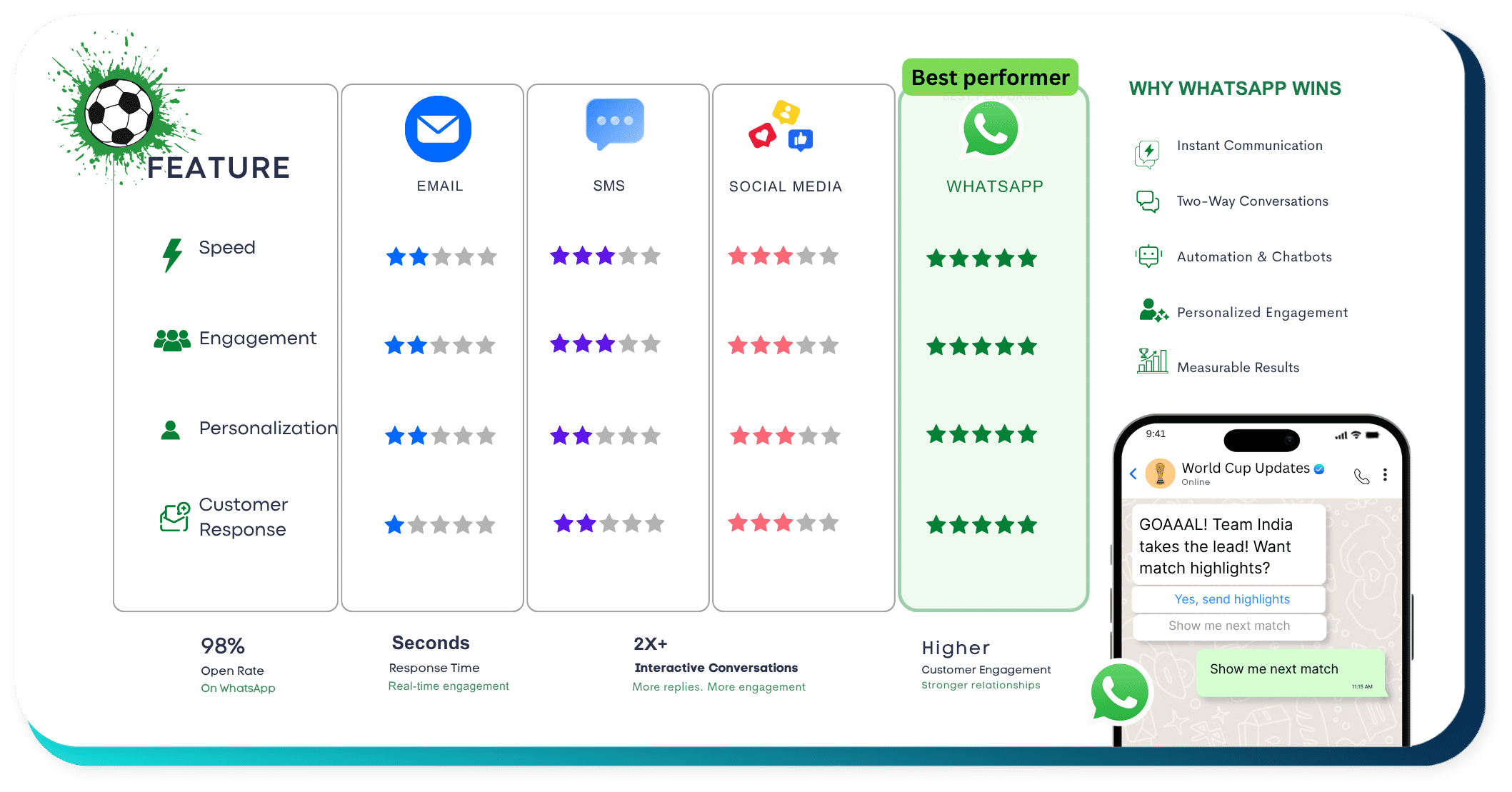
WhatsApp works for FIFA World Cup marketing because it matches how people behave during live events.
Fans do not experience the tournament in a clean, linear way. They do not only sit in front of a screen and watch. They move between TV, mobile, social media, food delivery apps, fantasy platforms, e-commerce websites, group chats, and search. Their attention is fragmented, but their emotional involvement is high.
This is exactly where WhatsApp fits.
Email is too slow for live moments. SMS is too limited for rich engagement. Social media is crowded and algorithm-driven. Websites require users to make extra effort. Apps are useful only if customers have already installed them.
WhatsApp, on the other hand, is immediate, familiar, and conversational. It allows brands to communicate directly with users in a space where they are already active. It also supports formats that are useful for event campaigns: images, videos, buttons, lists, catalogs, forms, quick replies, payment links, location sharing, and automated journeys.
This isn't just intuition. According to Meta's 2026 omnichannel whitepaper with the Retailers Association of India, 72% of product discovery in India now happens on WhatsApp. For brands planning World Cup campaigns, that number matters more than any open rate benchmark.
The channel becomes even more powerful when it is connected to the WhatsApp Business API. With the API, brands can move beyond basic conversations and build proper marketing workflows. They can segment audiences, automate replies, trigger messages based on customer actions, integrate CRM data, support multi-agent conversations, run chatbot journeys, and measure campaign performance.
This is why WhatsApp should not be treated as only a customer support tool. For modern Indian brands, it can act as a full-funnel marketing channel.
It can help acquire leads through Click-to-WhatsApp Ads. It can qualify customers using WhatsApp Flows. It can engage them through polls, quizzes, and contests. It can convert them through catalogs, offers, and payment links. It can retain them through post-event loyalty messages and reactivation campaigns.
That is the real value of WhatsApp marketing duringthe FIFA World Cup: it turns fan attention into a customer journey.
The Real Opportunity: From Football Fandom to First-Party Data
A World Cup campaign can generate reach. But reach alone is not a business asset. The stronger opportunity is first-party data.
Every interaction on WhatsApp can help a brand understand the customer better. A user who selects Argentina as their favorite team is giving the brand a preference signal. A user who joins a watch-party list is showing local event intent.
A 62% increase in leads generated is what Meta's India retail report found for brands using WhatsApp Business Messaging. That's not a social media vanity metric. Those are contacts with verified numbers who started a conversation.
This data becomes useful when brands capture it properly and connect it to future campaigns. The point is not to force every industry into football. The point is to use football as a context for customer engagement.
This is where WhatsApp performs better than many traditional channels. A social media post may get likes. A TV ad may create recall. A display ad may create impressions. But a WhatsApp conversation can collect a response, qualify intent, and move the user to the next step.
Thus, WhatsApp proves to be especially useful for Indian marketers who are under pressure to prove ROI. A well-designed campaign does not end with awareness. It can show opt-ins, replies, clicks, leads, purchases, bookings, repeat orders, and customer retention.
The World Cup gives brands the moment. WhatsApp gives them the mechanism.
Create Your Anantya.ai Account
How Brands Can Use WhatsApp During the FIFA World Cup
The smartest WhatsApp Marketing Campaigns during the FIFA World Cup will not look like generic promotional blasts. They will be built around real fan behavior.
A user watching a match at 12:30 AM does not want a random sales pitch. But they may respond to a live poll, a prediction game, a flash offer, a food delivery update, a screening reminder, or a relevant product recommendation. The difference is context.
Here are some of the most practical WhatsApp campaign examples brands can use during the tournament.
Match Reminders and Live Updates
Brands can allow customers to subscribe to match reminders, fixture updates, team announcements, and key tournament alerts. This works especially well for media brands, sports platforms, restaurants, gaming apps, fantasy sports platforms, and fan communities.
The experience can be simple. A user clicks an ad, enters WhatsApp, selects their favorite teams, chooses their preferred language, and opts in for updates. From there, the brand can send relevant reminders instead of flooding everyone with every match.
This is useful because relevance protects the campaign from becoming spam. A Portugal fan may want updates about Portugal. A casual viewer may only want reminders for semi-finals and finals. A restaurant customer may only want screening updates for their city. The more specific the preference capture, the better the campaign performance.
Prediction Campaigns
Football fans love being right. Prediction campaigns use that instinct well.
Brands can ask users to predict match winners, final scores, first goal scorers, yellow cards, penalty shootouts, or Player of the Match. These campaigns are easy to understand and naturally interactive.
The reward does not always have to be large. It can be a coupon, loyalty points, early access, a free add-on, a discount code, merchandise, or a chance to enter a larger giveaway.
For brands, prediction campaigns are valuable because they create repeat engagement. A user can return before every major match. Over time, the brand can build a leaderboard, reward streaks, and identify highly engaged users.
Fan Polls and Interactive Quizzes
Polls and quizzes are useful because they reduce friction. Users do not need to write long responses. They simply tap.
A brand can ask: Who wins tonight? Which team has the best attack? Who is the most underrated player? Which match are you most excited for? Which team has the strongest fan base in India?
Quizzes can be used for deeper engagement. A sports media platform can test football knowledge. An edtech brand can run a sports trivia series. A D2C brand can use quizzes to unlock coupons. A restaurant can run "guess the score" games before screening nights.
The advantage of WhatsApp is that the journey does not need to stop after the answer. A chatbot can immediately respond with the result, reward, next question, coupon, or product recommendation.
Giveaways, Coupons, and Rewards
Giveaways are not new, but WhatsApp makes them easier to manage.
A brand can run campaigns around jerseys, vouchers, match-night meals, subscriptions, travel credits, watch-party passes, merchandise bundles, or cashback rewards. Users can enter through Click-to-WhatsApp ads, QR codes, website buttons, social media links, or in-store posters.
Once the user enters the WhatsApp journey, the brand can collect consent, ask a few qualifying questions, issue a unique coupon, and continue the conversation later.
This is far cleaner than asking users to comment on social media and then trying to manually track entries.
Watch-Party Bookings
For restaurants, pubs, cafes, hotels, clubs, malls, cinemas, and event organizers, WhatsApp can become a direct booking channel during the World Cup.
A user can open a WhatsApp chat, choose the match, select the number of guests, pick a location, view package options, pay an advance, and receive confirmation without moving across multiple pages.
This is one of the strongest use cases because it solves a real customer problem. During big matches, people do not want to call five venues. They want quick availability, clear pricing, and confirmation.
A WhatsApp chatbot can handle most of this journey automatically and escalate only high-value or complex queries to a human agent.
Merchandise and Match-Night Commerce
The World Cup creates natural demand for jerseys, fan gear, speakers, projectors, snacks, beverages, gaming accessories, flags, decor, and limited-edition bundles. WhatsApp commerce can make this journey more direct. Instead of sending customers to a website first, brands can use product catalogs, carousels, recommendation flows, and payment links inside the app itself.
• Think: The Souled Store drops a team-color collection, jerseys, tote bags, phone cases, one WhatsApp flow that asks "which team are you backing?" and serves the relevant products. No FIFA licensing needed. Just fan identity doing the work.
• Zomato pushes a "match-night order" campaign: select your kickoff time, get a combo deal timed to arrive before the first half. The chatbot handles the upsell at checkout, "add garlic bread for 49 rupees?" No human involved.
• boAt or Noise bundles a portable speaker with a discount code that unlocks only inside WhatsApp. User clicks a Click-to-WhatsApp ad, picks their team, gets a "fan pack" recommendation. One conversation, one purchase, zero landing page drop-off.
The key is to keep the journey simple. During event-led moments, customers do not want to browse endlessly. They want quick decisions.
WhatsApp Broadcast Campaigns for FIFA World Cup Marketing
WhatsApp broadcast messages can be powerful during the World Cup, but only if they are used carefully.
The mistake many brands make is treating broadcasts like bulk SMS. They prepare one message, send it to everyone, and expect results. That approach may create short-term reach, but it can also increase opt-outs, blocks, and message fatigue.
A better WhatsApp broadcast campaign starts with segmentation.
Brands should divide audiences by interest, intent, and behavior. A customer who has previously purchased sports products should not receive the same message as someone who only signed up for a coupon. A Mumbai user looking for screening venues should not receive Delhi offers. A hardcore fan should not receive only final-match updates. A casual viewer should not be pushed into daily football alerts.
Useful segments for FIFA World Cup marketing include:
- City or region
- Preferred language
- Product category interest
- High-intent leads
- Existing customers vs new customers
Once segmentation is clear, broadcast messages become more relevant.
A food delivery brand can send different match-night combos based on city and order history. A retail brand can send team-color product recommendations based on browsing behavior. A travel brand can send international package information only to users who showed interest in travel. A restaurant can remind only confirmed leads about limited seating for a specific screening.
This is how WhatsApp broadcast messages move from interruption to utility.
The message itself should also be direct. Every broadcast should have one purpose and one primary action. If the goal is to book, the CTA should be "Reserve Now." If the goal is to sell, the CTA should be "Shop Now." If the goal is engagement, the CTA should be "Vote" or "Predict."
Trying to do too much in one message weakens the campaign.
How WhatsApp Chatbots Improve Fan Engagement
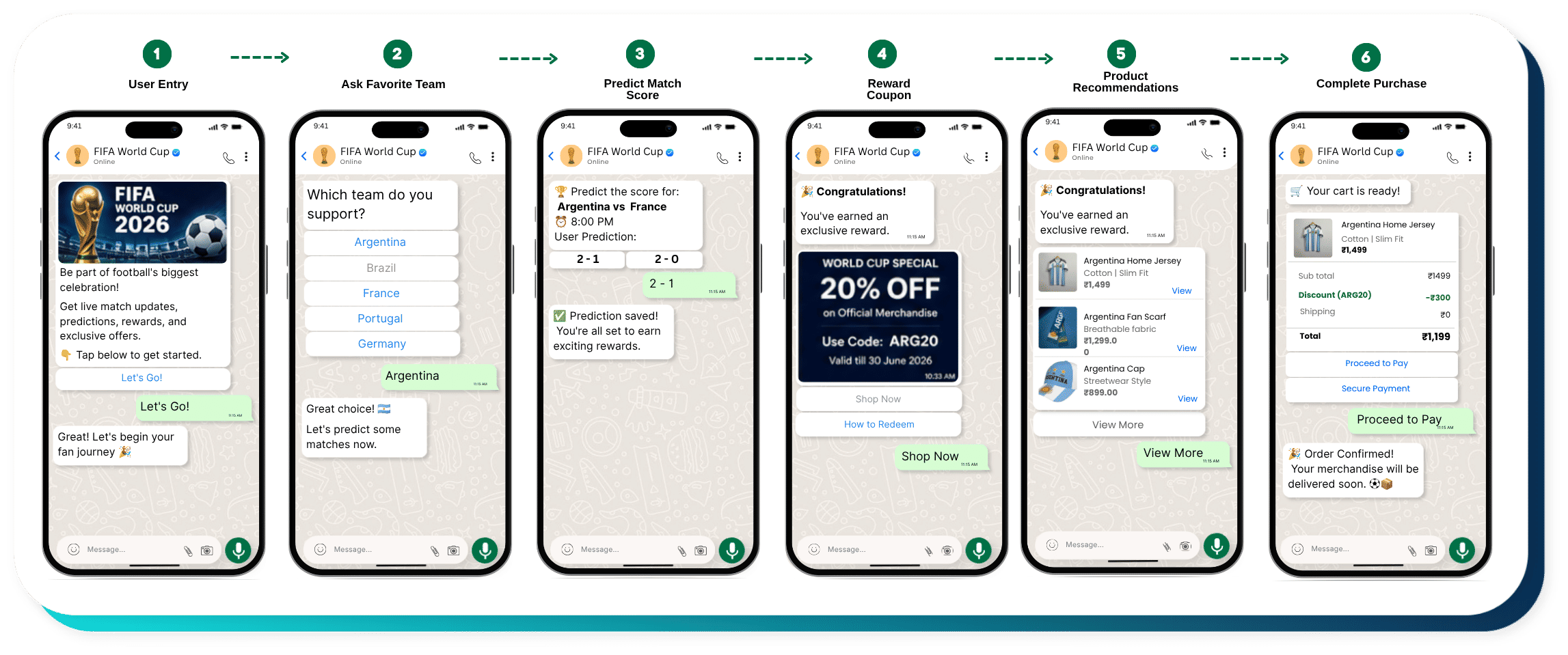
A FIFA World Cup campaign can create a sudden spike in customer conversations. That is good for attention, but difficult for operations.
If a restaurant receives hundreds of screening queries before a major match, manual replies will slow down. If an e-commerce brand runs a limited-time offer, customers may ask about sizes, delivery, payment, returns, and availability at the same time. If a travel brand promotes match packages, users may need help with flights, visas, hotel options, and pricing.
This is where WhatsApp chatbots become essential.
A good WhatsApp chatbot is not just an FAQ bot. It should guide the user through a specific journey. It should understand what the customer wants, ask the right questions, show relevant options, and move the user closer to an outcome.
For World Cup campaigns, chatbots can support several use cases. They can show match schedules, send reminders, answer contest questions, collect prediction entries, distribute coupons, recommend products, confirm bookings, share payment links, track orders, and escalate complex queries to human agents.
For example, a user may click a Click-to-WhatsApp ad that says, "Book your World Cup screening table." The chatbot can ask for the city, preferred outlet, match, number of people, seating preference, and contact details. It can then show available slots and complete the booking.
Another user may enter through a quiz campaign. The chatbot can ask five football questions, calculate the score, issue a coupon, and recommend a product bundle based on the user's interest.
A third user may enter through a retail offer. The chatbot can ask which team they support, whether they are shopping for themselves or gifting, their budget, and preferred category. Based on the answers, it can show relevant products.
This is what makes WhatsApp automation useful. It reduces waiting time for customers and reduces manual load for teams. More importantly, it keeps the interaction alive when the user's intent is highest.
The World Cup is time-sensitive. A delayed response can mean a lost booking, a missed order, or a cold lead. A chatbot helps the brand stay responsive during late-night surges, half-time spikes, weekend demand, and final-match chaos.
However, chatbot design matters. A poor chatbot can damage the experience. If the flow is too long, too robotic, or too vague, users will drop off. The best chatbots keep choices simple, use clear buttons, avoid unnecessary questions, and give users a human support option when needed.
For Indian audiences, language also matters. Brands should consider offering English and regional-language options, especially when campaigns target large consumer segments beyond metro cities.
A strong WhatsApp chatbot should feel less like a form and more like a helpful conversation. That is the difference between automation that supports customer engagement and automation that frustrates customers.
Using Click-to-WhatsApp Ads During FIFA Campaigns
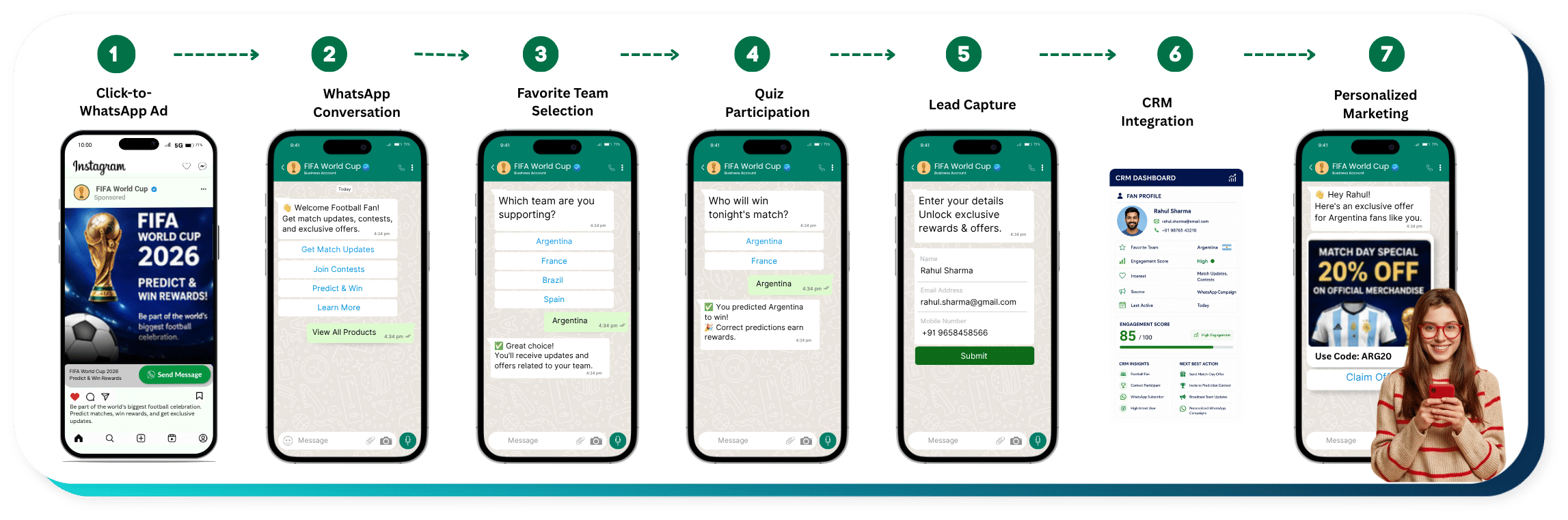
Click-to-WhatsApp ads are one of the most useful acquisition tools for World Cup campaigns because they reduce the gap between interest and action.
In a normal campaign, a user sees an ad, clicks to a landing page, reads the page, fills a form, waits for a callback, and may or may not convert. Every step creates drop-off. The numbers back this up. Retailers running Click-to-WhatsApp campaigns are seeing 61% higher ROAS on average, according to Meta's 2026 India retail report. During a high-attention moment like the World Cup, that gap widens further because intent is already high before the ad even runs.
With Click-to-WhatsApp ads, the journey becomes shorter. A user sees an ad on Facebook or Instagram, taps it, and enters a WhatsApp conversation. From there, a chatbot or agent can collect information, answer questions, recommend products, confirm bookings, or capture the lead.
This works particularly well during live events because attention is unstable. A person may be interested in a screening pass, match-night combo, jersey, travel package, or contest, but they may not want to fill a long form. A chat-based journey feels easier.
A practical Click-to-WhatsApp funnel for the FIFA World Cup could look like this:
- Ad creative: "Watching the final with your gang? Book your table before slots run out."
- WhatsApp entry: User taps the ad and opens chat.
- Chatbot flow: City ? outlet ? match ? number of guests ? package ? booking confirmation.
- CRM update: Lead details and booking status are stored.
- Follow-up: User receives reminders, payment updates, and post-match offers.
This same structure can work across industries. An e-commerce brand can run "Shop your team colors." A food brand can run "Order match-night combos." A travel brand can run "Plan your football trip." An edtech brand can run "Take the football quiz and unlock a reward." A fintech brand can run "Pay during match week and win cashback."
The format changes, but the logic remains the same: turn passive interest into a direct conversation.
Role of WhatsApp Business API in Event Marketing
The WhatsApp Business API is what allows brands to run event marketing at scale.
The regular WhatsApp Business App may work for small teams and local businesses. But larger campaigns need automation, integration, segmentation, analytics, multi-agent support, and structured message flows. That is where the API becomes important.
For FIFA World Cup marketing campaigns, the WhatsApp Business API can support:
- Automated customer journeys: Brands can build journeys for opt-ins, quizzes, bookings, purchases, reminders, feedback, and retention.
- WhatsApp broadcast messages: Businesses can send approved message templates to opted-in audiences and personalize them based on customer data.
- Chatbot automation: Brands can deploy bots for FAQs, lead qualification, order support, contest participation, and product recommendations.
- CRM integration: Customer responses, preferences, and lead details can be synced with CRM platforms so sales and marketing teams can act on them.
- Multi-agent support: When a conversation needs human attention, it can be routed to the right agent or team.
- Campaign analytics: Brands can track delivery, read rates, replies, clicks, conversions, and drop-offs to understand what is working.
- Customer engagement automation: Businesses can trigger messages based on user actions such as ad clicks, cart abandonment, booking interest, payment status, or previous purchase behavior.
This matters because a World Cup campaign does not operate like a normal monthly campaign. It has peaks. Some days will be quiet. Some matches will create sudden spikes. Knockout games, semi-finals, and the final will drive higher urgency.
The API helps brands manage this variation without losing control of the customer experience.
Industry-Wise WhatsApp Marketing Ideas for Indian Brands
The FIFA World Cup is not only for sports brands. It can be used by any business that understands the customer behavior around the tournament.
- E-commerce and D2C Brands
E-commerce and D2C brands can build campaigns around team colors, match-night collections, limited-time bundles, fan merchandise, electronics, grooming, fashion, and gifting. A D2C apparel brand can create country-inspired collections. A home electronics brand can recommend speakers, projectors, smart TVs, or lighting setups for watch parties. A snack brand can push match-night combos. A gifting brand can create football-themed hampers. WhatsApp can support the entire journey from product discovery to purchase. Users can click an ad, enter WhatsApp, choose a category, browse recommendations, receive a coupon, and complete the purchase. - Food Delivery, Restaurants, and Cafes
Food is one of the most natural categories for the World Cup because matches create group occasions. Restaurants can use WhatsApp to promote screenings, table reservations, group packages, late-night menus, and match-day offers. Food delivery brands can send personalized combo offers based on order history and match timings. A simple campaign can ask users to select their city, match, and group size. Based on the response, the chatbot can show available packages or delivery options. The important thing is timing. A match-night food offer sent too early may be forgotten. Sent too late, it may miss the decision window. WhatsApp helps brands send timely nudges when customers are closer to action. - Travel and Hospitality
The 2026 FIFA World Cup creates opportunities for travel companies, hotels, visa consultants, airlines, and experience platforms. Not every customer will travel for the tournament, but high-intent segments will need guidance. WhatsApp can help brands answer questions about packages, flights, hotel stays, visa processes, group travel, and itinerary planning. A Click-to-WhatsApp ad can bring interested users into a conversation where the chatbot qualifies budget, destination, travel dates, group size, and assistance required. From there, the lead can be routed to a sales advisor. For high-consideration purchases like travel, WhatsApp works because customers often want reassurance before converting. - Banking, Fintech, and Insurance
Financial brands can use the World Cup for rewards, cashback, card offers, UPI campaigns, credit products, insurance reminders, and loyalty engagement. For example, a fintech brand can run prediction-based cashback campaigns. A bank can promote card offers around match-night dining or travel bookings. An insurance brand can use football-themed journeys to create lighter engagement around serious products. The key is to avoid forcing the football angle. The campaign should connect naturally to customer behavior: spending, rewards, travel, safety, subscriptions, and convenience. - EdTech and Youth Brands
The World Cup attracts a young, digital-first audience. EdTech brands, student platforms, and youth communities can use quizzes, contests, prediction games, and gamified learning journeys to build engagement. A quiz campaign can start with football trivia and then move into a broader learning offer. A coding platform can create a football data challenge. A language-learning app can create country-themed vocabulary games. A student community can run prediction leagues and leaderboards. WhatsApp is useful here because it makes participation easy. Students do not need to download another app to join. - Retail Stores and Local Businesses
Local businesses can use WhatsApp for hyperlocal campaigns. A sports store can promote jerseys and football accessories. A cafe can take screening reservations. An electronics shop can recommend TV and speaker deals. A local bakery can sell match-night snack boxes. A mall can run contest entries through QR codes that open WhatsApp. For these businesses, WhatsApp can become the bridge between offline interest and digital follow-up.
The 5-Phase FIFA Campaign Framework
A strong FIFA World Cup WhatsApp marketing campaign should not begin on the day of the final. By then, the most expensive attention has already been captured by larger brands. The campaign should be planned in phases.
Phase 1: Pre-Tournament Opt-In Building
Before the tournament, brands should focus on collecting opt-ins and preferences. This is the time to ask users what they care about: favorite teams, city, language, match alerts, product interest, or offer preferences. The goal is not aggressive selling. The goal is to build a usable audience before the biggest moments arrive.
Phase 2: Group Stage Engagement
During the group stage, brands should build interaction habits. Prediction games, polls, quizzes, match reminders, and light offers work well here. This phase helps identify engaged users. Not everyone will convert immediately, but their behavior can help brands understand who is worth retargeting later.
Phase 3: Knockout Stage Conversion
The knockout stage is when urgency increases. Matches feel more important. Casual viewers begin paying attention. Social conversations become louder. Brands can use this phase for sharper campaigns: limited-time offers, watch-party bookings, final-match bundles, merchandise drops, and high-intent lead generation. The messaging should become more selective and more commercial, but not spammy.
Phase 4: Final Match Peak
The final is the biggest conversion moment. Food, events, retail, fantasy, entertainment, and media brands can use it for their strongest offers. However, because customer attention will also be the most crowded, messages need to be clear, timely, and specific. This is not the moment for long copy. It is the moment for direct value.
Phase 5: Post-Tournament Retention
Most brands stop once the event ends. That is a mistake. The post-tournament phase is where temporary attention can become long-term customer value. Brands can send thank-you messages, collect feedback, offer loyalty rewards, invite users to future communities, and segment them for upcoming campaigns.
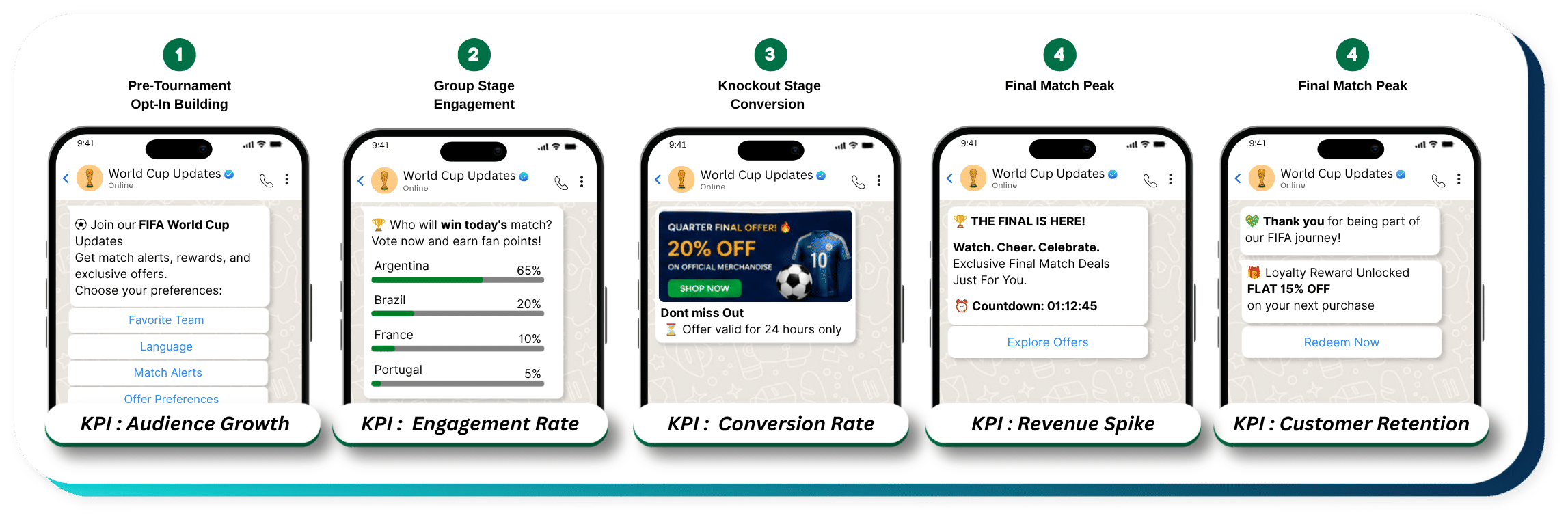
A World Cup campaign should not end with the trophy. It should leave the brand with a stronger customer database.
Measuring WhatsApp Campaign Performance During the World Cup
A campaign that generates replies but no business outcome is not enough. Brands need to define performance metrics before the campaign begins.
Important KPIs include opt-in rate, conversation start rate, reply rate, click-through rate, qualified lead rate, booking completion, coupon redemption, purchase conversion, average order value, repeat engagement, unsubscribe rate, and revenue attribution.
For Click-to-WhatsApp ads, brands should track how many users start conversations and how many complete the intended journey. For chatbot campaigns, they should track drop-off points. For broadcasts, they should monitor delivery, reads, replies, clicks, conversions, and opt-outs. For commerce campaigns, they should connect WhatsApp interactions to actual sales.
The best campaigns are not only creative. They are measurable.
This is especially important during major sporting events because attention can create misleading signals. A campaign may get a lot of engagement because the topic is popular, but that does not automatically mean it is driving leads or revenue. Measurement helps brands separate noise from performance.
Compliance and Consent: Do Not Turn a Marketing Moment Into Spam
WhatsApp marketing works only when users expect the message and find it useful. During high-energy events like the FIFA World Cup, brands may be tempted to over-message. That is where campaigns can go wrong.
A customer who opts in for match reminders should not suddenly receive unrelated promotions every day. A user who joins a contest should clearly know what kind of messages they will receive later. Promotional consent should be handled carefully. Opt-outs should be easy.
Brands should also be cautious about using FIFA names, logos, protected assets, official imagery, or sponsor-style language unless they have the right permissions. Non-sponsor brands can still participate in football culture, but they should avoid implying official association with FIFA or the tournament.
The safest approach is to build campaigns around fan behavior rather than protected tournament assets. Talk about match nights, football fever, fan predictions, watch parties, team colors, and community experiences. Do not pretend to be an official partner unless you are one.
Good marketing should not depend on misleading the customer.
How Anantya.ai Helps Brands Run WhatsApp Marketing Campaigns
Running a FIFA World Cup campaign on WhatsApp requires more than sending a few messages. Brands need the right setup, message strategy, automation, integrations, analytics, and support.
Anantya.ai helps businesses use WhatsApp as a complete customer engagement channel. Brands can manage WhatsApp Business API campaigns, send bulk broadcasts to opted-in audiences, build chatbot journeys, integrate CRM systems, automate customer communication, and track campaign performance from one place.
For event-led marketing, this becomes especially useful. A brand can run Click-to-WhatsApp ads, capture leads through automated flows, qualify users through chatbots, send segmented broadcast messages, manage support conversations, and measure campaign outcomes.
Whether the goal is lead generation, customer engagement, WhatsApp commerce, event registrations, product promotions, or customer retention, brands can build the infrastructure to turn conversations into measurable growth.
The World Cup creates the moment. Anantya helps brands build the journey around it.
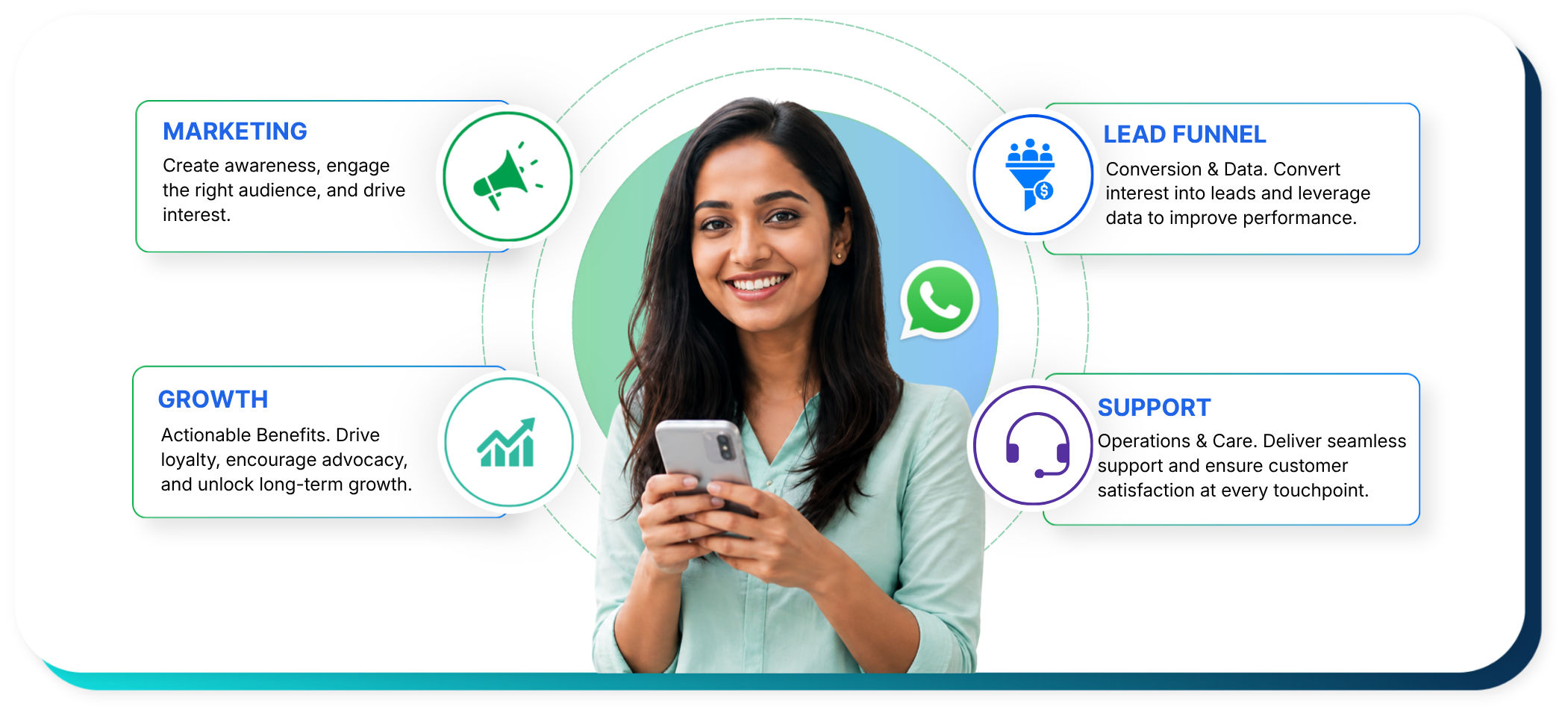
The World Cup Will Be Watched on Screens, But Won in Conversations
The FIFA World Cup is not just a sports event for Indian audiences. It is a shared cultural experience. It works because people participate even when India is not on the pitch. They choose teams, build communities, create rituals, and turn matches into social moments.
That is why the marketing opportunity is so large.
But brands need to understand the difference between attention and engagement. Attention is what the World Cup already has. Engagement is what brands need to build.
WhatsApp gives Indian brands a practical way to do that. Through WhatsApp marketing campaigns, WhatsApp broadcast messages, Click-to-WhatsApp ads, WhatsApp chatbots, automation, and the WhatsApp Business API, brands can move customers from interest to interaction and from interaction to conversion.
The brands that win this moment will not be the ones shouting the loudest. They will be the ones that make it easiest for fans to participate, respond, buy, book, share, and come back.
Because the World Cup may begin on the field, but for Indian customers, a lot of it will happen inside conversations.
And conversations are where WhatsApp wins.
Sources and References
- FIFA. FIFA World Cup 2026 Match Schedule, Fixtures, Results, Teams and Stadiums. Available at: fifa.com
- FIFA. FIFA World Cup 2026 Host Cities, Dates and Tournament Information. Available at: fifa.com
- Meta. AI Fuels India's Omnichannel Shopping Surge: Meta & Retailers Association of India Report. Available at: about.fb.com
- WhatsApp Business. WhatsApp Business Platform Overview. Available at: whatsapp.com
- Meta for Developers. WhatsApp Business Platform Documentation. Available at: developers.facebook.com
- Indian Express. India's Shopping Journey Is Moving to WhatsApp, Finds Meta–RAI Whitepaper. Available at: indianexpress.com
WhatsApp marketing is the use of WhatsApp to communicate with customers through promotional messages, broadcasts, automated conversations, customer support, product recommendations, offers, reminders, and engagement campaigns. With the WhatsApp Business API, brands can run these campaigns at scale and connect them with CRM, chatbots, and analytics.
Indian brands can use WhatsApp during the FIFA World Cup for match reminders, prediction contests, fan polls, giveaways, watch-party bookings, merchandise promotions, food offers, travel enquiries, customer support, and post-event retention campaigns.
The WhatsApp Business API is a solution for medium and large businesses that want to use WhatsApp for customer communication at scale. It supports automation, message templates, chatbots, CRM integrations, multi-agent support, broadcasts, and performance tracking.
WhatsApp broadcast messages allow businesses to send approved messages to multiple opted-in users. For best results, broadcasts should be segmented based on customer interest, location, language, purchase history, or previous interactions.
Yes. WhatsApp chatbots can improve customer engagement by providing instant responses, guiding users through campaigns, collecting leads, answering FAQs, distributing coupons, recommending products, confirming bookings, and routing complex queries to human agents.
Examples include prediction games, match reminder subscriptions, quiz-based coupons, team-based product recommendations, watch-party bookings, food combo offers, fantasy football updates, and post-match feedback campaigns.
WhatsApp is effective for event marketing because it supports real-time communication, interactive journeys, customer segmentation, automation, and direct response. It helps brands turn event attention into measurable actions such as leads, bookings, purchases, and repeat engagement.
Click-to-WhatsApp ads allow users to move directly from a Facebook or Instagram ad into a WhatsApp chat. This reduces friction and helps brands capture leads, answer questions, run chatbot journeys, and drive conversions faster during high-attention sports moments.
Table of Contents:
- India's Football Obsession Is Bigger Than Football
- Why the FIFA World Cup Creates a Massive Marketing Opportunity for Indian Brands
- Why WhatsApp Is Becoming the Preferred Channel for Event Marketing
- The Real Opportunity: From Football Fandom to First-Party Data
- How Brands Can Use WhatsApp During the FIFA World Cup
- WhatsApp Broadcast Campaigns for FIFA World Cup Marketing
- How WhatsApp Chatbots Improve Fan Engagement
- Using Click-to-WhatsApp Ads During FIFA Campaigns
- Role of WhatsApp Business API in Event Marketing
- Industry-Wise WhatsApp Marketing Ideas for Indian Brands
- The 5-Phase FIFA Campaign Framework
- Measuring WhatsApp Campaign Performance During the World Cup
- Compliance and Consent
- How Anantya.ai Helps Brands Run WhatsApp Marketing Campaigns
- Conclusion
- FAQs