

RCS Messaging: The Complete Guide to Business Communication Beyond SMS and WhatsApp (2026)
Quick Answer: RCS (Rich Communication Services) is the next generation of SMS. It delivers WhatsApp-like rich messaging, verified branding, and interactive content directly into a user's native Android messaging app, with no app download required.
Businesses in India are adopting it fast. India leads globally with 27% of smartphone users already interacting with brands via RCS, ahead of every other market.
The Problem With SMS in 2026
Here is a number every marketing team should sit with: 98% open rate.
That is what SMS used to promise. A short message, straight to the inbox, read within 3 minutes. No algorithm, no ad spend. Guaranteed eyeballs.
Then two things happened at once.
Promotional SMS volume exploded. By 2024, Indian consumers were receiving an average of 15-20 commercial SMS messages a day. Open rates held, but trust collapsed. Spoofed sender IDs, phishing links, and fake OTPs turned what was once a trusted channel into a suspicious one.
At the same time, WhatsApp arrived and did something SMS never could: it enabled real conversation. Images, documents, voice notes, quick replies. A platform people wanted to be on.
But WhatsApp has a ceiling. It requires an app download and an active account. In large markets, penetration is strong, but not universal. Feature phone users, app-averse demographics, and enterprise use cases that require carrier-level delivery are all gaps WhatsApp cannot close.
So where does that leave businesses that need to reach every customer, on every device, every time?
That is the problem RCS was built to solve. And it is solving it faster than most Indian brands realize.
What is RCS Messaging?
RCS stands for Rich Communication Services. It is a communication protocol developed by the GSMA (Global System for Mobile Communications Association) as the official successor to SMS.
Unlike WhatsApp or Telegram, RCS is not a standalone app. It is built into the native messaging app on Android devices (Google Messages). A customer with a supported Android phone and a carrier that enables RCS already has it, without downloading anything, creating an account, or taking any action.
The technology has existed since 2008 but stalled for over a decade because mobile carriers could not agree on interoperability standards. Google resolved this in 2019 by taking over RCS Universal Profile development and driving direct carrier integrations globally. Since then, adoption has moved fast.
Today, RCS powers what Google calls Google Messages on the consumer side, and what businesses access through RCS Business Messaging (RBM) on the enterprise side.
The simplest definition: RCS transforms traditional SMS into an interactive, app-like messaging experience without requiring the customer to install anything.
SMS vs RCS vs WhatsApp: Full Comparison
| Feature | SMS | RCS | WhatsApp Business API |
|---|---|---|---|
| Character limit | 160 characters | 1,600+ characters | No hard limit |
| Images and videos | No | Yes, high quality | Yes |
| Rich Cards | No | Yes | Partial, via templates |
| Carousel messages | No | Yes | Yes |
| Read receipts | No | Yes | Yes |
| Typing indicators | No | Yes | Yes |
| Verified sender branding | No | Yes, logo and badge | Yes, green tick |
| Internet required | No | Yes | Yes |
| App download required | No | No | Yes |
| Fallback if unsupported | N/A | Auto-falls back to SMS | No fallback |
| Open rate reported | 90-98% | Around 85% in early benchmarks | 75-90% |
| Spam or phishing risk | High | Low with verified senders | Low |
| Works on iPhones | Yes | Basic support on iOS 18+ | Yes |
| India carrier support | Full | Jio, Airtel, Vi rolling out | N/A |
Sources: GSMA Universal Profile documentation; Routee RCS Trends 2026; Juniper Research India RCS Report 2024
How Does RCS Messaging Work?
Most blogs skip this section. It matters for campaign planning, so let's cover it properly.
When a business sends an RCS message, here is what happens:
- Step 1: Message sent via RCS-enabled platform or API The business uses an RCS platform (like Anantya.ai) or direct API integration to send the message. The platform connects to a messaging aggregator or directly to Google's RCS infrastructure.
- Step 2: Google routes to carrier Google checks whether the recipient's carrier supports RCS, and whether the recipient's device and messaging app can receive RCS.
- Step 3a: RCS supported The message is delivered as a rich message to the recipient's Google Messages app. They see the brand's verified name, logo, images, buttons, and any interactive elements included.
- Step 3b: RCS not supported - fallback to SMS If the recipient's device or carrier does not support RCS, the platform automatically downgrades to standard SMS. The customer still receives the message, just as plain text. The sender pays SMS rates for that delivery.
What Happens When the Receiver Does Not Support RCS?
This is one of the most searched questions about RCS. The short answer: nothing breaks.
The fallback is automatic and invisible. No configuration required. No message is lost. For businesses running large campaigns, this means designing once for a rich experience and letting the platform handle delivery optimization.
For campaigns where the rich experience is critical (product carousels, appointment confirmations with action buttons), brands can track RCS vs SMS delivery rates separately and optimize targeting toward RCS-enabled devices over time.
Key Features of RCS Messaging
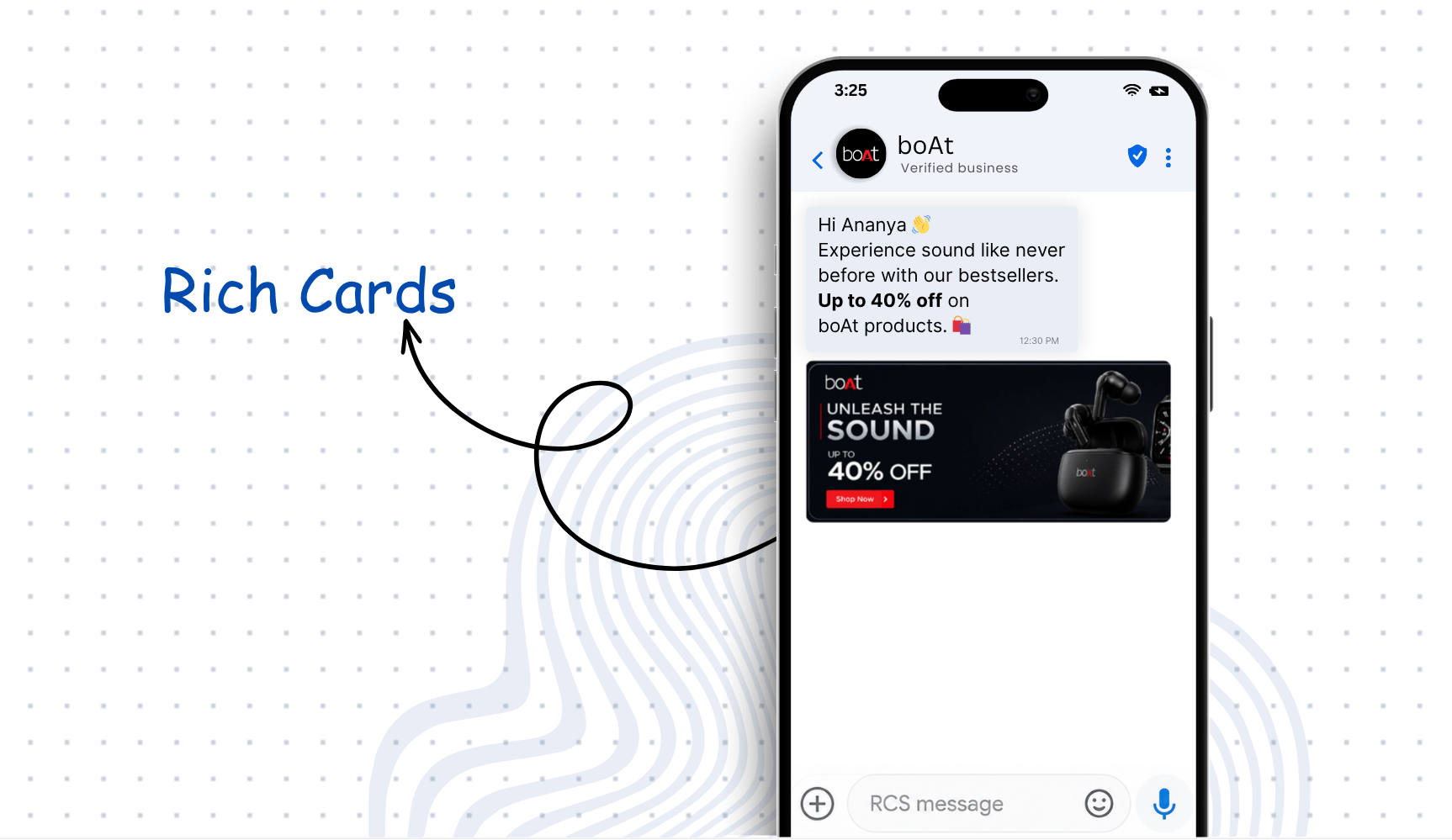
- Rich Cards
A structured card that includes a headline, image, description, and up to four action buttons. Think of it as a mini landing page within a message. For example, a retail brand can send a product card with an image, price, and a 'Buy Now' button, allowing customers to make a purchase without leaving their messaging app.
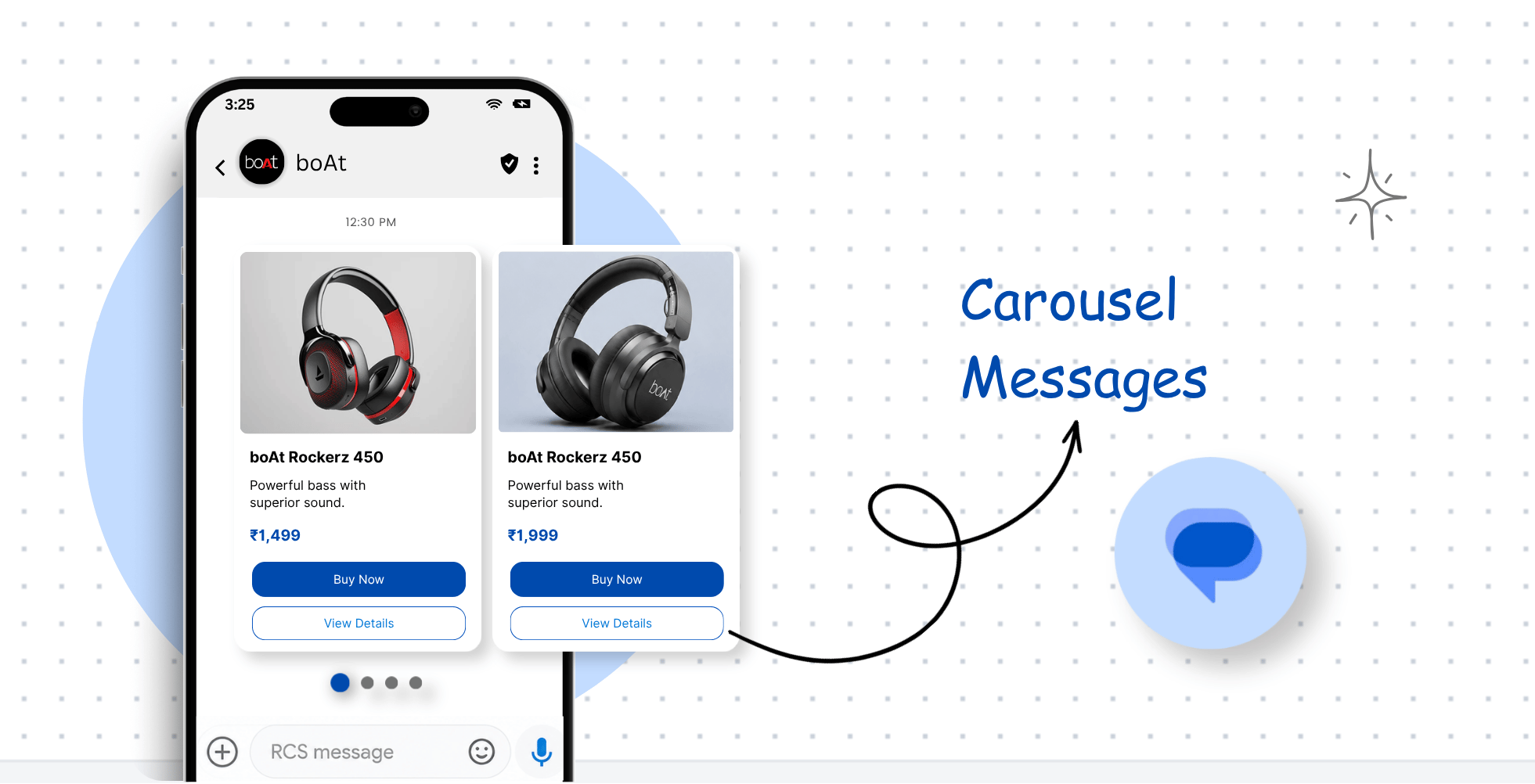
- Carousel Messages
Between 2 and 10 rich cards displayed in a horizontal scroll. Ideal for product catalogues, flight options, and service menus. A travel brand can send 5 destination cards in one message, each with a photo, price, and "Book Now" button.
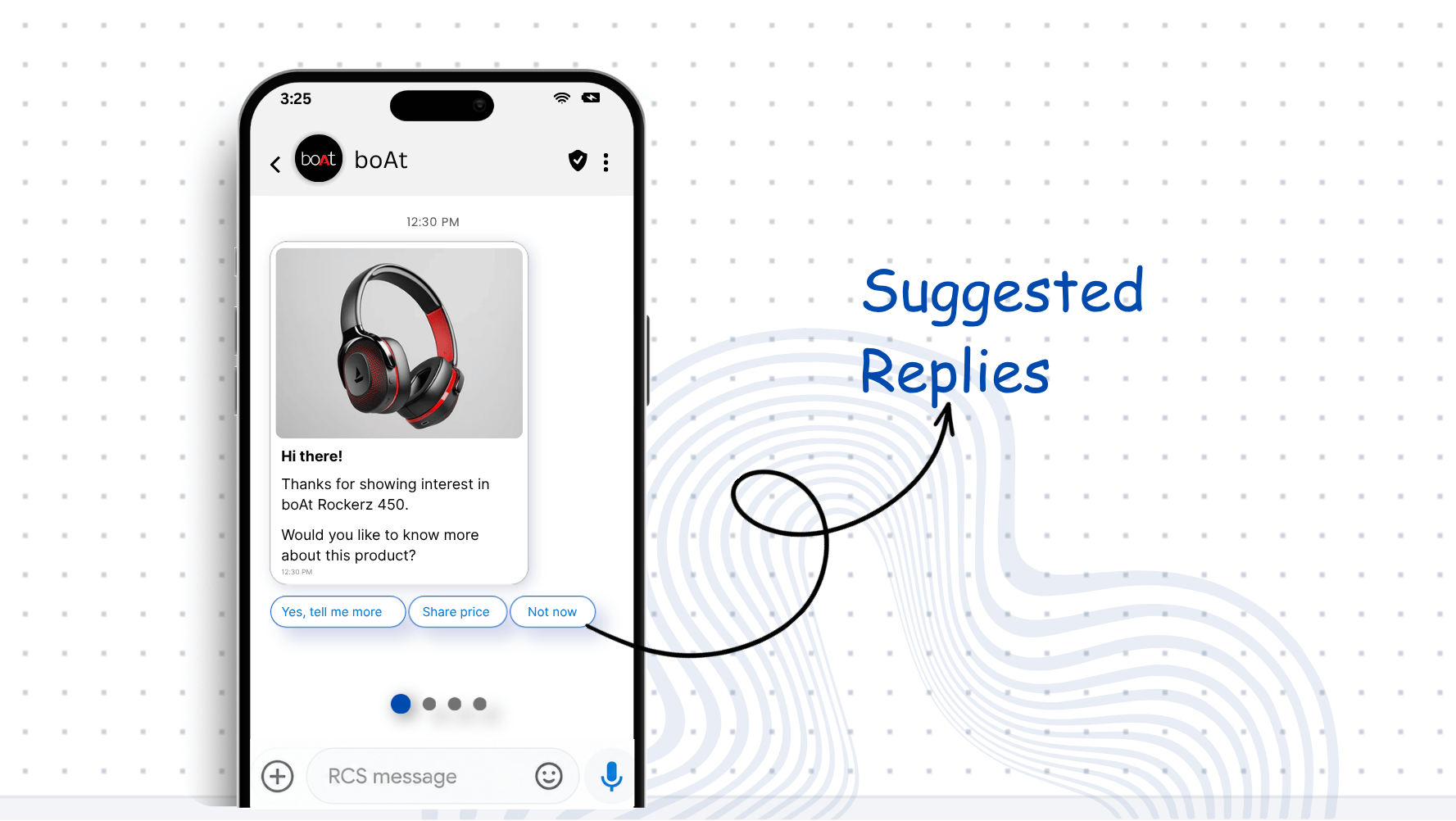
- Suggested Replies
Pre-set response options that appear as tappable chips below the message. Instead of typing, customers tap. This significantly reduces friction in surveys, feedback collection, and lead qualification flows.
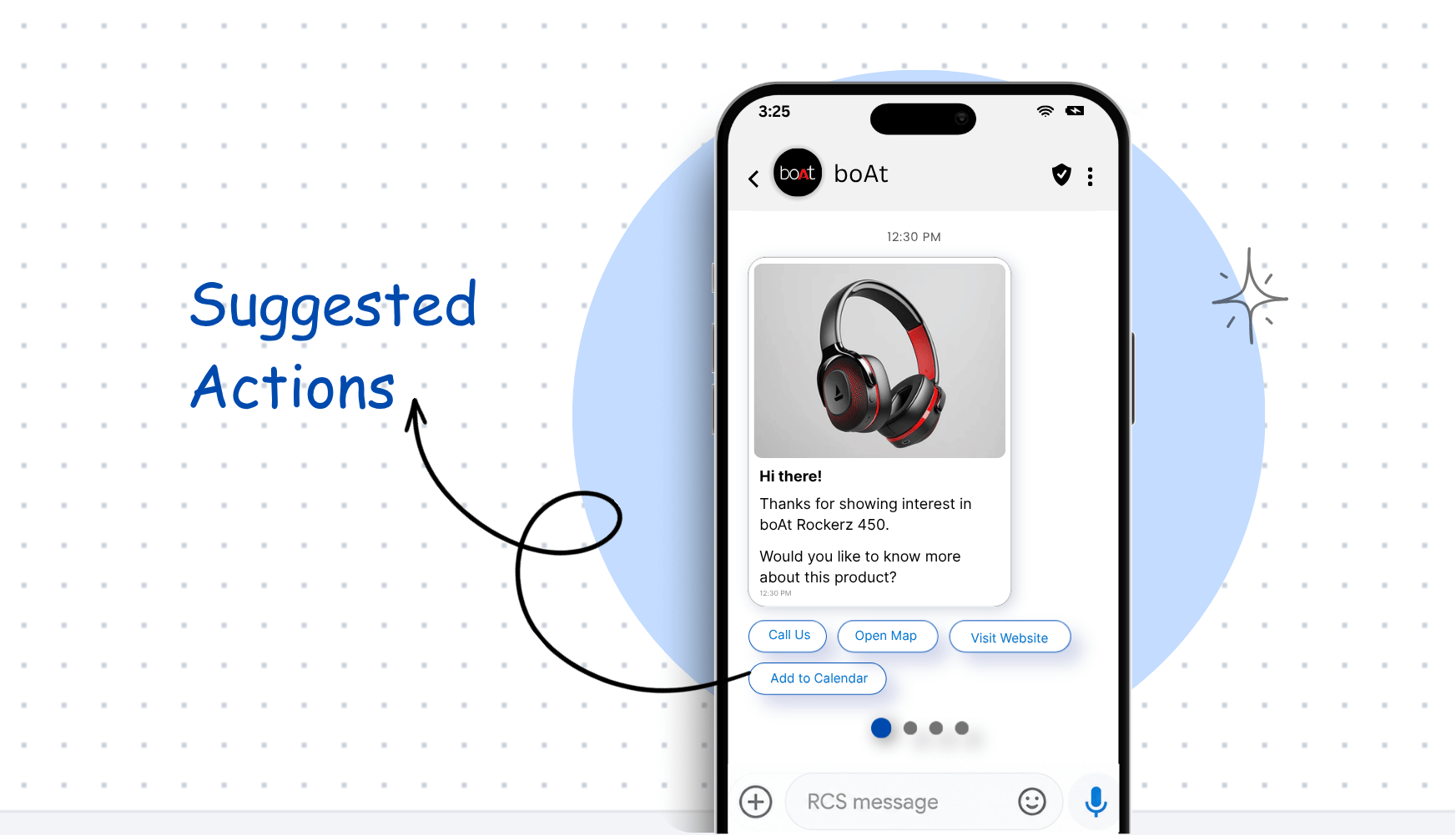
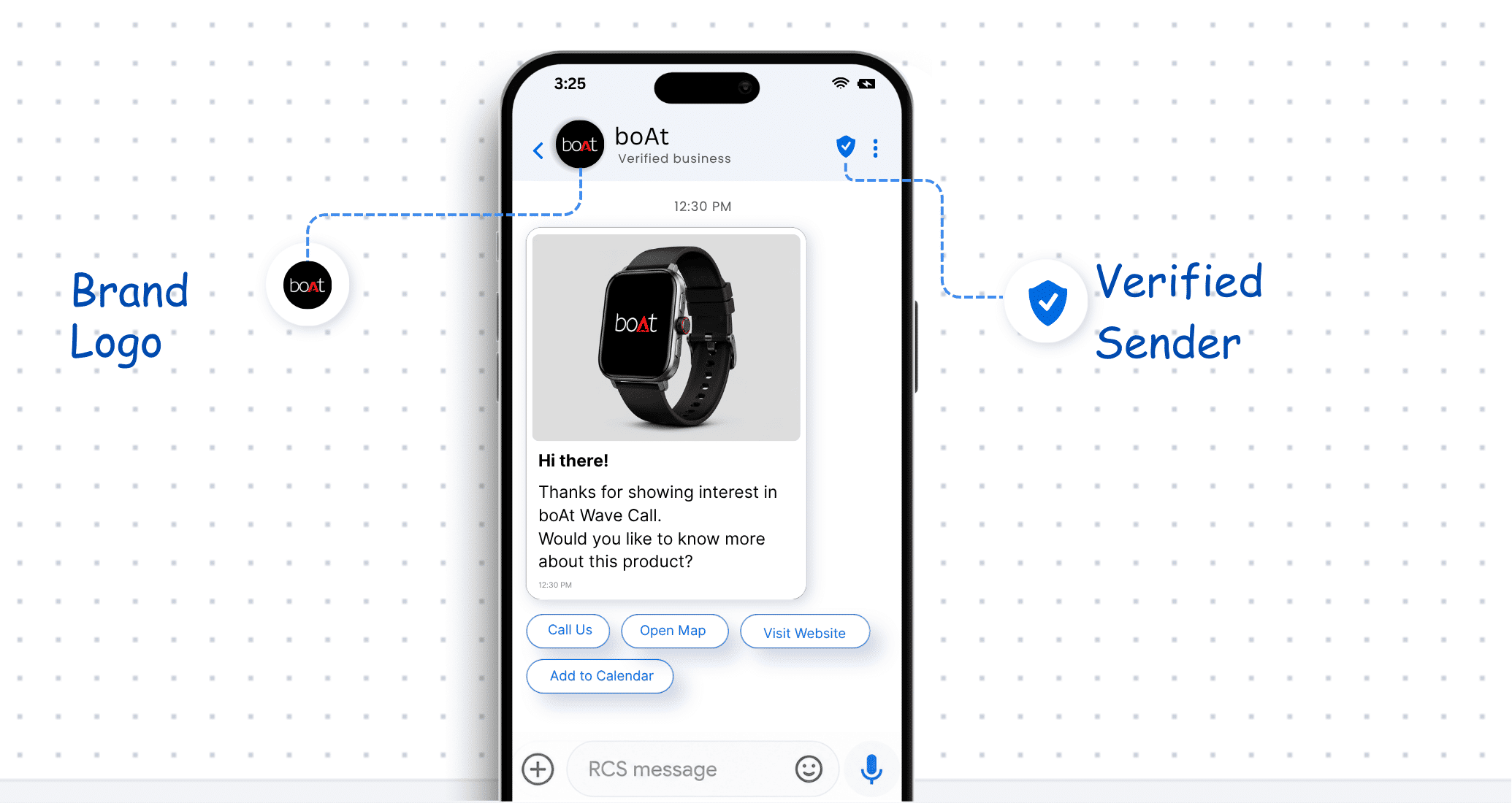
- Suggested Actions
One-tap buttons that trigger a specific action: "Call Us", "Open Map", "Visit Website", "Add to Calendar", or "Share Location". These replace multi-step manual processes and cut the time from message to action.
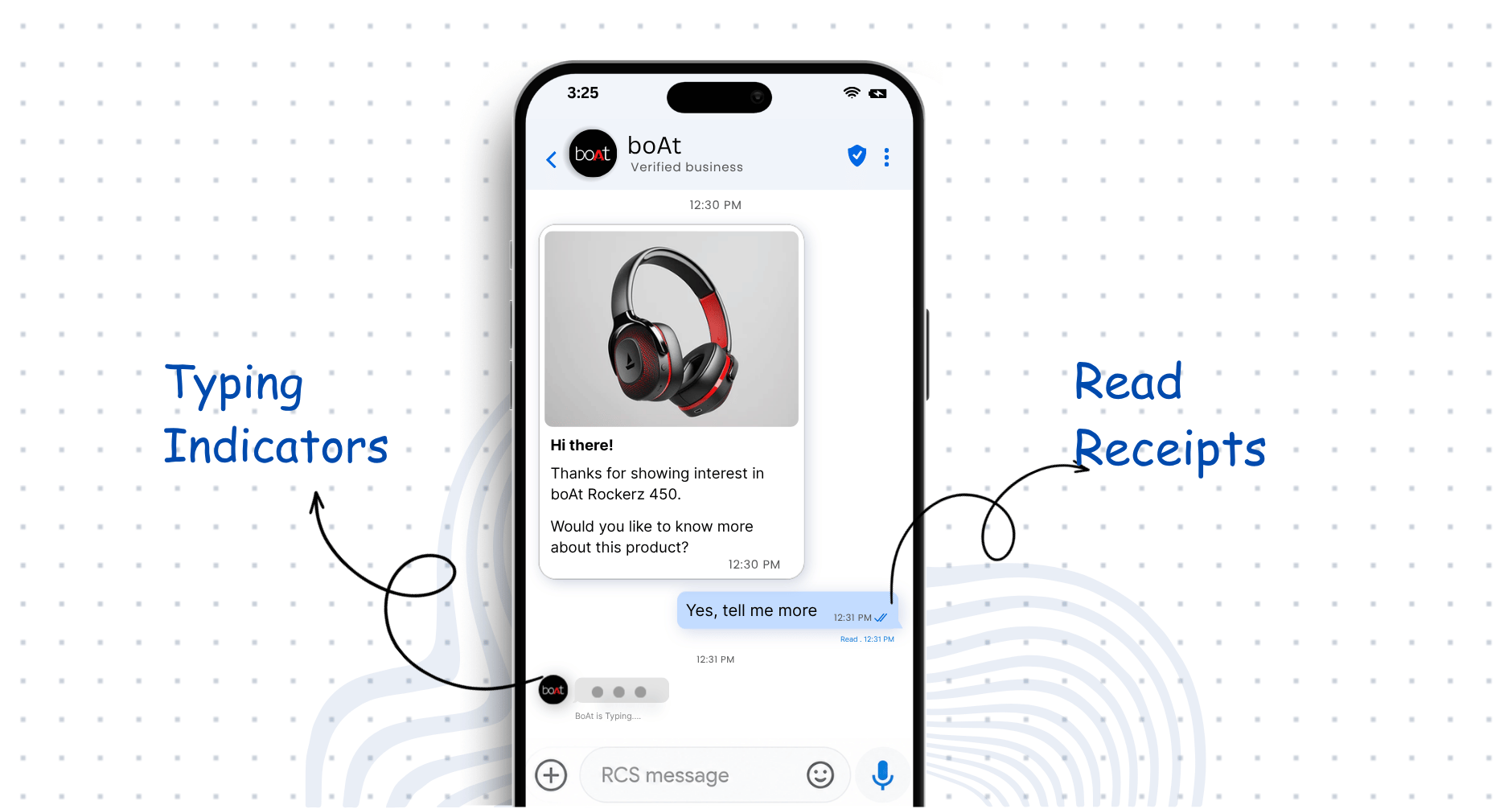
- Read Receipts and Typing Indicators
Brands can see when a message was delivered and read. In two-way RCS conversations, typing indicators show when a customer is responding. This enables more natural, responsive customer service flows.
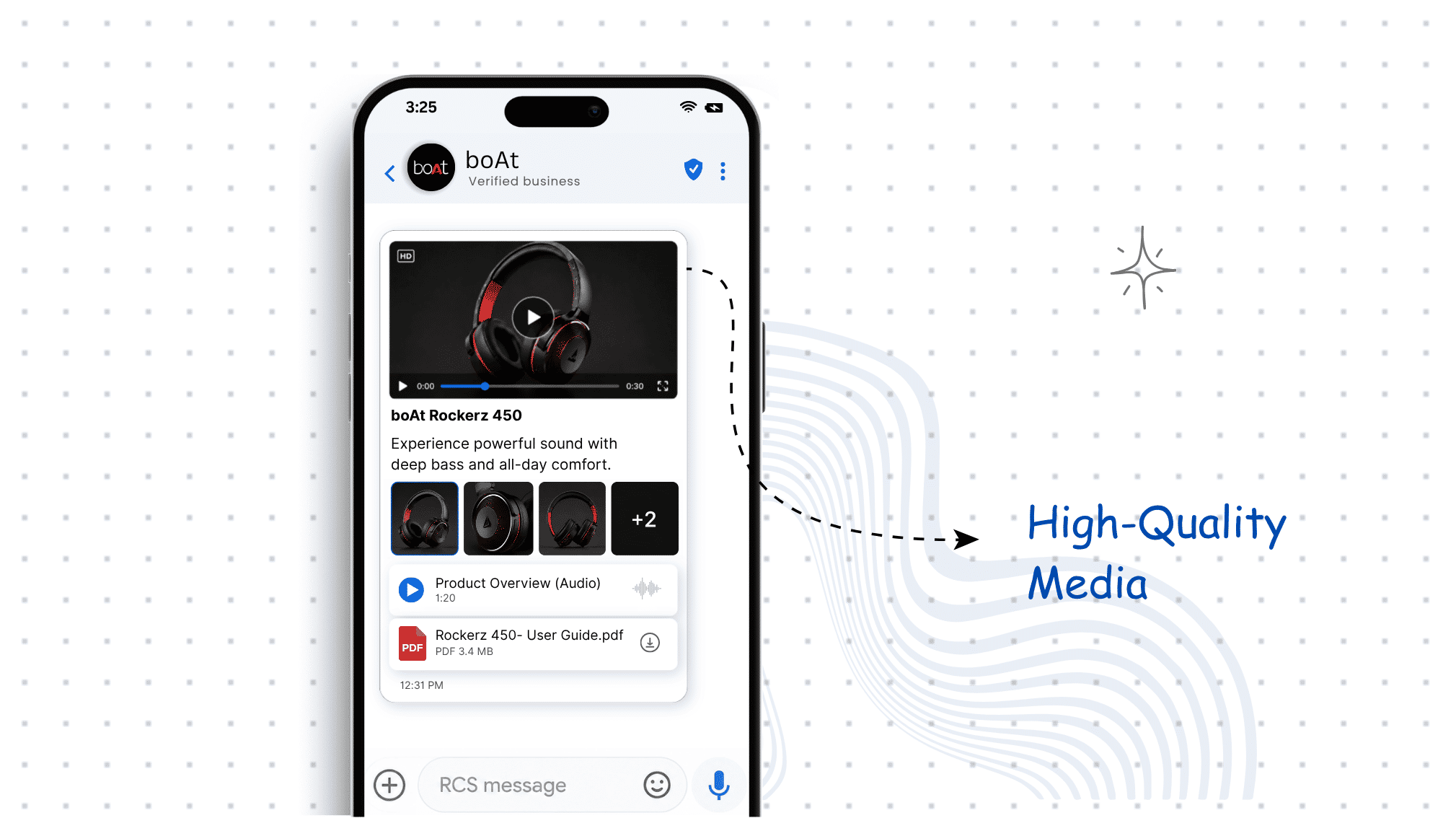
- High-Quality Media
RCS supports images, video, audio, and documents in original quality. Unlike MMS, compression is not required. A product video sent via RCS looks the same as it does on a brand's website.
- Verified Sender Profiles
Every business sending RCS is verified. Their name, logo, and a verification badge appear on every message. Customers always know who they are talking to before they read a word. This eliminates the biggest trust problem in SMS: spoofed or unknown sender IDs.
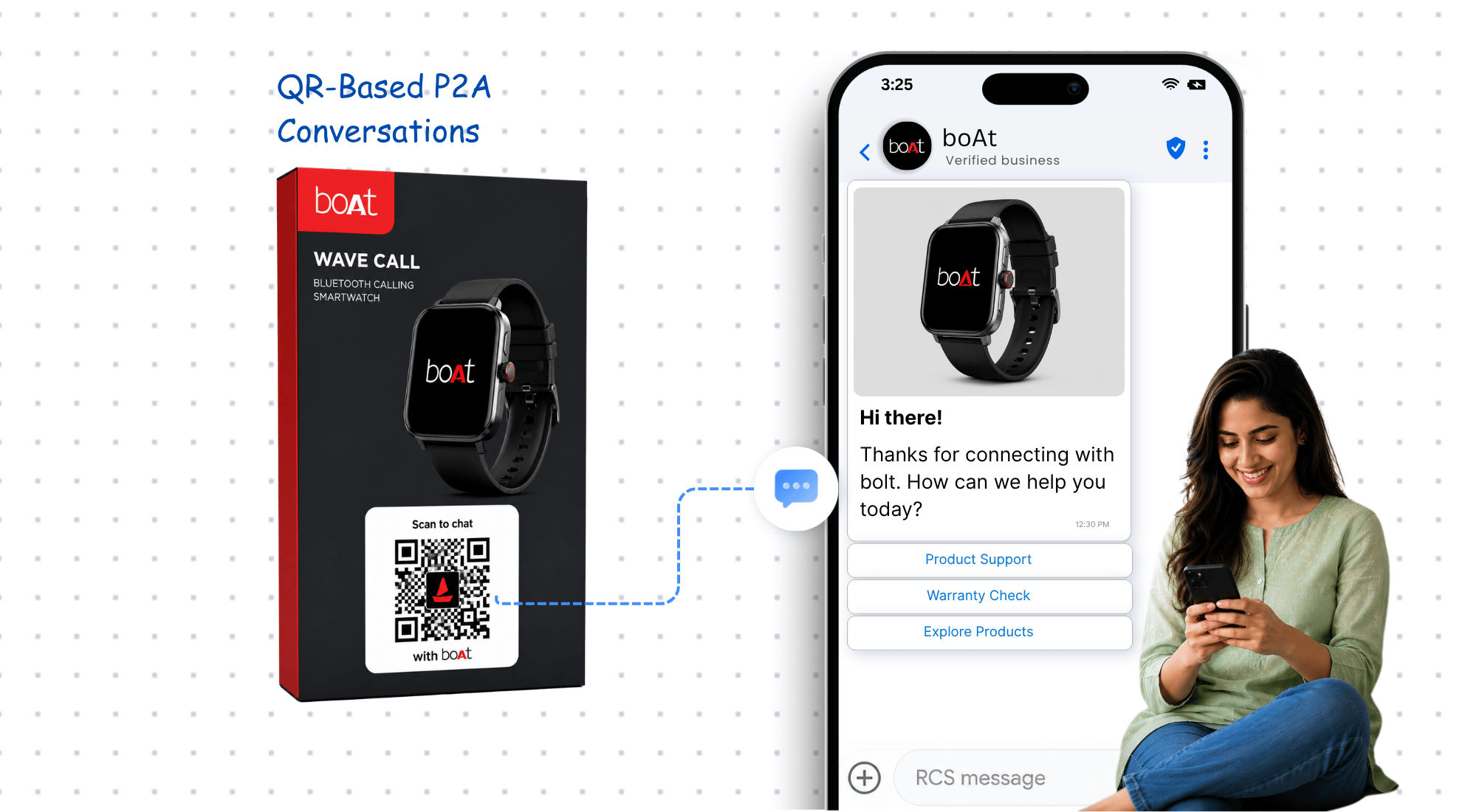
- QR-Based P2A Conversations
A customer scans a QR code on a product, receipt, or in-store display, and it opens an RCS conversation with the brand directly. This is called Person-to-Application (P2A) communication and creates new offline-to-online touchpoints.
Explore RCS Messaging with Anantya.ai
What is RCS Business Messaging (RBM)?
RCS Business Messaging (RBM) is the enterprise-facing layer of RCS. It is the system through which verified brands access RCS at scale for campaigns, transactional messages, and customer service.
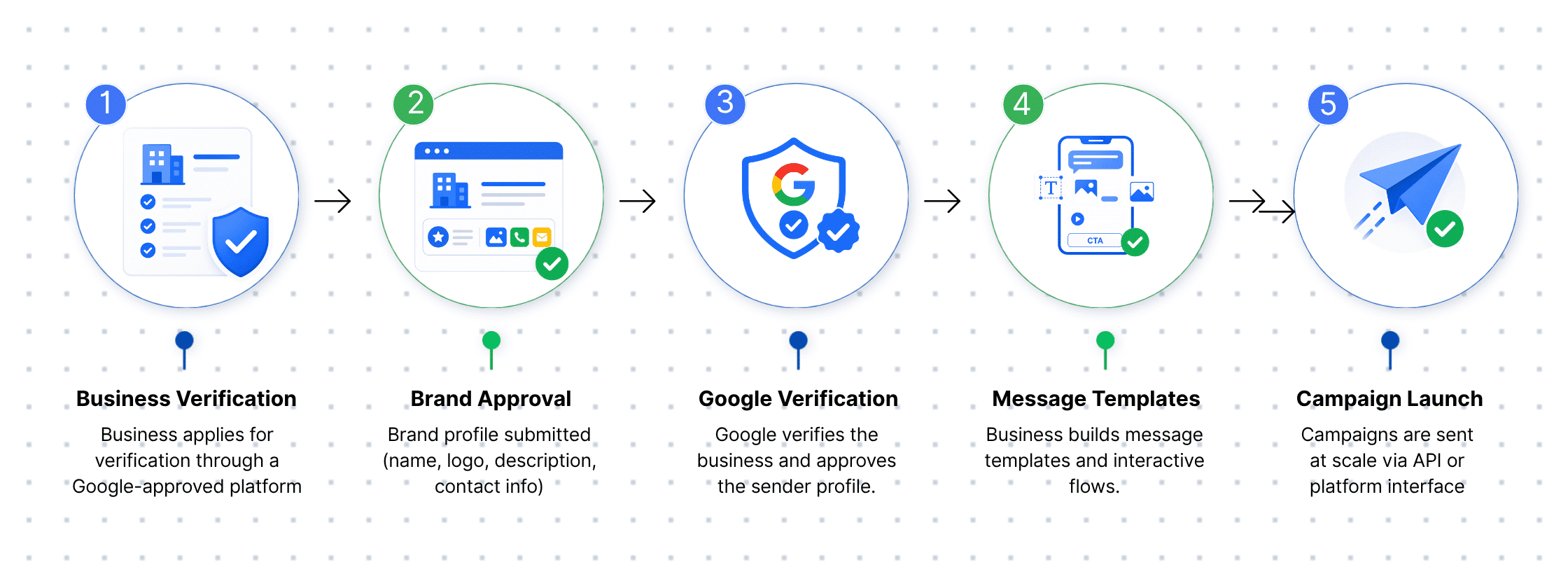
How RBM Works
- A business applies for verification through a Google-approved messaging aggregator or platform.
- They submit a brand profile: company name, logo, description, and contact information.
- Google verifies the business and approves the sender profile.
- The business builds message templates and interactive flows.
- Campaigns are sent at scale via API or platform interface.
Once verified, every message from that business displays a persistent branded sender profile with a checkmark. No more anonymous 6-digit sender codes. Customers see a recognized brand name and verified identity before they open the message.
This verification layer is what separates RBM from consumer RCS. It is also the primary reason RCS achieves significantly better engagement than unverified SMS in brand communications.
Top RCS Use Cases for Businesses
- eCommerce
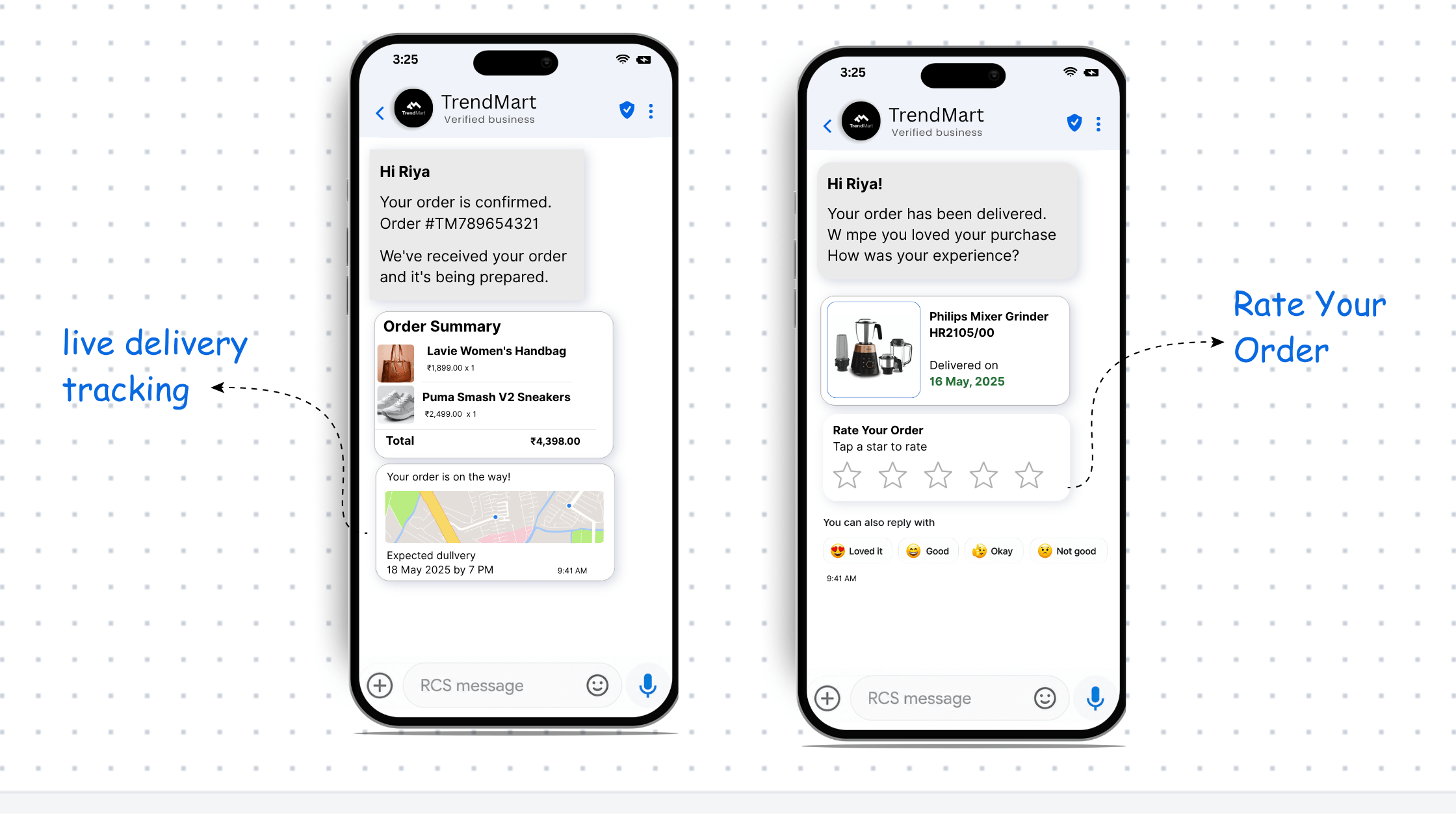
Order confirmations with product images and live delivery tracking. Abandoned cart messages with a carousel of the exact items left behind. Flash sale announcements with product cards and countdown timers. Post-delivery review requests with a "Rate Your Order" suggested reply.
- Banking and Finance
OTP delivery with verified branding so customers trust the source instantly. Account activity alerts with "Dispute" or "Confirm" action buttons. Loan offer cards with "Calculate EMI" and "Apply Now" buttons. Credit card statement summaries with document attachments.
- Healthcare
Appointment reminders with "Confirm", "Reschedule", or "Cancel" buttons. Prescription pickup notifications. Lab report delivery. Health check package promotions with booking links.
- Travel and Hospitality
Booking confirmation cards with check-in and upgrade options. Flight status updates with action buttons for rebooking or support. Hotel arrival information with "Open Map" and "Add to Calendar" actions.
- Education
Admission update cards with document upload links. Fee payment reminders with direct payment links. Course launch announcements with carousel previews. Scholarship notification cards.
- Real Estate
New project launch carousels with property images, price ranges, and "Book Site Visit" buttons. Follow-up flows after property inquiries. Document checklist cards for loan processing.
- Customer Support
Automated tier-1 FAQ responses with quick reply chips. Agent handoff flows triggered by specific responses. Post-resolution satisfaction surveys. Feedback collection with star-rating suggested replies.
RCS Marketing Campaign Examples
- Promotional Campaign
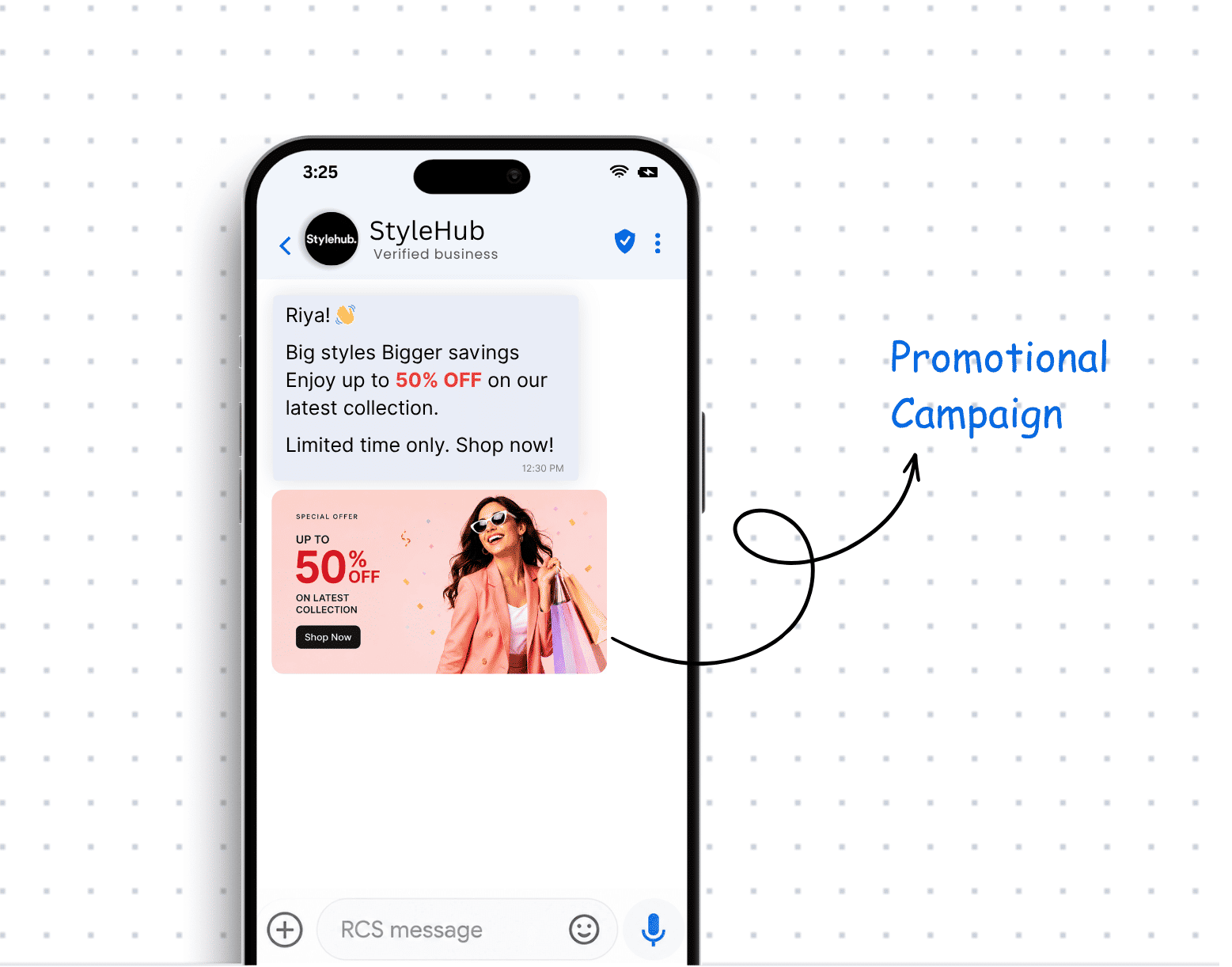
A fashion brand sends a campaign before a sale. The message contains a full-width banner image, a carousel of 6 bestselling products with prices, a "Shop Now" button, and a "Remind Me Tomorrow" suggested reply. Open, browse, convert within the native messaging app.
- Abandoned Cart Recovery
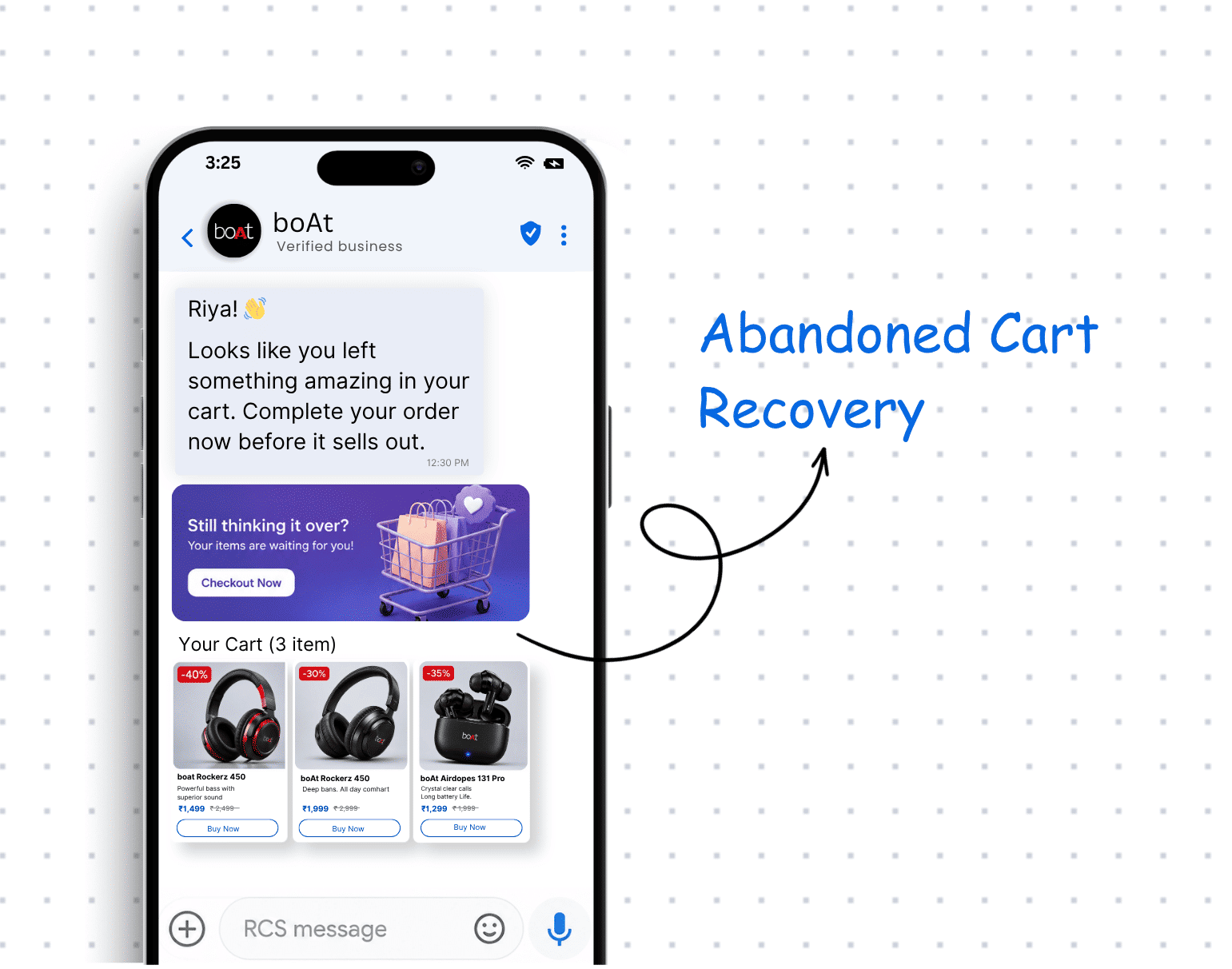
A customer added 3 items to their cart but did not check out. They receive an RCS message showing those exact 3 items in a carousel, each with the product image, name, price, and an "Add to Cart" button. One tap to resume checkout.
- Appointment Reminder
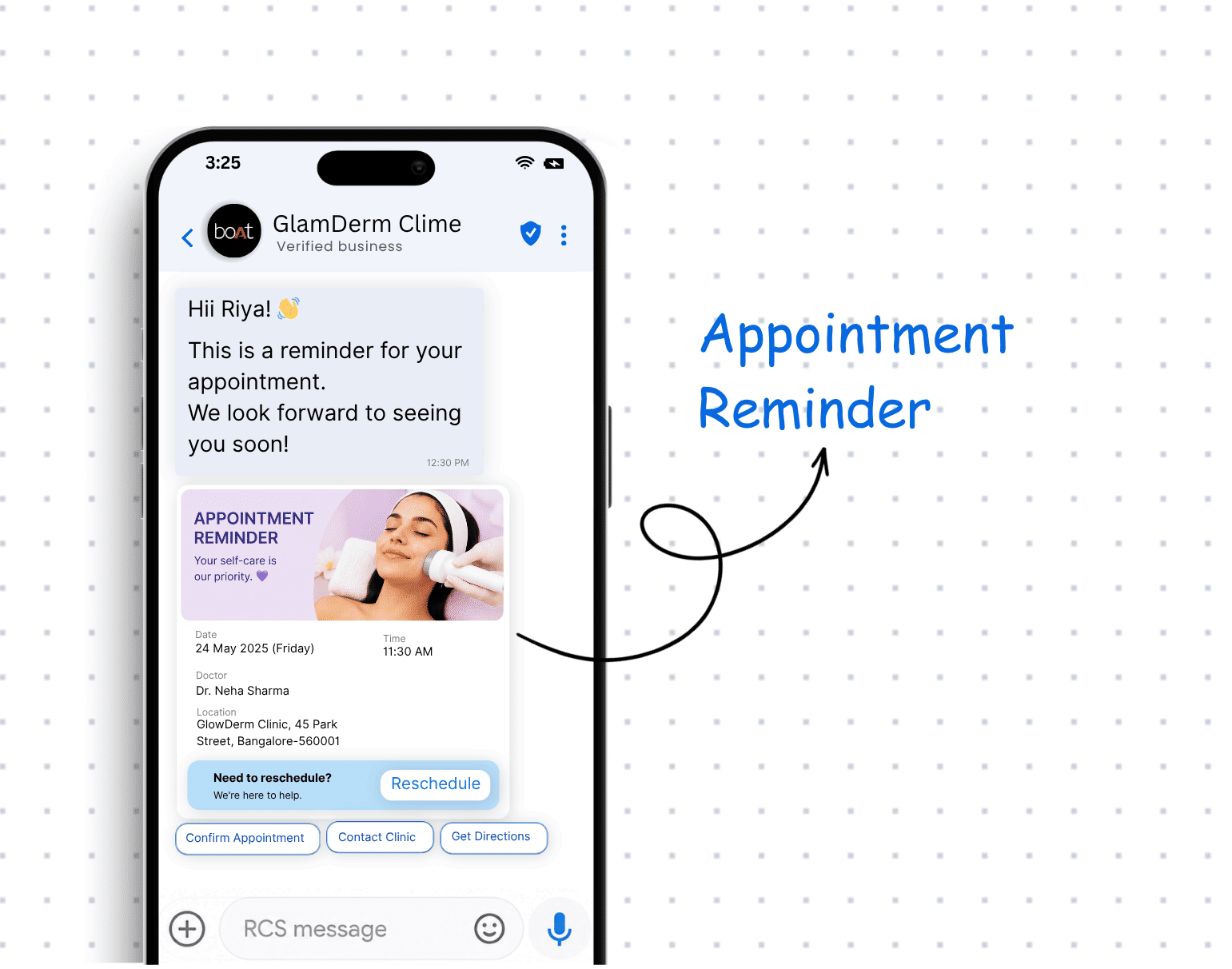
A clinic sends a reminder 24 hours before an appointment. The card shows the doctor's name, date, time, clinic address with an "Open Map" action, and two buttons: "Confirm" and "Reschedule". No phone call required.
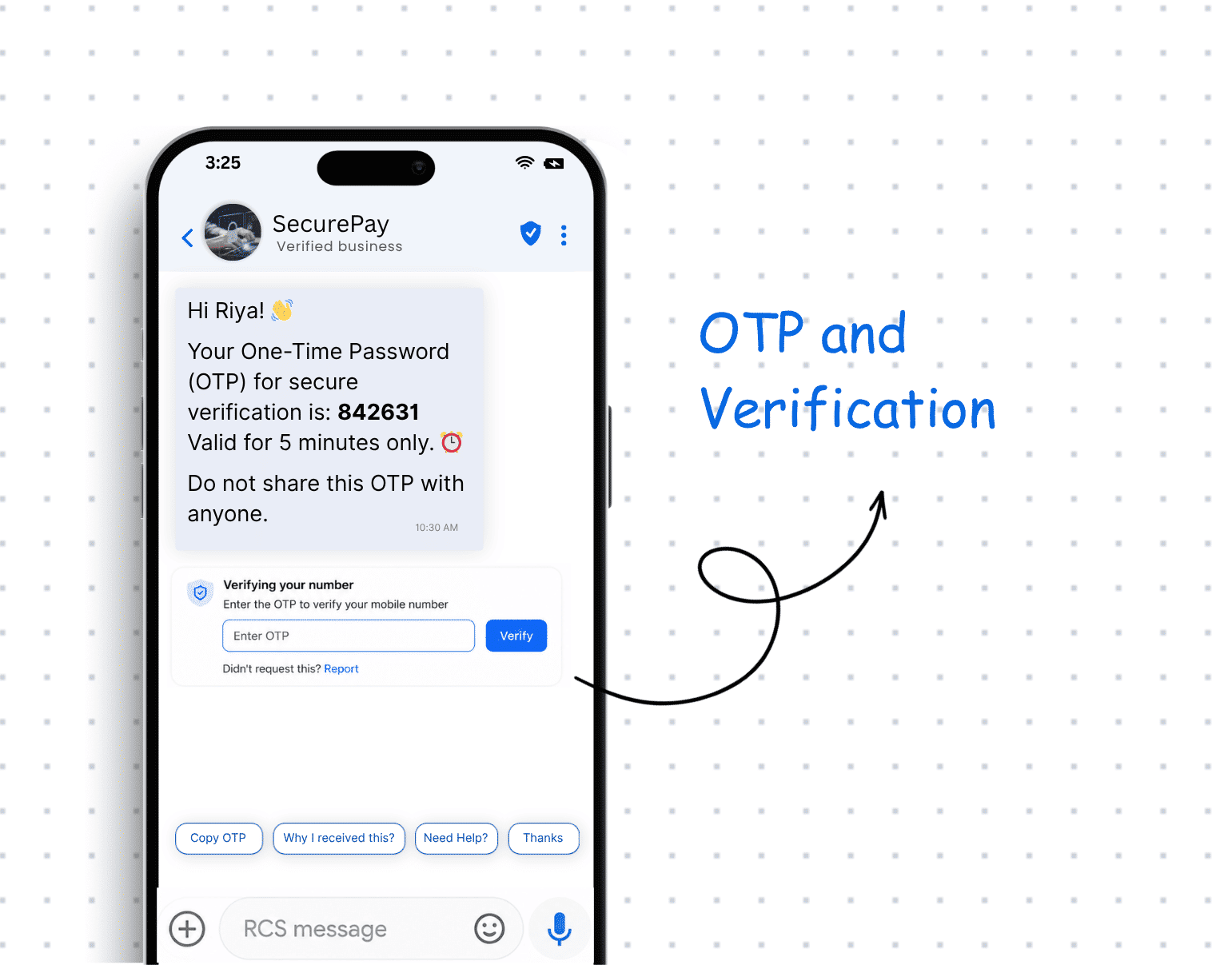
- OTP and Verification
A bank sends an OTP via RCS with the bank's logo, verified checkmark, and name displayed prominently. Customers instantly recognize it is legitimate. The card includes a "Didn't request this?" button that opens a support flow. Same OTP content as SMS, but with brand trust built in.
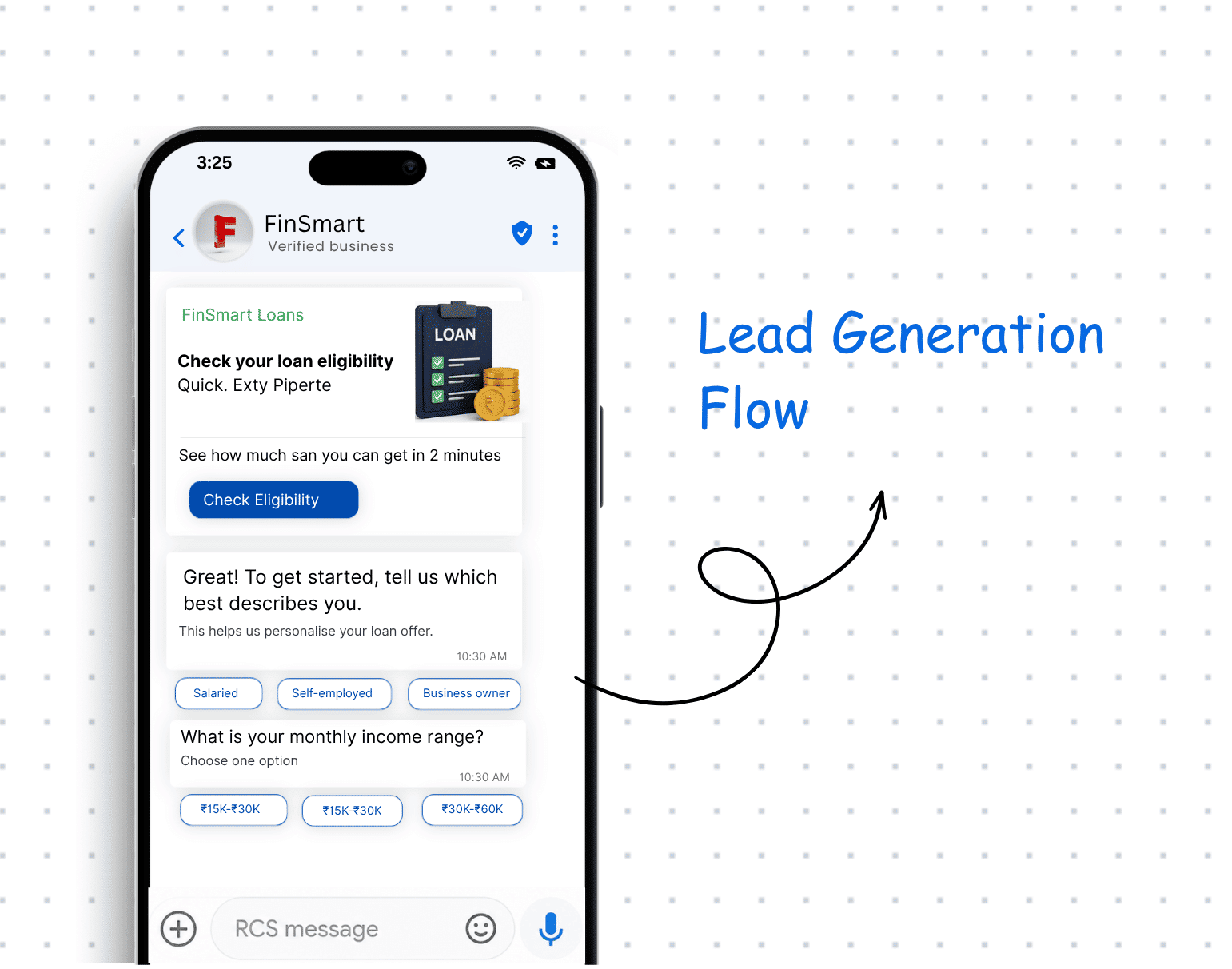
- Lead Generation Flow
A fintech company sends a loan eligibility card. A simple qualifying question appears with 3 suggested reply chips: "Salaried", "Self-employed", "Business owner". Tapping one triggers the next card in the qualification sequence. Structured lead capture, no web form required.
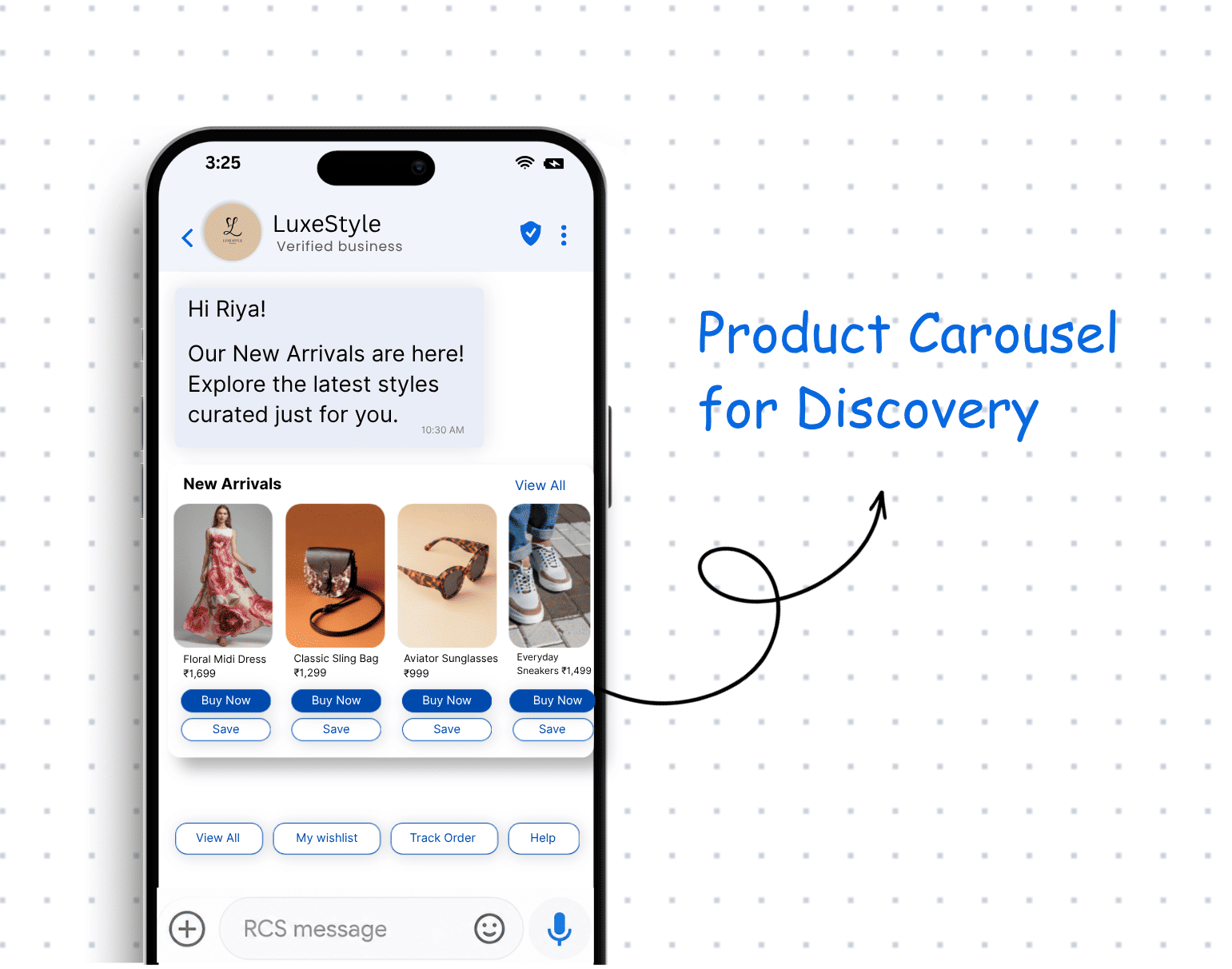
- Product Carousel for Discovery
A D2C brand sends a "New Arrivals" carousel with 8 products. Each card has a product image, name, price, "Buy Now" and "Save to Wishlist" buttons. Browse, save, and purchase happen entirely inside the message thread.
RCS Rich Cards: Technical Details
Most Indian businesses asking about RCS stumble here. These are the specs that matter for campaign execution.
Single Rich Card
- Title: Up to 200 characters.
- Description: Up to 2,000 characters.
- Media: 1 image or video.
- Buttons: Up to 4 action buttons per card.
Carousel Rich Cards
- Number of cards: 2 to 10 cards per carousel.
- Each card: Individual image, title, description, and buttons.
- Card height: Short (100-200px media) or medium (112-168px media) - consistent height across all cards improves visual experience.
Image Specifications
- Minimum width: 600 pixels.
- Maximum file size: 5MB for images, 25MB for video.
- Recommended aspect ratio: 16:9 (landscape) for banner-style, 3:4 (portrait) for product images.
- Formats supported: JPEG, PNG for images; MP4 for video; PDF for documents.
Button Types Available
- Open URL (website, landing page, payment link).
- Dial a phone number.
- View a location on map.
- Share the user's location.
- Create a calendar event.
- Send a suggested reply.
What Happens at Character Limits
If a title or description exceeds the limit, the message either truncates silently or fails template validation depending on the platform. Always validate templates before sending at scale.
Getting these details right is the difference between a campaign that converts and one that breaks silently. The creative brief, technical setup, and platform validation all need to align.
RCS Pricing in India
RCS pricing in India is still in its early, evolving stage. Unlike WhatsApp Business API (which has standardized per-conversation pricing), RCS A2P pricing depends on the aggregator, campaign type, and volume commitments.
What is publicly confirmed: Airtel, in partnership with Google, has been rolling out RCS with business messaging priced at approximately ₹0.11 per message for A2P RCS, according to reported industry data. This is comparable to premium SMS pricing, but with significantly richer delivery.
General pricing structure:
- A2P RCS messages (business to consumer): priced per message, similar to SMS pricing models.
- Volume discounts apply at scale, similar to bulk SMS pricing tiers.
- Fallback SMS delivery is charged separately at standard SMS rates.
How to think about ROI:
RCS campaigns typically show higher click-through and conversion rates than equivalent SMS campaigns. A campaign that converts at 2-3x the rate of SMS at a similar or slightly higher cost per message still produces better cost-per-acquisition.
The recommended approach:
Run a pilot RCS campaign on a single use case alongside your existing SMS benchmark. Measure cost-per-lead or cost-per-conversion, not cost-per-message, and let the data drive the budget decision.
Is RCS Better Than WhatsApp?
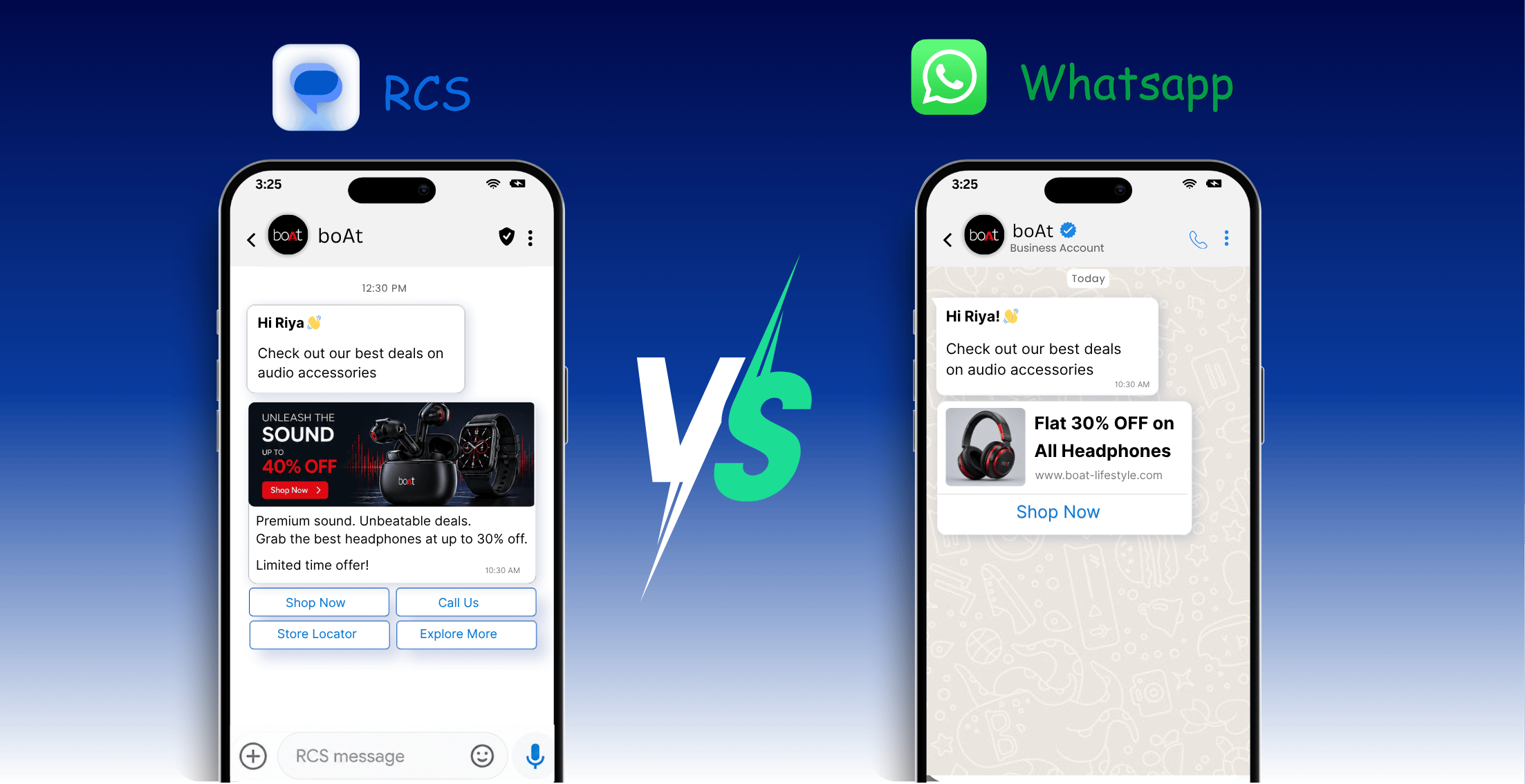
This is one of the most searched questions about RCS. The honest answer: each channel wins in different scenarios.
Where RCS Has the Advantage
- Reach: Works on any supported Android device. No app download, no WhatsApp account required.
- Fallback: Automatically downgrades to SMS if RCS is not supported, so no message is ever lost.
- Trust signals: Verified sender profiles with logo and checkmark on every message.
- Native experience: No platform switching, no app context, delivered inside the default messaging app.
- Transactional use cases: OTPs, alerts, and confirmations where delivery reliability is the priority.
Where WhatsApp Has the Advantage
- User intent: People actively open WhatsApp. The engagement habit is already built.
- Retention: Two-way conversations, broadcast lists, and chatbots maintain ongoing relationships.
- India penetration: WhatsApp has deep, habitual penetration in India. Most customers expect brands to be there.
- API maturity: The WhatsApp Business API ecosystem, template infrastructure, and partner network are more developed.
- iPhone coverage: Works on all smartphones, not just Android with RCS-enabled carriers.
The Right Answer for Most Businesses
The question is not "which is better?" It is "what does each channel do best for my specific use cases?"
RCS covers the reach where WhatsApp has gaps. WhatsApp deepens relationships where users are already active. Running both as part of an omnichannel strategy, with the right message going to the right channel based on device, location, and intent, is what high-performing brands in 2026 are building.
Challenges and Limitations of RCS
A balanced view earns trust. Here is what is genuinely hard about RCS right now.
iPhone Compatibility
Apple added basic RCS support in iOS 18, which enables SMS-to-RCS upgrades for consumer messaging. But full RBM features, including verified sender profiles, rich cards, and suggested actions, are not yet supported on iPhones. For brands targeting audiences with high iPhone usage, RCS campaign reach is still limited to that segment.
Internet Dependency
Unlike SMS, RCS requires a mobile data or Wi-Fi connection. Users with limited data plans or in areas with poor connectivity may not receive RCS messages. The fallback to SMS handles delivery, but not the rich experience.
Carrier Dependency
RCS relies on individual carrier implementations. In India, Jio, Airtel, and Vi are rolling out RCS, but coverage uniformity across all users, plans, and regions is still developing. Businesses should check current coverage before making RCS their primary channel.
Spam Risk as Adoption Grows
Every successful messaging channel eventually attracts spam. Google has spam detection built into Google Messages, but as more businesses enter RCS, message frequency management and targeting precision will become critical for maintaining deliverability and inbox reputation.
User Awareness
Most customers do not know what RCS is. They receive a "better-looking message" and engage with it. That is actually fine from an experience perspective, but it means brands cannot market "reach us on RCS" the way they can with WhatsApp. Discoverability is primarily push-based.
RCS Adoption in India: The Data
India is not just an RCS adopter. It is a global leader.
These numbers from published research and industry data make the case:
- 27% of smartphone users in India now interact with brands via RCS messages, the highest rate in the world, ahead of South Africa (13%) and all European markets, according to a 2024 MEF study cited by Plusmo Research.
- India experienced a 1,162% increase in RCS interactions during Black Friday 2024, followed by a 1,455% surge on Cyber Monday, according to CleverTap enterprise deployment data.
- India and China together are projected to account for 30% of all global RCS business messages by 2025, per Juniper Research.
- India alone is projected to reach 254 million A2P RCS users by 2029, generating approximately $544 million in revenue, per Juniper Research forecasts.
- RCS is expected to surpass 100 million active users in India by 2026, per industry estimates.
- The global RCS market, valued at approximately $3 billion in 2025, is projected to reach $9 billion by 2030, per Buddy Infotech market research.
- Globally, RCS adoption grew 550% in 2024,with over 1.2 billion monthly active users worldwide.
These numbers explain why forward-looking Indian brands are not asking "should we try RCS?" They are asking "how fast can we build the flows?"
Future of RCS Messaging
AI-Powered Conversational Agents on RCS
As conversational AI matures, RCS becomes the delivery surface for intelligent brand agents. A customer sends a query; the AI understands intent, personalizes the response, and completes the transaction, all within the native messaging thread. No app context switch. No browser. Just conversation.
Conversational Commerce Inside Messages
RCS already supports payment links. Full in-app payment flows where customers browse, select, and pay without leaving the message thread are the logical and imminent next step. For eCommerce and BFSI brands, this eliminates the last major friction point in the messaging purchase journey. Messaging apps are becoming mini websites.
Apple's Full RBM Adoption
Apple's move to support RCS on iOS 18 is the clearest signal yet that RCS is mainstream infrastructure, not a Google project. As Apple expands RBM feature support to iPhones, the total addressable audience for rich business messaging grows to include essentially every smartphone user. This is the single biggest near-term unlock for RCS at scale.
AI Overviews and Search Visibility
Google is increasingly surfacing RCS-related answers in AI Overviews for business messaging queries. Brands that publish authoritative RCS content early build topical authority in a space where most Indian competitors have not yet invested.
Hyper-Personalization at Scale
Combining RCS delivery with customer data platforms (CDPs) and behavioral triggers enables genuinely personalized rich messages: the right product card, the right action button, delivered at the moment of highest intent. The channel can carry the experience that previously required a mobile app.
How to Get Started with RCS: Step-by-Step
Here is the practical path for an Indian business adopting RCS.
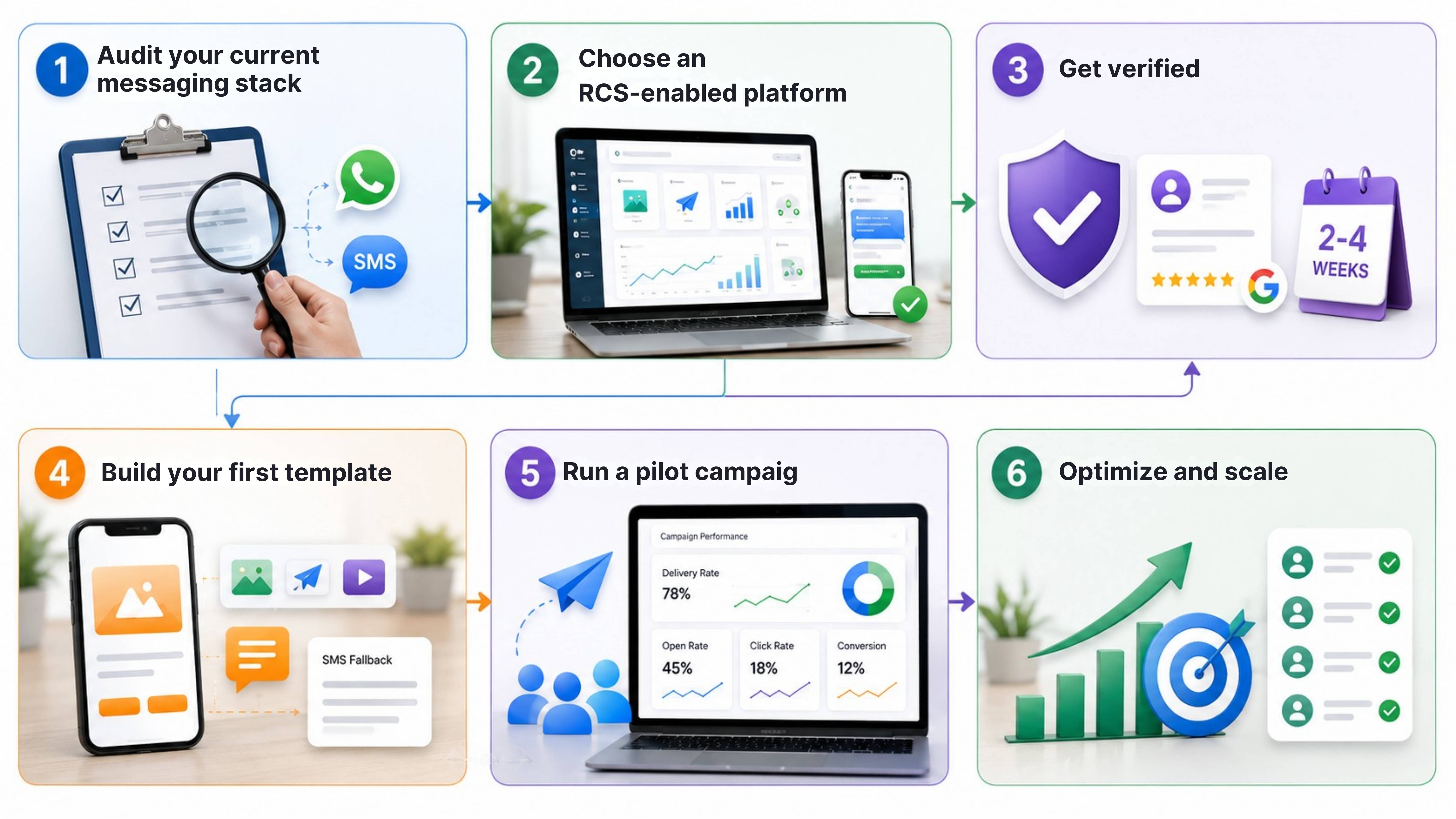
- Step 1: Audit your current messaging stack Identify which existing SMS or WhatsApp use cases would benefit most from rich interactivity. Order confirmations, appointment reminders, and abandoned cart flows are the easiest starting points.
- Step 2: Choose an RCS-enabled platform Work with a platform that handles business verification, template building, campaign scheduling, and analytics. Look for platforms that also manage SMS fallback automatically.
- Step 3: Get verified Submit your business profile (name, logo, contact information, use case description) for Google verification through your chosen aggregator. Verification timelines vary but typically take 2-4 weeks for new registrations.
- Step 4: Build your first template Start with one use case. Design the rich card or carousel, set up the fallback SMS text, and validate the template against the platform's content guidelines before going live.
- Step 5: Run a pilot campaign Send your first RCS campaign to a segment of your existing customer base. Measure delivery rate (RCS vs SMS fallback), open rate, button click rate, and conversion against your SMS baseline.
- Step 6: Optimize and scale Use pilot data to refine the creative, improve targeting (focus on RCS-enabled devices), and build the business case for broader rollout. The data almost always justifies expansion.
How Anantya.ai Helps Businesses with RCS Messaging
Anantya.ai is a CPaaS platform built for Indian brands that take messaging seriously. As an omnichannel communication platform, Anantya.ai supports RCS alongside WhatsApp Business API, enabling businesses to run coordinated campaigns across both channels from a single dashboard.
- Campaign Setup Build rich card campaigns, carousels, and interactive flows without needing engineering resources. Anantya's platform handles template creation, content validation, and campaign scheduling.
- Automation Configure trigger-based RCS flows for abandoned carts, appointment reminders, delivery updates, payment alerts, and lead qualification sequences. Automations run off customer behavior signals, not scheduled broadcast times.
- API Integration For engineering teams that want direct control, Anantya.ai provides API access to integrate RCS messaging into existing CRMs, order management systems, ERP platforms, and customer data sources.
- Omnichannel Orchestration Run WhatsApp and RCS in parallel, routing customers to the right channel based on device type, location, engagement history, and message type. One platform, unified analytics, coordinated customer experience.
- Analytics and Reporting Track delivery rates (RCS vs SMS fallback), read rates, button click rates, conversion metrics, and campaign-level ROI. Every campaign builds on data from the last one.
If you are evaluating RCS, the place to start is a single pilot use case measured against your SMS baseline. The data makes the case better than any pitch.
Explore how Anantya.ai powers RCS and WhatsApp campaigns for Indian brands. Talk to the team.
RCS (Rich Communication Services) is the next generation of SMS. It delivers images, videos, carousels, action buttons, read receipts, and verified sender branding directly inside the default Android messaging app, with no app download required from the customer.
SMS sends plain text with a 160-character limit. RCS sends rich, interactive content such as images, buttons, carousels, and documents inside the same native messaging app. It also supports read receipts, typing indicators, and verified brand profiles, features SMS was never designed to support.
Apple added basic RCS support in iOS 18, enabling improved consumer-to-consumer messaging between Android and iPhone users. However, full RCS Business Messaging features (verified sender profiles, rich cards, suggested actions) are not yet supported on iPhones. RCS campaigns default to SMS fallback for iPhone recipients.
The message automatically falls back to standard SMS and is delivered as plain text. No message is lost. The sender pays SMS rates for that delivery, and the fallback is seamless with no manual handling required.
RCS supports up to 1,600+ characters in the body text, compared to 160 characters for a standard SMS. Rich card titles support up to 200 characters, and descriptions support up to 2,000 characters.
RCS is supported on Android devices running Google Messages with a carrier that has enabled RCS. In India, Jio, Airtel, and Vi are rolling out RCS support, and coverage is expanding rapidly.
RBM stands for RCS Business Messaging. It is the enterprise version of RCS where verified businesses can send branded, interactive messages with a persistent sender profile, company logo, and verification badge at scale via API.
A Rich Card is a structured message unit containing an image or video, a title, a description, and up to 4 action buttons. Multiple rich cards can be combined into a carousel for browsing multiple products or options.
P2A stands for Person-to-Application. A customer scans a QR code on a physical product, receipt, or display, which opens an RCS conversation with the brand. It creates a direct conversational entry point from any offline touchpoint.
Images should be a minimum of 600 pixels wide and under 5MB. For carousels, consistent dimensions across all cards produce a cleaner visual. MP4 video files are supported up to 25MB.
Airtel has reported RCS business messaging pricing at approximately Rs. 0.11 per message for A2P RCS. Pricing varies by aggregator and volume. SMS fallback is charged at standard SMS rates, so businesses should evaluate cost-per-conversion rather than only cost-per-message.
They serve different strengths. RCS offers broader reach with no app requirement and automatic SMS fallback. WhatsApp offers deeper engagement where users are already habitual. Most high-performing businesses use both as part of an omnichannel strategy, assigning each channel to the use cases it handles best.
Not in the near term, and likely not as a complete replacement. WhatsApp has deep behavioral penetration in India. RCS is more likely to complement WhatsApp by covering reach gaps, while WhatsApp handles retention and two-way engagement. The winning strategy is both.
Begin with a pilot campaign on one use case, such as order confirmation, appointment reminder, or abandoned cart recovery. Work with an RCS-enabled platform like Anantya.ai to set up templates, run the pilot, and compare metrics against your SMS baseline. The pilot data drives the business case for expansion.
Sources and References
2. Juniper Research - India and China RCS Business Messages Forecast (2024)
3. CleverTap - RCS: The Next Big Customer Engagement Opportunity in India (2025)
4. MEF (Mobile Ecosystem Forum) - RCS Commercial Messaging Adoption Study (2024), via Plusmo Research
5. Routee - RCS Messaging Trends to Watch in 2026
7. Buddy Infotech - RCS Messaging Statistics and Trends (2026)
8. VanDenBerg Web - What Does an Ideal Blog Post Look Like in 2026?
About Anantya.ai
Anantya.ai is a CPaaS (Communication Platform as a Service) company helping Indian brands, D2C businesses, and enterprises build smarter customer communication across WhatsApp, RCS, and other messaging channels. With automation, campaign management, and omnichannel orchestration, Anantya.ai helps businesses move from broadcast messaging to genuine conversation at scale.
Have a question about RCS or want to evaluate it for your business? Talk to the Anantya.ai team.